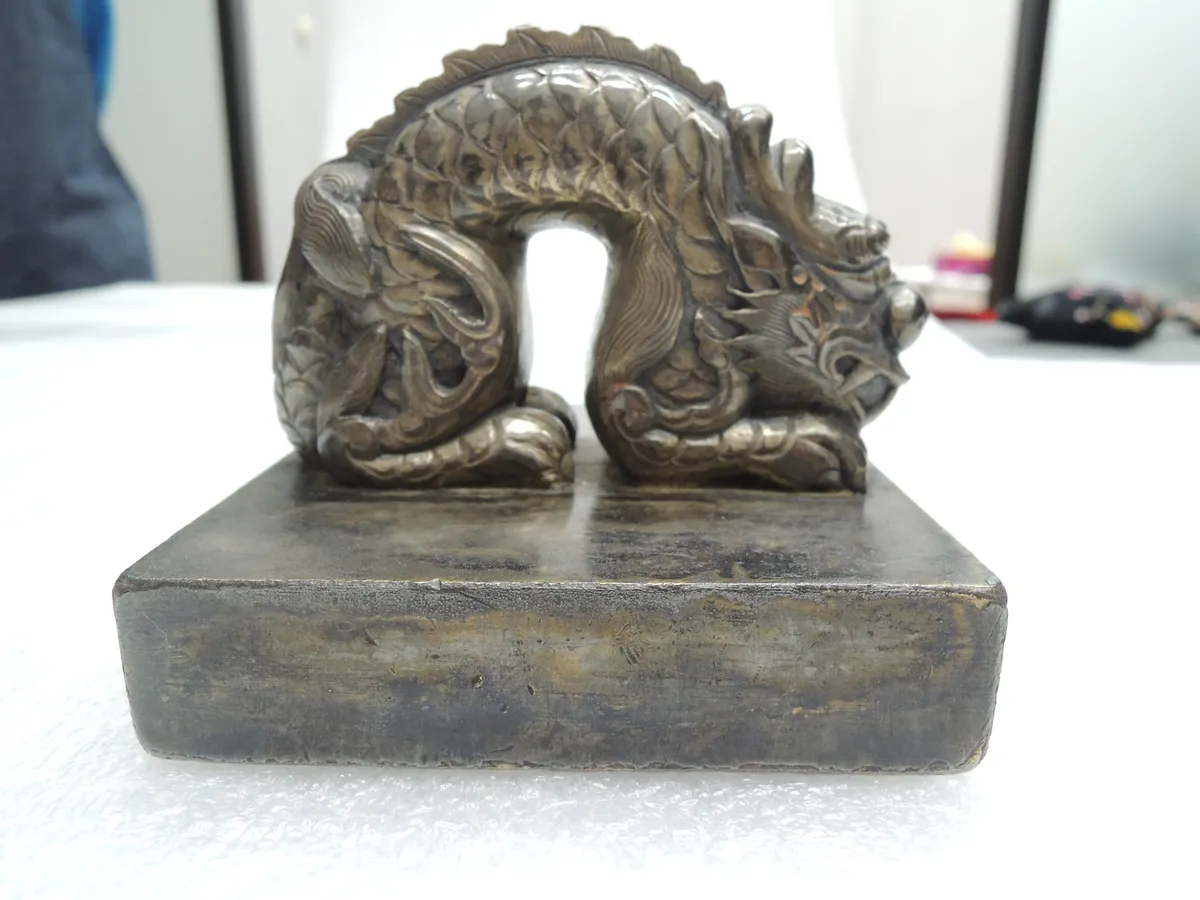
Guksae Daewonsubo
國璽 大元帥寶
서울특별시 용산구
Basic information
- Designation
- Treasure No.1618-8
- Category
- Books & Records
- Era
- 1899년(광무3)
- Designated year
- 2021
- Location
- 용산구, 서울특별시— 서울특별시 용산구 서빙고로 137 (용산동6가, 국립중앙박물관)
- Coordinates
- 37.524702, 126.977740Kakao address conversion
AI Docent
Coming soonAn AI-generated, friendly retelling of this heritage site is available in Korean. An English version is on our roadmap — for now, please see the official description below.
Description
Machine-translatedThis English description was machine-translated and may contain inaccuracies. Refer to the original Korean text for details.
The National Seal 'Daewonsubo' (Great Commander-in-Chief Seal) was created on June 22, 1899, during the Korean Empire period when the Wonsu-bu (Commander-in-Chief's Office) was established to unify army and navy command. One of three seals created—the Daewonsubo, Wonsu Jibo, and Wonsu-bu In—it was used for military appointment documents. Repatriated on August 15, 1946, when the U.S. Military Administration transferred it to the Government-General Bureau, subsequently transferred to the National Central Museum on June 28, 1954, remaining in institutional care. The Daewonsubo comprises a dragon-shaped handle knob, a shallow supporting pedestal, and seal body, executed in small-seal script displaying dignified and refined character execution. Regarding knob style, Joseon monarchy seals featured turtle-shaped handles, whereas the Daewonsubo reflects Korean Empire seal conventions by adopting a dragon-shaped design. The addition of a supporting pedestal beneath the knob represents another characteristic feature of this era's national seals. Though some discoloration and fading appear from elapsed time, the seal largely retains its original form without missing portions in the knob and seal face characters. The Daewonsubo, as a Korean Empire national seal with dragon-shaped handle featuring a supporting pedestal, preserves its original form while exemplifying King Gojong's desire to maintain military authority and strengthen military capabilities for pursuing autonomous reform through powerful military force.
Location
지도를 불러오는 중…
Have you visited this place?
Log in and verify your visit on-site via GPS to record a stamp in My Journey. (QR verification coming later.)
Images: KOGL (khs.go.kr) · Data source: Korea Heritage Service Open API (khs.go.kr)