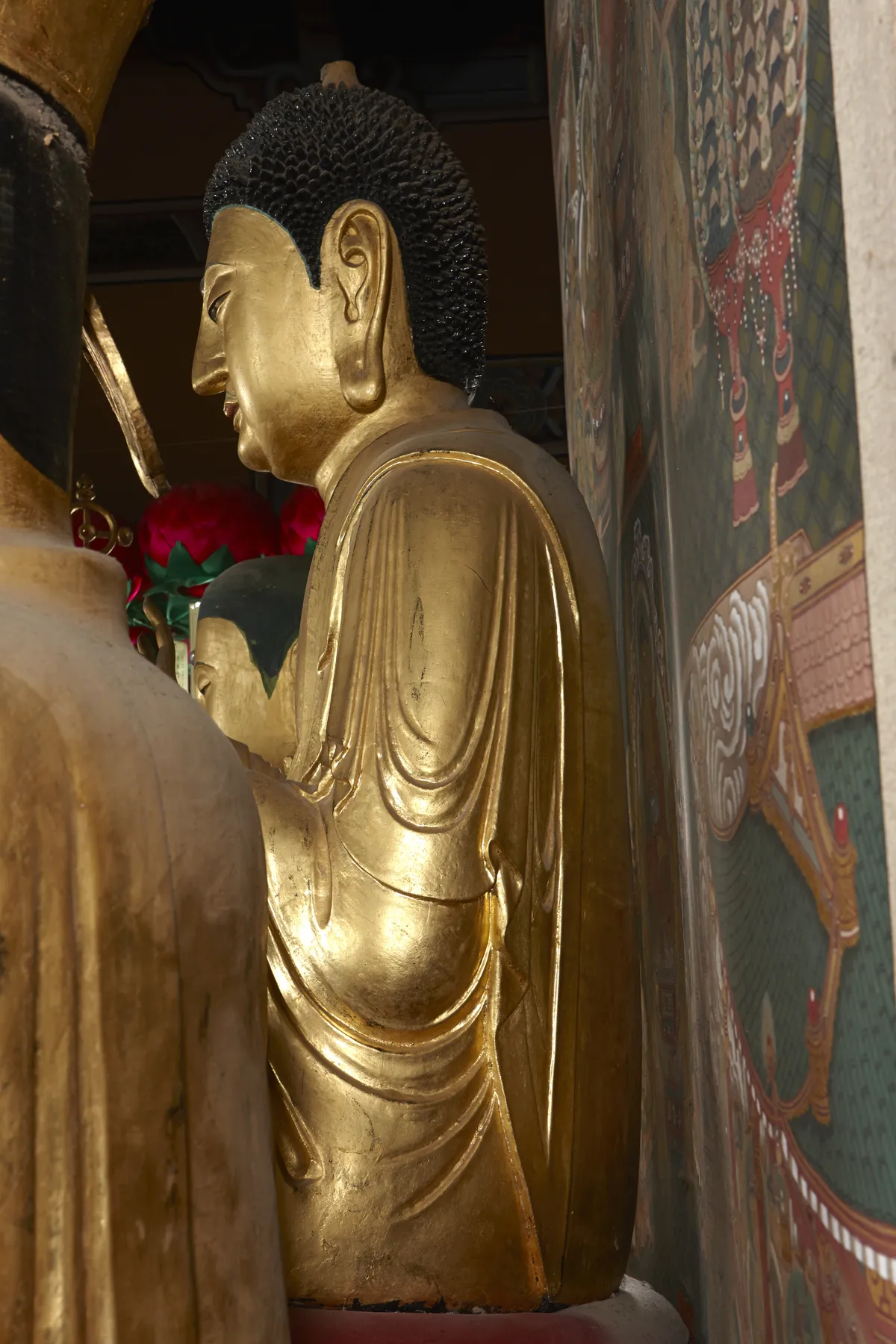
Gaesimsa Wooden Amitabha Seated Buddha, Seosan
瑞山 開心寺 木造阿彌陀如來坐像
충청남도 서산시
Basic information
- Designation
- Treasure No.1619
- Category
- Sculpture
- Era
- (12세기 ~13 세기)
- Designated year
- 2009
- Location
- 서산시, 충청남도— 충남 서산시 운산면 개심사로 321-86, 개심사 (신창리)
- Coordinates
- 36.746673, 126.590343
AI Docent
Coming soonAn AI-generated, friendly retelling of this heritage site is available in Korean. An English version is on our roadmap — for now, please see the official description below.
Description
This Amitabha Buddha statue, according to a scroll with an ink-written text about the circumstances of its repair, discovered in 2004, inside it, was repaired in 1280 (the 6th year of the reign of King Chungnyeol during the Goryeo Dynasty). The repair work was overseen by Seungjaesaek, a government institution in charge of Buddhist affairs, and an official of Siheungwiwi by the name of Song had the practical responsibility over the process. This statue was, therefore, created no later than in 1280, the year of its repair. Seungjaesaek, meanwhile, appears to have been established sometime during King Chungnyeol’s reign and was responsible for publishing Buddhist scriptures, repairing temples, repairing and re-gilding Buddhist statues and coordinating state Buddhist rites. The repair of this Amitabha Buddha, mentioned in the above text, is the earliest thus far known activity attributed to Seungjaesaek. This statue, having clean lines at the same time as appearing massive and dignified, is finely proportioned, and the sculptural technique is highly refined and sophisticated. The face of the Buddha, with well-defined features and a solemn expression, appears, however, quite exotic. The folds of his robe on the left shoulder are rendered with a few short bell-shaped lines, and the folds below them are circular in shape. This type of drapery treatment is seen also in the Wooden Seated Amitabha Buddha of Gaeunsa Temple in Seoul – which was repaired in 1274 -, the Wooden Seated Amitabha Buddha of Bongnimsa Temple in Hwaseong – believed to date from the 13th century - and the Dry-lacquered Seated Amitabha Buddha in Simhyangsa Temple in Naju. At the same time, this statue is more robust and livelier than the latter. A consummate work of sculpture, this statue is arguably the best late Goryeo wooden Buddhist statue, thus far known.
Location
지도를 불러오는 중…
Have you visited this place?
Log in and verify your visit on-site via GPS to record a stamp in My Journey. (QR verification coming later.)
Images: KOGL (khs.go.kr) · Data source: Korea Heritage Service Open API (khs.go.kr)