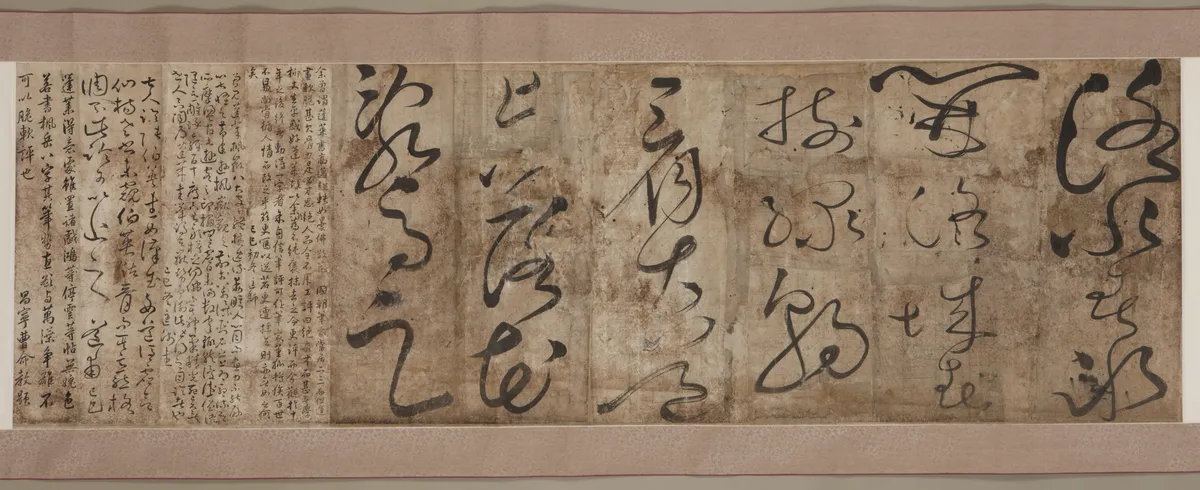
Yangsaeon Choseo
楊士彦 草書
서울특별시 마포구
Basic information
- Designation
- Treasure No.1624
- Category
- Books & Records
- Designated year
- 2010
- Location
- 마포구, 서울특별시— 서울 마포구 백범로 35, 서강대학교박물관 (신수동,서강대학교)
- Coordinates
- 37.551191, 126.939261
AI Docent
Coming soonAn AI-generated, friendly retelling of this heritage site is available in Korean. An English version is on our roadmap — for now, please see the official description below.
Description
This calligraphy is by Yang Sa-eon (1517-1584, penname: Bongnae), a Joseon scholar-official of the 16th century who was also a sijo poet and a calligrapher renowned for his cursive script. The text is the first verse of “Nagyangdo (Streets in Luoyang),” a five-word poem by the Tang-dynasty poet Chu Guangxi, consisting of five total verses. The calligraphy, originally in a folded book format, was mounted to a scroll sometime in the recent past. Yang Sae-eon, along with Hwang Gi-ro (1521-1576, pen-name: Gosan), is considered one of the two greatest masters of cursive script calligraphy and had a tremendous influence on later generations of Joseon calligraphers. He was fond of landscapes of a Taoist mood like Geumgangsan Mountain and loathed mundane constraints. This temperament of his is echoed also by his calligraphic style. Yang Sa-eon liked to write in cursive script, in an unconstrained and free style, similar to the style of Tang-dynasty calligraphers Zhang Shui and Huai Su. Among other writings by Yang Sa-eon, thus far known, Bongnae yumuk (Calligraphy by Yang Sa-eon; Treasure No. 1539, Yonsei University Library) is the original manuscript of a poem in Sino-Korean characters and Hangeul, composed by him; considered invaluable for research into the Korean literature of this period. Another manuscript of a poem of his and other short works included in the calligraphy album Geunmuk (Rose of Sharon Calligraphy; Sungkyungkwan University Museum) have survived as well. Meanwhile, this five word poem, written with a round brush, in large cursive characters, absolutely unbridled and free-flowing, lets his artistic temperament and Daoist leanings shine through far better than any of the above writings of his. This masterly showcase of the calligraphic style of a man hailed as “Choseong (Saint of Cursive Script)” has survived with three postscripts by Yi Gwang-sa (1705-1777), a major calligrapher of late Joseon, and another by Jo Myeong-gyo (1678-1753), dated 1749; which adds further value to it.
Location
지도를 불러오는 중…
Have you visited this place?
Log in and verify your visit on-site via GPS to record a stamp in My Journey. (QR verification coming later.)
Images: KOGL (khs.go.kr) · Data source: Korea Heritage Service Open API (khs.go.kr)