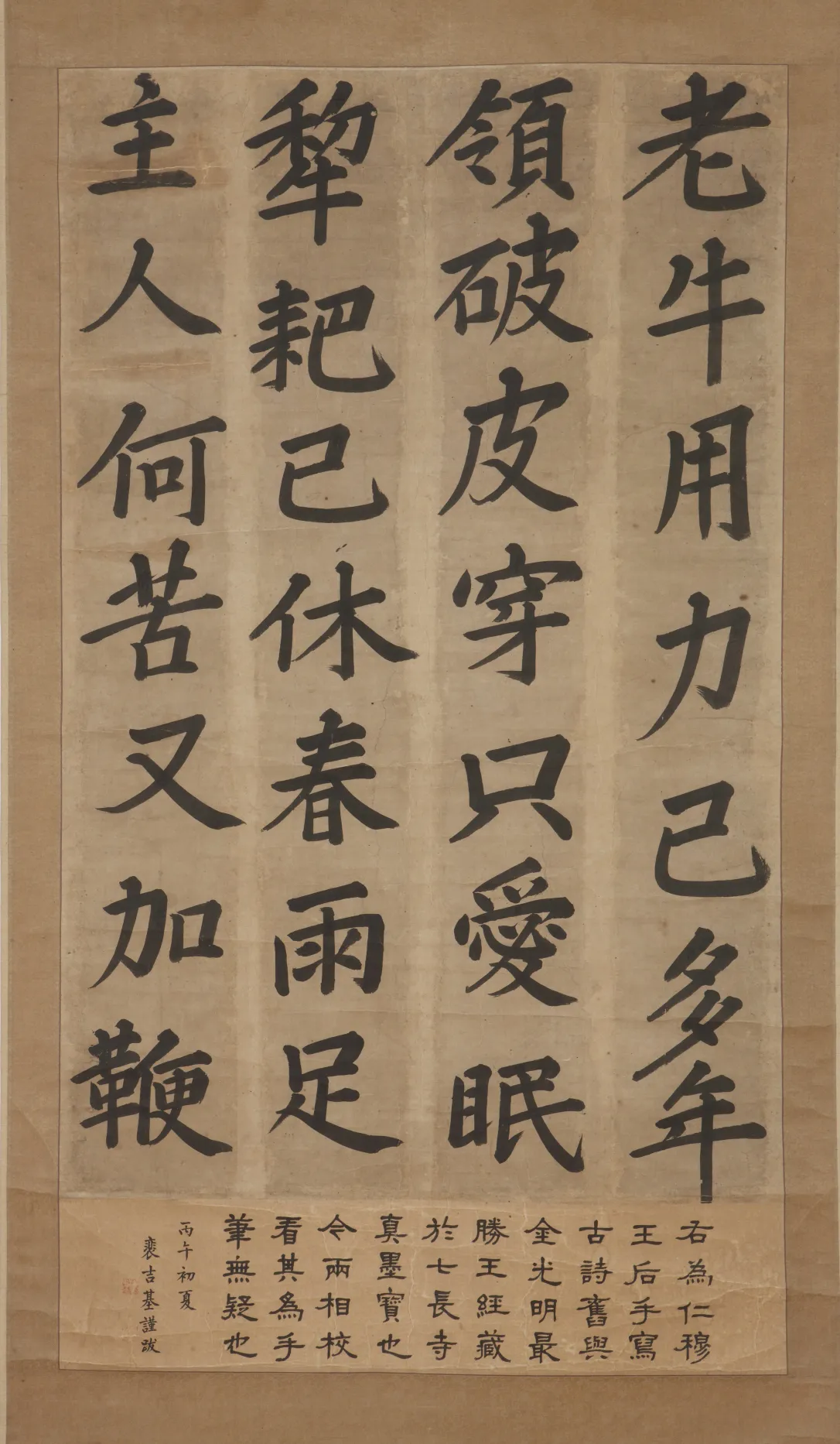
Inmogwanghu Eopil Chireonsi
仁穆王后御筆 七言詩
경기도 안성시
Basic information
- Designation
- Treasure No.1627
- Category
- Books & Records
- Designated year
- 2010
- Location
- 안성시, 경기도— 경기 안성시 죽산면 칠장로 399-18, 칠장사 (칠장리)
- Coordinates
- 37.028650, 127.397772
AI Docent
Coming soonAn AI-generated, friendly retelling of this heritage site is available in Korean. An English version is on our roadmap — for now, please see the official description below.
Description
This is a seven-word quatrain written by Queen Consort Inmok (1584-1632), the second wife of King Seonjo, in large characters. The four-line poem (seven characters in each line), in four long vertical strips of paper, was mounted to a scroll sometime in the recent past. A postscript by Bae Gil-gi, a modern Korean calligrapher, dated 1966, is added below the queen’s calligraphy. The bottom sheet is in fine condition, but the color appears slightly too bright between the calligraphy strips. Meanwhile, inside the strokes of the twenty-eight characters making up this seven-word poem, there is a twenty-eight word text written by a monk named Jewoldang, in tiny, dark-ink characters. Chiljangsa Temple was chosen by Queen Consort Inmok as the place to pray for the souls of her father and son (Prince Yeongchang), in 1623, the year when King Injo was restored to the throne, and was renovated during the same year, under a project funded by her. A hand-copied Suvarna-prabhasa Sutra (Sovereign Kings of the Golden Light Sutra) among the historical treasures housed in this temple is said to have been written by Queen Consort Inmok (currently in the collection of the Dongguk University Museum). Indeed, the handwriting in this sutra is identical in style to the one in the seven-word poem. Queen Consort Inmok’s handwriting is quite similar to that of King Seonjo, and influenced the handwriting of her daughter, Princess Jeongmyeong. Other version of this same calligraphy have survived to the present, including a wood block (Relics Related to Princess Myeongan, Treasure No. 1220) and a reproduction written in gold, on a piece of black silk cloth (National Museum of Korea, Accession No.: Deok 2053); both of which match exactly this scroll calligraphy in character form. But, in these two reproductions, the four-line, twenty-eight character poem is re-arranged into three lines (ten characters in each line) by readjusting the space between characters. During the Joseon Dynasty, past kings’ handwriting samples were often reproduced in wood blocks. But, their originals have rarely survived. Extant writings of queens are most often letters either written in their own hand or in the hand of a lady-in-waiting. As for writings in large Sino-Chinese characters, this seven-word poem by Queen Consort Inmok and writings by Queen Consort Myeongseong are the only extant examples.
Location
지도를 불러오는 중…
Have you visited this place?
Log in and verify your visit on-site via GPS to record a stamp in My Journey. (QR verification coming later.)
Images: KOGL (khs.go.kr) · Data source: Korea Heritage Service Open API (khs.go.kr)