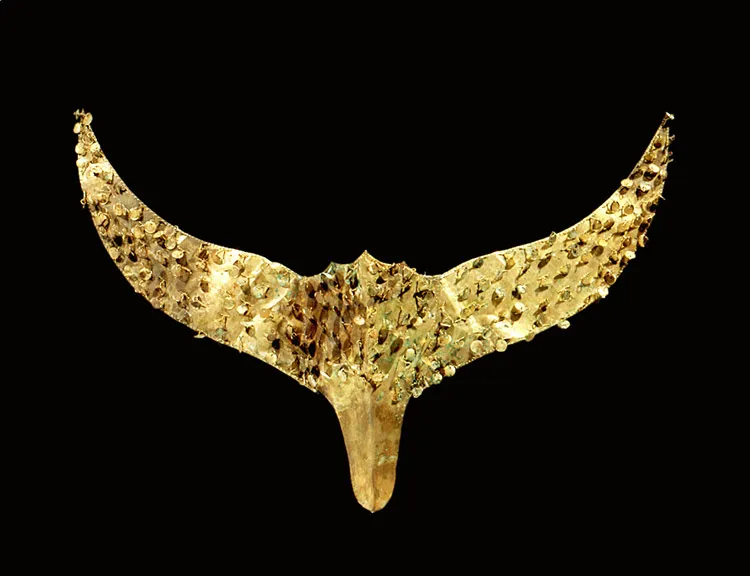
Gold Diadem Ornament from the South Mound of Hwangnamdaechong Tomb
皇南大塚 南墳 金製 冠飾
서울특별시 용산구
Basic information
- Designation
- Treasure No.630
- Category
- Craft
- Era
- 신라시대(5∼6세기)
- Designated year
- 1978
- Location
- 용산구, 서울특별시— 서울특별시 용산구 서빙고로 137 (용산동6가, 국립중앙박물관)
- Coordinates
- 37.524041, 126.980350
AI Docent
Coming soonAn AI-generated, friendly retelling of this heritage site is available in Korean. An English version is on our roadmap — for now, please see the official description below.
Description
This diadem ornament was found in the south mound of Hwangnamdaechong Tomb. It is 45 cm in height and 59 cm in width (the length between the two wing tips). It is made up of three gold plates. The middle plate has three projections in the upper part and so the whole shape looks like the Chinese character 出. The lower part gets narrower towards the end, forming a V. On both sides of this middle plate, plates in the shape of birds’ wings are connected with small nails. There is a small circular ornament on the front. However, there is no decoration on the lower part of the middle plate, which is supposed to be fixed to the diadem. The edge of the ornament for the diadem is decorated with minute dots. The middle plate is folded a little inwards lengthwise, which makes it probable that it was usually stuck into something else. However, it is not certain whether it is a part of the diadem worn every day. Similar ornaments for a diadem have frequently been excavated from Gaya tumuli. Hwangnamdaechong Tomb is a Silla tumulus and is located in Hwangnam-dong, Gyeongju, Gyeongsangbuk-do. Its Gyeongju Tumuli serial number is Hwangnam-dong tumulus no 98. It was excavated and researched by the Office of Cultural Asset in 1973 and 1975. Today the outward form of the tumulus is restored. Two mounds connected north and south give it the shape of a small gourd. It is the largest mound from the Silla Period. Its breadth is 80m east-west, 120m north-south. The height of the south tumulus is 23m and that of the north tumulus is 22m.
Location
지도를 불러오는 중…
Have you visited this place?
Log in and verify your visit on-site via GPS to record a stamp in My Journey. (QR verification coming later.)
Images: KOGL (khs.go.kr) · Data source: Korea Heritage Service Open API (khs.go.kr)