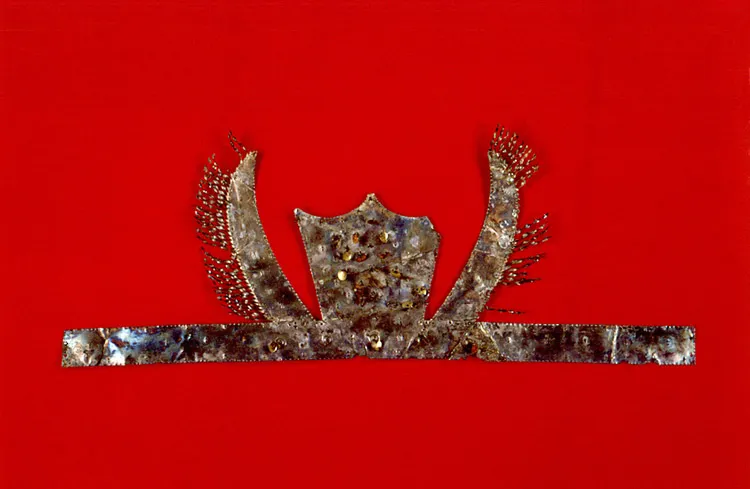
Silver Crown from the South Mound of Hwangnamdaechong Tomb
皇南大塚 南墳 銀冠
서울특별시 용산구
Basic information
- Designation
- Treasure No.631
- Category
- Craft
- Era
- 신라시대(6∼7세기)
- Designated year
- 1978
- Location
- 용산구, 서울특별시— 서울특별시 용산구 서빙고로 137 (용산동6가, 국립중앙박물관)
- Coordinates
- 37.524702, 126.977740Kakao address conversion
AI Docent
Coming soonAn AI-generated, friendly retelling of this heritage site is available in Korean. An English version is on our roadmap — for now, please see the official description below.
Description
This silver crown from Silla was found among articles buried with the body in the south mound of mound No. 98, Hwangnam-dong, Gyeongju. The articles were placed outside the wood coffin towards the head. The crown is 17.2 cm high, 16.6 cm in diameter, and the width of the headband is 3.2cm. The decoration over the headband consists of three branches. This is quite a unique mode unlikely to be seen in other official headdresses of the Silla era. The branch in the center is bent like a bow and has a projection at the top. There is a diamond-shaped silver plate with a wide top and a narrow bottom attached to this branch. On both sides there are crescent-shaped silver plates. The outside parts of these plates are clipped and then twisted to make a sort of feather-like shape. Such feather shape branches are a unique feature, not seen in other gold diadems of Silla. A similar official headdress was found in Uiseongtamni Ancient Tombs, but this is the first discovery in Gyeongju. Tumulus No. 98 in Hwangnam-dong is a Silla tumulus that has come down from the Three Kingdoms period. Its serial number is 98 and it is located in the Tumuli Park of tomb of King Michu. It was named Hwangnamdaechong Tomb after investigations in 1973 and 1975. It has the shape of a small gourd, the two mounds being connected north and south. It is the largest of the Silla dynasty mounds. Its diameter is 80m east-west and 120m north-south. The south mound is 23 m high, and the north mound is 22 m high. The inside of the tumulus is made by piling up stones over the coffin, which is characteristic of tombs made in the Silla era.
Location
지도를 불러오는 중…
Have you visited this place?
Log in and verify your visit on-site via GPS to record a stamp in My Journey. (QR verification coming later.)
Images: KOGL (khs.go.kr) · Data source: Korea Heritage Service Open API (khs.go.kr)