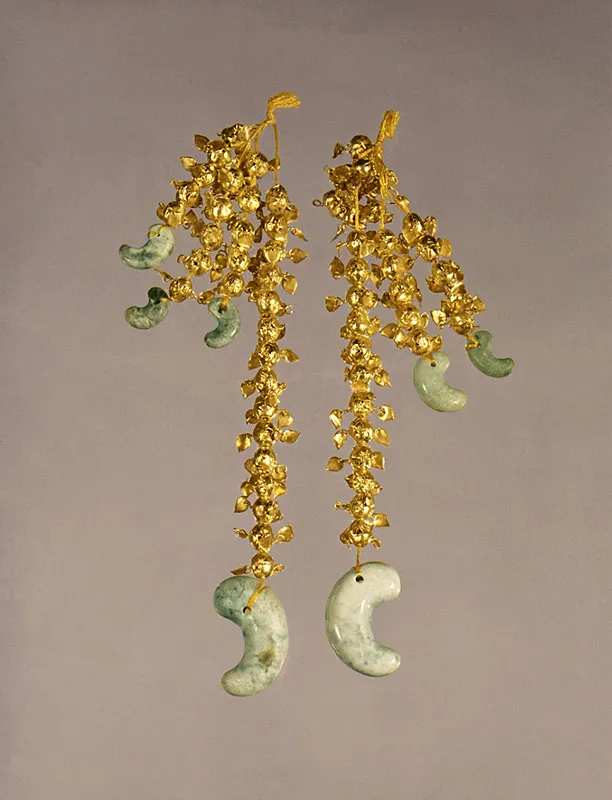
Gold Pendants from Hwangnam-dong, Gyeongju
慶州 皇南洞 金製 垂飾
경상북도 경주시
Basic information
- Designation
- Treasure No.633
- Category
- Craft
- Era
- 신라시대(5∼6세기)
- Designated year
- 1978
- Location
- 경주시, 경상북도— 경북 경주시 일정로 186, 국립경주박물관 (인왕동,국립경주박물관)
- Coordinates
- 35.829387, 129.227912
AI Docent
Coming soonAn AI-generated, friendly retelling of this heritage site is available in Korean. An English version is on our roadmap — for now, please see the official description below.
Description
These Silla ornaments were excavated from the tomb of King Michu in Gyeongju. They are made up of one long pendant and three shorter pendants. The long pendant is 15.5cm. A row of hollow beads and petal ornaments are connected with twisted gold threads to form the long pendant, and there is a green jade at the end. The shorter pendants are basically similar to long one. It is not certain whether the present remaining form is the original shape. Still, it is the most splendid ornament excavated from the tumuli of Silla. King Michu was the 13th king of Silla, reigning for 23 years from 262 to 284. The tomb of King Michu is otherwise called Jukjangneung (Tomb of Bamboo Soldiers), or Jukhyeonneung (Tomb where Bamboo Soldiers Appeared). The legendary origin of these names is written in Samguk sagi (The History of the Three Kingdoms). In 297 (the 14th year of his son, King Yuri’s reign), Iseogoguk (a nearby confederation of tribes) invaded Geumseong, the capital of Silla. Soldiers of the Silla Kingdom went out to meet their enemy but could not fend them off. At the critical moment a host of soldiers appeared. Their numbers were countless and all of them had bamboo leaves stuck behind their ears. They fought together with the soldiers of Silla, defeated the enemy, and then disappeared. Afterwards somebody noticed a heap of bamboo leaves on King Michu’s tomb and this led people to say that the dead Michu helped Silla with his secret army. The inside of the tumulus is made by piling up stones over the coffin, like Cheonmachong Tomb (Heavenly Horse Tumulus) and Hwangnamdaechong Tomb.
Location
지도를 불러오는 중…
Have you visited this place?
Log in and verify your visit on-site via GPS to record a stamp in My Journey. (QR verification coming later.)
Images: KOGL (khs.go.kr) · Data source: Korea Heritage Service Open API (khs.go.kr)