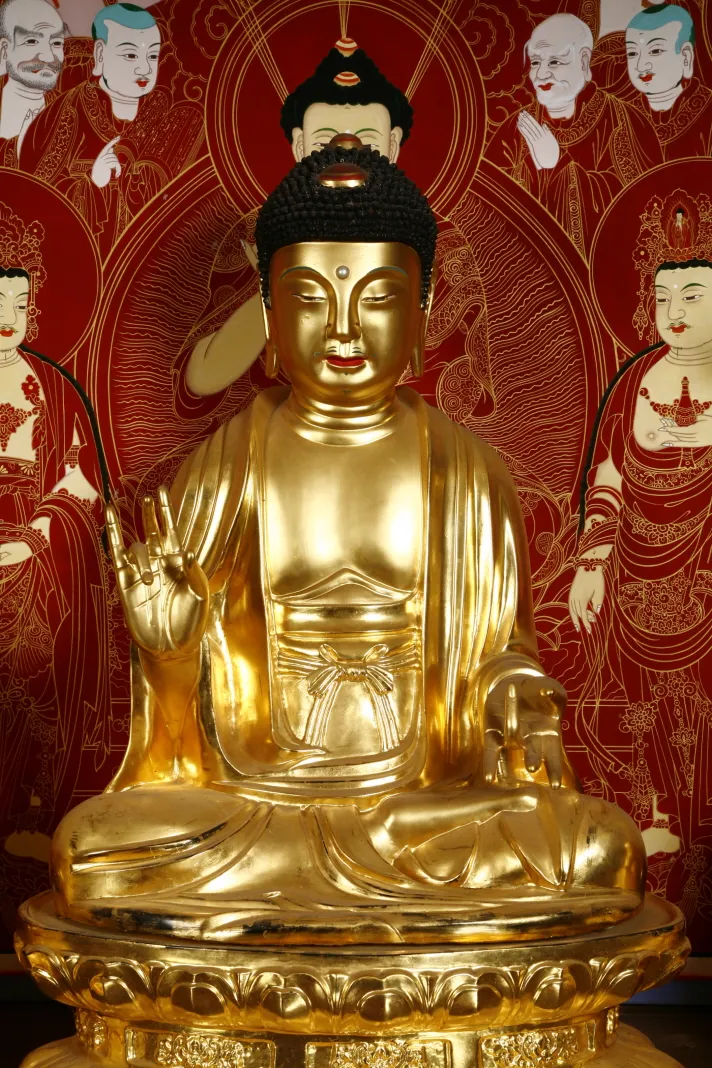
Daeseungsa Geumdongamitayeoraejwasang Mit Reliquary Objects, Mungyeong
聞慶 大乘寺 金銅阿彌陀如來坐像 및 腹藏遺物
경상북도 문경시
Basic information
- Designation
- Treasure No.1634
- Category
- Sculpture
- Designated year
- 2010
- Location
- 문경시, 경상북도— 경북 문경시 산북면 대승사길 283, 대승사 (전두리)
- Coordinates
- 36.748201, 128.270650Kakao address conversion
AI Docent
Coming soonAn AI-generated, friendly retelling of this heritage site is available in Korean. An English version is on our roadmap — for now, please see the official description below.
Description
The creation date of the Gilt-bronze Seated Amitabha Buddha of Daeseungsa Temple was accidentally discovered during a recent examination of the statue (composition analysis, X-ray imaging). An inscription on the head of the Buddha, written in ink, indicates that this statue was made in the year of 1301. The Sutra of Casket Seal Dharani (1292) and Taejanggyeong Mandala, found inside the statue, along with an incense pouch bearing an ink-written inscription, are also dated. These votive objects including the Dharani Sutra appear to have been placed inside the statue from the outset, at the time when it was created, possibly sometime in the early 14th century. When the statue was inspected through x-ray imaging, it was revealed that the bead decoration on the ushnisha was also cast in bronze, like the rest, and that the bead decoration had not significantly changed in its appearance, from its original state. In the late 13th to 14th century, Buddhist sculptures in Tibetan style with Yuan influence were popular in the Gaeseong area. This statue of Daeseungsa Temple, on the other hand, exhibits, interestingly, the characteristics of an earlier mid-Goryeo tradition. This work is of particular interest also because it constitutes the link between an earlier style and the new style that succeeded it, exemplified by the Amitabha Buddha of Suguksa Temple in Seoul, believed to date from sometime in the 13th century, or the Bhaisajyaguru Buddha of Janggoksa Temple in Cheongyang (1346). This statue of Amitabha Buddha, which was most probably cast around 1301, as indicated by the date inscription on the head and the dated Dharani written in ink, is expected to serve as a reference in dating other late Goryeo Buddhist sculptures. It is also among the most accomplished gilt-bronze sculptures from its time – when gilt-bronze statues were particularly widely produced – in a fine state of preservation. The twelve-sheet Dharani, found inside the Gilt-bronze Seated Amitabha Buddha of Daeseungsa Temple, were printed between 1292 (the 18th year of the reign of King Chungnyeol during the Goryeo Dynasty) and 1301 (the 27th year of King Chungnyeol’s reign), with either pre-existing woodblocks or woodblocks that were carved then and were placed inside the statue at the time of its creation. The date inscription written in ink, on the head of the Buddha, is helpful not only for dating the statue, but also for precisely dating the votive objects, including the Dharani text. The list of votive objects is as follows: 1. Amitabha Triad Dharani (1301, the 27th year of King Chungnyeol’s reign): printed Dharani with ink-written printing information, including the date of the 25th day in the fifth lunar month, 1301; 2. Diamond World Mandala printed in 1292 (the 18th year of King Chungnyeol’s reign) with woodblocks carved during the same year), which is accompanied by publishing information (the first Seungjesaek edition dated 1291) and an ink-written phrase; 3. Ajabeomjawonsang taejanggye Mandala, which is a printed version of late Goryeo Dharani with two phrases written by donors, in ink, “Dongwongyecheong” and “Dongwonseungbong”; and 4. Incense pouch dating from late Goryeo with ink-written phrases on the outside.
Location
지도를 불러오는 중…
Have you visited this place?
Log in and verify your visit on-site via GPS to record a stamp in My Journey. (QR verification coming later.)
Images: KOGL (khs.go.kr) · Data source: Korea Heritage Service Open API (khs.go.kr)