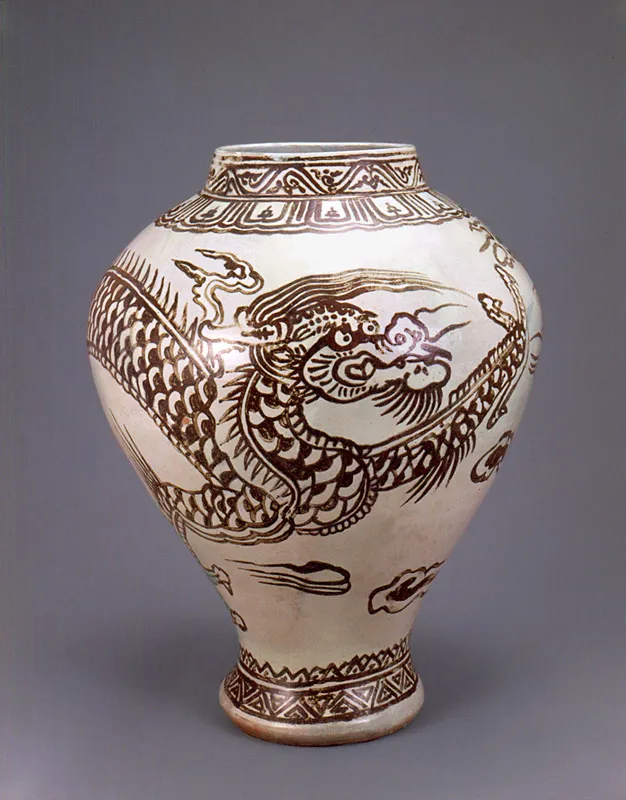
White Porcelain Cheolhwaunryongmun Jar
白磁 鐵畵雲龍文 立壺
서울특별시 서대문구
Basic information
- Designation
- Treasure No.645
- Category
- Craft
- Era
- 조선시대
- Designated year
- 1978
- Location
- 서대문구, 서울특별시— 서울 서대문구 이화여대길 52, 이화여자대학교박물관 (신촌동)
- Coordinates
- 37.561700, 126.943700Museum-based location
AI Docent
Coming soonAn AI-generated, friendly retelling of this heritage site is available in Korean. An English version is on our roadmap — for now, please see the official description below.
Description
The 45.8 cm tall white porcelain jar with the mouth 15.8 cm in diameter and the bottom 15.7 cm in diameter was produced in the late Joseon Dynasty. Its rather small mouth stands slightly tilted inward, while the body is fully expanded at the shoulder. The body gradually narrows as it goes down and gradually spreads again towards the bottom. The jar is painted in light gray enamel. There are drawings of vines and lotus flower patterns around the mouth and shoulder. Above the heel are double lines of triangles, which look like a modified version of lightning patterns. There is a drawing of a dragon carrying a yeouiju (a crystal bead that bestows omnipotence) in its claw surrounded by clouds. With its lively glare, wide-open mouth, shiny horns, whiskers, claws and scales, the imaginary animal looks alive and just about to swallow something. The inner part of the heel is caved inward. There is a trace that gives hints that the jar might have been baked with its heel mounted on a fine sand base. The distinctive shape, the grayish white enamel, the patterns produced by the drawing technique using oxidized iron paint and the caved-in heel are common features in the pottery excavated near Sangnim-ri, Seondong-ri and Jeongji-ri in Gwangju, Gyeonggi-do Province, where many kilns that produced such types existed during the 17th century. In particular, the portrayal of clouds and a dragon on the surface of the jar suggests that this piece might have been used in the royal palace. This is among the masterpieces produced by the oxidized iron technique in the early 17th century.
Location
지도를 불러오는 중…
Have you visited this place?
Log in and verify your visit on-site via GPS to record a stamp in My Journey. (QR verification coming later.)
Images: KOGL (khs.go.kr) · Data source: Korea Heritage Service Open API (khs.go.kr)