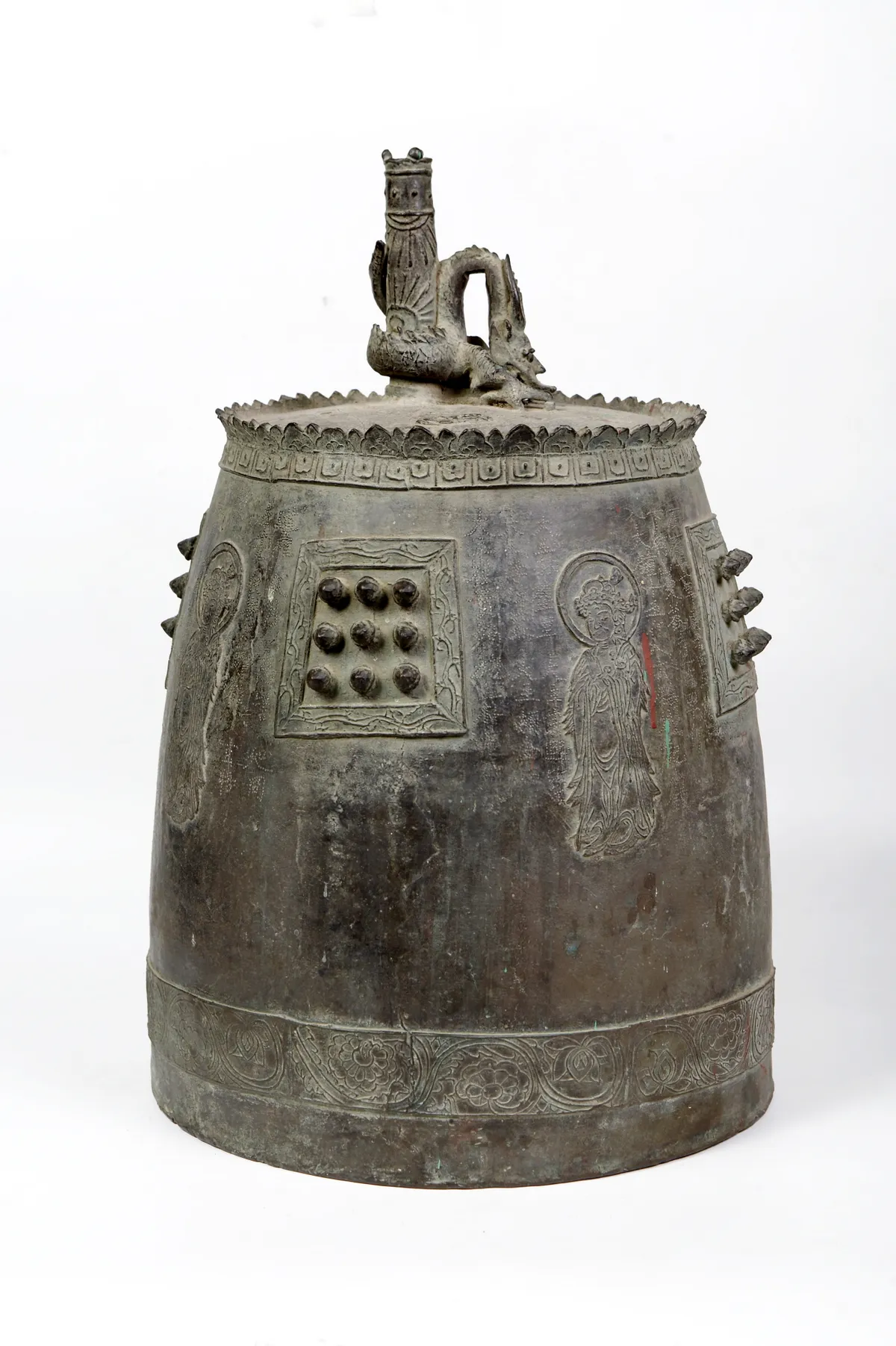
Gwangheungsa Bronze Bell, Andong
安東 廣興寺 銅鍾
경상북도 안동시
Basic information
- Designation
- Treasure No.1645
- Category
- Craft
- Era
- 1583년
- Designated year
- 2010
- Location
- 안동시, 경상북도— 경상북도 안동시 광흥사길 105(서후면, 광흥사)
- Coordinates
- 36.646021, 128.613565Kakao address conversion
AI Docent
Coming soonAn AI-generated, friendly retelling of this heritage site is available in Korean. An English version is on our roadmap — for now, please see the official description below.
Description
After the Bronze Bell of Haeinsa Temple (1491) was made in the late 15th century, there was, in Joseon, a sharp drop in the number of temple bells casted, and this lull lasted until the mid-16th century. Not coincidentally, no temple bells bearing a date inscription, from this period, has been thus far discovered. When the casting of temple bells resumed, after a lull of some fifty to seventy years, they were initially Chinese-style bells which had been popular in preceding eras. This eventually gave way to the production of mixed-style bells, blending Chinese and Korean styles, and also the production of bells in the native style of Korea, as this tenuous tradition managed to survive. After this transition period, once into the 17th century, following two successive wars in the 16th century and early 17th century (Japanese Invasion of 1592 and Manchu Invasion of 1627), mixed-style bells and traditional Korean-style bells imposed themselves as two main varieties of temple bells, shaping the style of late Joseon bells. Known examples of temple bells cast during the 16th century include the bell of Baengnyeonsa Temple (1569), bell of Anjeongsa Temple (1580), bell of Taeansa Temple (1581), bell of Gwangheungsa Temple (1583), and the bell of Gapsa Temple (1584). Of these, the bell of Gwangheungsa Temple is an example of traditional Korean style bells and is noted for its transition characteristics, making it a precursor of 17th-century Korean style bells. In comparison, the bronze bell of Gapsa Temple is in Chinese style, with an added touch of traditional Korean style. The bronze bell of Gwangheungsa Temple, one of the few surviving Joseon temple bells from the 16th century, is in a good state of preservation, although rather modest in size, measuring only about 60cm in height. Ornamental motifs are quite simple, but elegant in a restrained manner. The standing Bodhisattva in relief sculpture, in four places of the surface, the most flattering detail in this bell, has delicate facial features and is dressed in a gracefully draping robe with a jewel crown having intricate details. This standing Bodhisattva relief sculpture reflects the new characteristics of Bodhisattvas that appeared in mid-Joseon Buddhist paintings. The inscription on the bell says that it was cast in a hermitage in Hagasan Mountain, using one hundred-forty geun (one geun being about 600g) of bronze. The location of this hermitage, meanwhile, has not been identified. The inscription also lists the names of the caster and a painter who took part in the creation of the bell: Kim Ja-san and Buddhist monk Wono, who are, based on their name, a secular sculptor and a monk painter, respectively. The collaboration between a secular and religious artist is an interesting detail casting new light on the artisanal history of this period. In conclusion, this Buddhist temple bell, highly exemplary of the style of mid-Joseon bronze bells, excellently embodying their most essential characteristics, also offer important clues about the artisanal scene of mid Joseon.
Location
지도를 불러오는 중…
Have you visited this place?
Log in and verify your visit on-site via GPS to record a stamp in My Journey. (QR verification coming later.)
Images: KOGL (khs.go.kr) · Data source: Korea Heritage Service Open API (khs.go.kr)