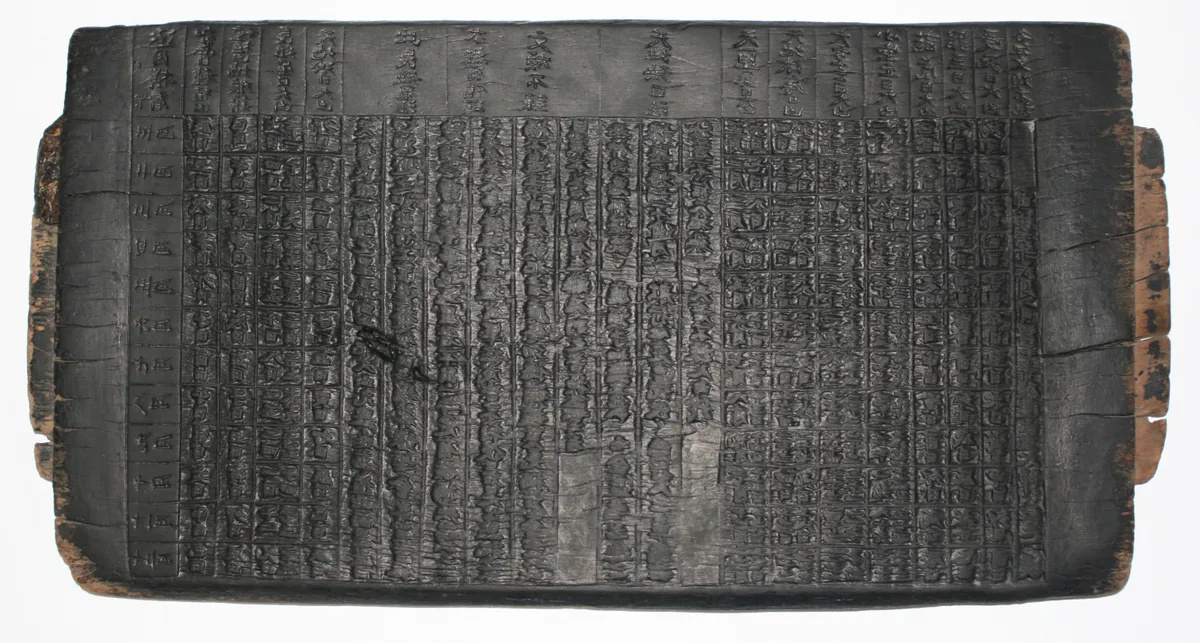
Gilhyungchugwolhoenggan Goryeo Woodblocks
吉凶逐月橫看 高麗木板
경상북도 성주군
Basic information
- Designation
- Treasure No.1647
- Category
- Books & Records
- Era
- 1219년
- Designated year
- 2010
- Location
- 성주군, 경상북도— 경상북도 성주군 가야산식물원길 17-56(수륜면, 심원사)
- Coordinates
- 35.800336, 128.135602Kakao address conversion
AI Docent
Coming soonAn AI-generated, friendly retelling of this heritage site is available in Korean. An English version is on our roadmap — for now, please see the official description below.
Description
This printing block was carved in June 1219 (the 6th year of the reign of King Gojong during the Goryeo Dynasty) in Buseoksa Temple, and is one of the oldest printing blocks with a clearly established date and place of carving. Printing blocks surviving from the Goryeo Dynasty are mostly for Buddhist texts, exemplified by the National Treasure-designated Tripitaka Koreana, carved between 1236 (the 23rd year of King Gojong’s reign), and 1251 (the 38th year of the same reign). As for non-religious texts, the extant examples are only a handful. This printing block is carved with a horizontally-written text that lists auspicious and inauspicious dates for various activities, based on divination systems such as unmyeonghak (natal astrology) in which any given date is believed to be either auspicious or inauspicious and the ohaeng (five elements) theory. This book, intended as a reference for choosing dates for various family events or farming and household activities, is a compilation of selections from different books on related themes. On one side of the printing block, there is a list of titles that are eleven activities including sowing and planting on a gucho day, an inauspicious day. Each date, organized by month, is expressed in sexagenary terms. In the entries on jangdanseong and cheonjiang days, long notes are provided, explaining calamities that may be expected, should certain activities be carried on these days. Interestingly, it is said that even if proscribed activities were conducted on a jangdanseong day, the associated calamities could be avoided through ‘gwangsu gongdeok’; in other words, by engaging in charitable deeds recommended in Buddhism. This detail is an important clue as to the relationship that existed, during the Goryeo Dynasty, between the natal astrology based on the five element theory and Buddhism. The information carved in a corner of the printing block that this book was published in Buseoksa Temple, then a major temple, by a person who held a rite there – whose name is also specified- is noteworthy in relation to the methods used around this period to propagate Buddhism. On the other side, twenty farming activities that can be carried out on auspicious days are listed. Although a single block, this printing block is of great value, given that it is one of the oldest printing blocks with a clearly known date and place of carving and the name of the maker also known. Meanwhile, as the text pertains to everyday activities of ordinary people, it is also invaluable for the study of folklore in the early 13th century, as well as for the study of Buddhism and bibliographic research into this period.
Location
지도를 불러오는 중…
Have you visited this place?
Log in and verify your visit on-site via GPS to record a stamp in My Journey. (QR verification coming later.)
Images: KOGL (khs.go.kr) · Data source: Korea Heritage Service Open API (khs.go.kr)