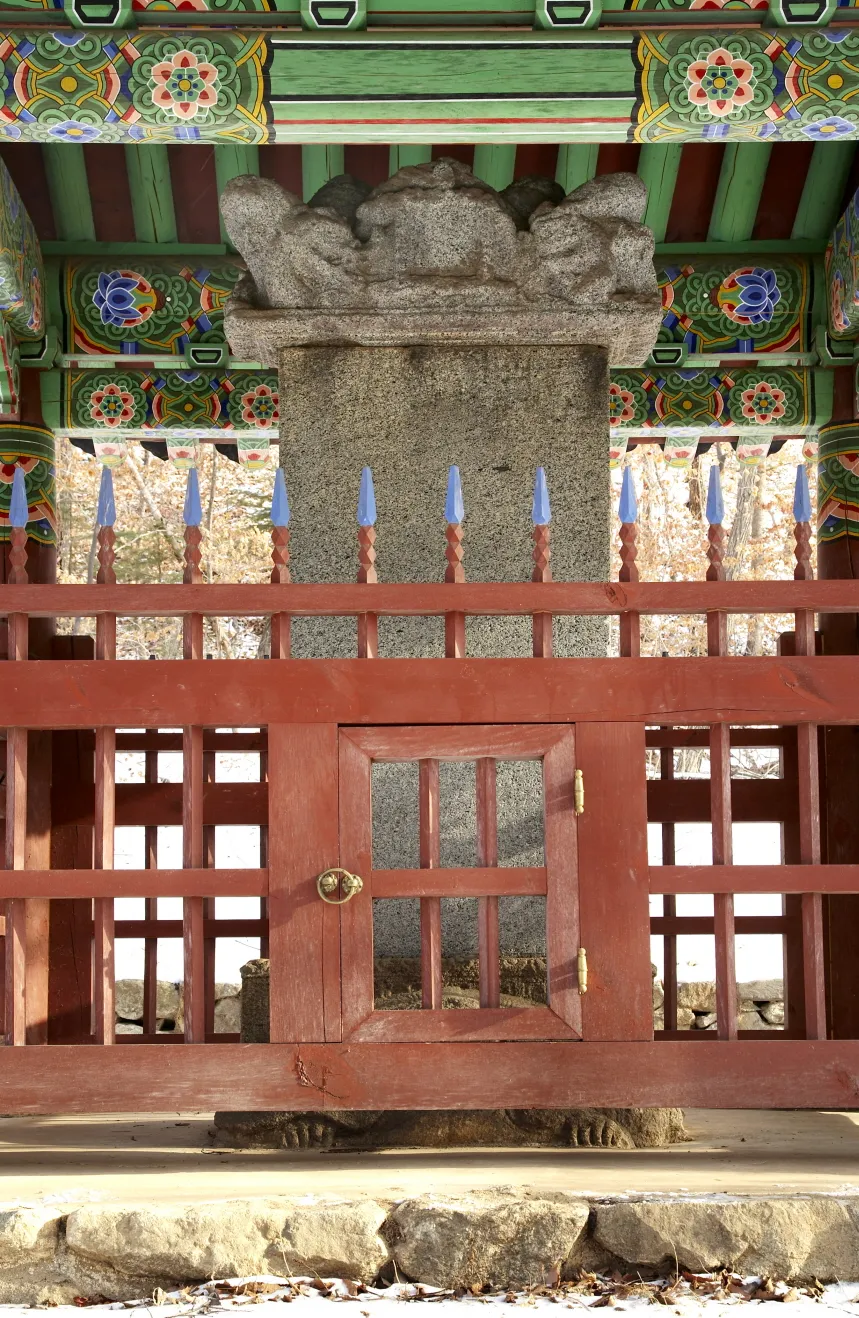
Myeongbongsa Gyeongcheongseonwonjajeokseonsaneungun Memorial Stele of Buddhist Monk, Yecheon
醴泉 鳴鳳寺 境淸禪院慈寂禪師陵雲塔碑
경상북도 예천군
Basic information
- Designation
- Treasure No.1648
- Category
- Books & Records
- Era
- 고려시대(941년)
- Designated year
- 2010
- Location
- 예천군, 경상북도— 경상북도 예천군 명봉사길 62 (상리면)
- Coordinates
- 36.777986, 128.377246
AI Docent
Coming soonAn AI-generated, friendly retelling of this heritage site is available in Korean. An English version is on our roadmap — for now, please see the official description below.
Description
This stele was erected in 941 (the 24th year of the reign of King Taejong during the Goryeo Dynasty), on the order of the king to commemorate the spirituality of Master Jajeok (882-939), a Buddhist monk who lived between late Unified Silla and early Goryeo. This stele is carved with a text recounting his life and accomplishments. On the back side of the memorial stone, there is a ten-line text in idu script, relating the content of an official letter (cheommun) to the monk Ubeopsa and describing the circumstances of the creation of this monument. The cheommun, being an official document drafted in idu script, is of particular significance for the light it casts on the style of official documents in early Goryeo and as a concrete example of an idu text from this period. Although the engraved text is missing some parts, this does not pose a problem for the understanding of its overall meaning. The memorial stone is also preserved in a nearly intact state, except for the missing head of the tortoise-shaped pedestal. As for the Master Jajeok, he is the successor to the monk Jingyeong who was a spiritual heir of monk Wongam of Godarwon Temple, Yeoju and who revived the Bongnimsan School of Zen Buddhism by re-establishing it in Changwon. Monk Jajeok, as monk Jingyeong’s successor at the helm of the Bongnimsan School (also known as the Hyemoksan School), is considered to have ensured the continuity of the lineage of this school of Zen Buddhism into the Goryeo Dynasty. The text on this stele was composed by Choe Eon-wi, a celebrated writer of this period, and was carved using an assorted set of characters written in the hand of the Tang-dynasty calligrapher Ouyang Xun as the models. This stele, the first case of Goryeo with inscriptions in idu script, is of inestimable value for the understanding of the history of early Goryeo Buddhism and art and for the history of the Korean language.
Location
지도를 불러오는 중…
Have you visited this place?
Log in and verify your visit on-site via GPS to record a stamp in My Journey. (QR verification coming later.)
Images: KOGL (khs.go.kr) · Data source: Korea Heritage Service Open API (khs.go.kr)