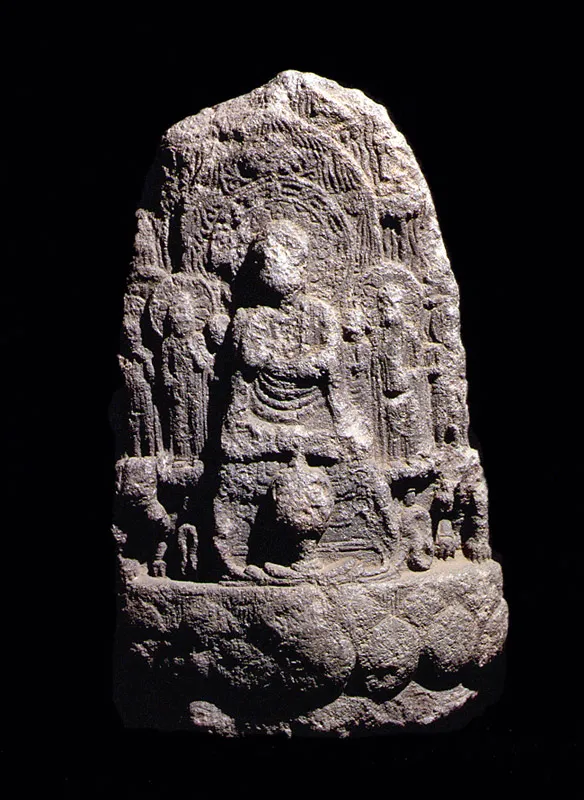
Sejongsi Yeonhwasa Chiljonbulbisang
世宗市 蓮花寺 七尊佛碑像
세종특별자치시
Basic information
- Designation
- Treasure No.650
- Category
- Sculpture
- Era
- 통일신라시대
- Designated year
- 1978
- Location
- , 세종특별자치시— 세종특별자치시 연화사길 28-1 (월하리)
- Coordinates
- 36.592504, 127.279579Kakao address conversion
AI Docent
Coming soonAn AI-generated, friendly retelling of this heritage site is available in Korean. An English version is on our roadmap — for now, please see the official description below.
Description
This Buddha statue belongs to the same line as a series of Buddhist stone monuments discovered in Yeongi County. Seven principal Buddha images are carved on the surface of a lozenge shaped stone, centering on a principal Buddha image. Lotus stems rise from the left and right at the front of the rectangular pedestal, the top of which has carved pleats, centering the big lotus bloom, and a lion sits crouching on the end. The attendant Bodhisattvas stand to the left and right of the principal Buddha, who sits on a lotus stem. A statue of Arhat with its upper body projected stands between the principal Buddha and the attending Bodhisattvas, and a statue of Vajradhara is on the lion outside. The face of the principal Buddha is abraded, but with a thick sacerdotal robe wrapping the shoulders, covering the rigid body. This aspect is similar to other stone monuments where the carving traditions of the Three Kingdoms Period are reflected. The principal Buddha and the attending Bodhisattvas have the round haloes and they are included in one mandorla in the shape of a ship. The mandorla has lotus and flame patterns, and seven carved Buddhas. Following the carving tradition of the Three Kingdoms period, this statue has new elements added in part, and this indicates that it was created together with the stone monuments of Biamsa Hermitage and Yeonhwasa Temple, estimated to have been around 678, the 18th year of the reign of King Munmu. The lotus flower pattern of the mandorla and the long, thin body of the attending Bodhisattvas especially show the style of the age of Baekje, suggesting that it was made by itinerant people of Baekje.
Location
지도를 불러오는 중…
Have you visited this place?
Log in and verify your visit on-site via GPS to record a stamp in My Journey. (QR verification coming later.)
Images: KOGL (khs.go.kr) · Data source: Korea Heritage Service Open API (khs.go.kr)