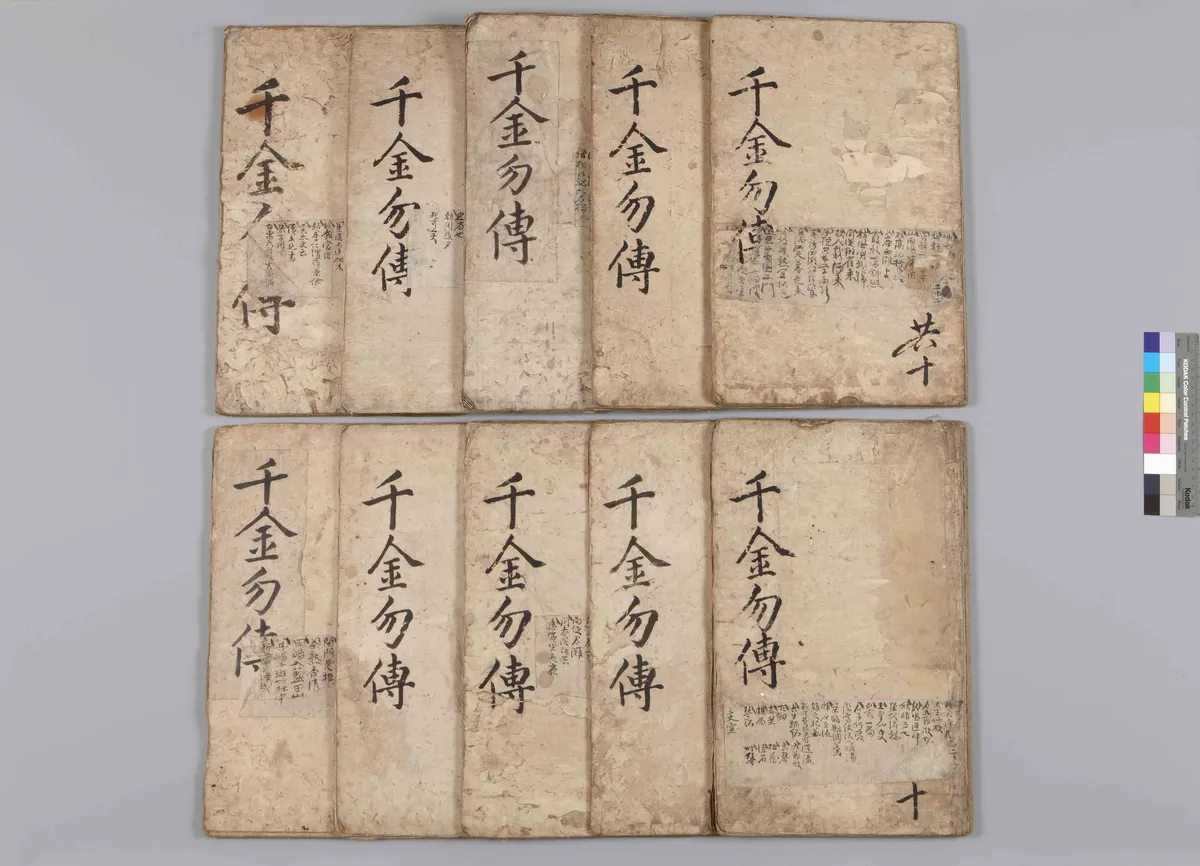
Ihajin Piljeok Cheongeummul Hall
李夏鎭 筆蹟 千金勿傳
경기도 안산시
Basic information
- Designation
- Treasure No.1673
- Category
- Books & Records
- Era
- 17세기 후반
- Designated year
- 2010
- Location
- 안산시, 경기도— 경기도 안산시 상록구 성호로 131(부곡동, 성호박물관)
- Coordinates
- 37.315030, 126.859616
AI Docent
Coming soonAn AI-generated, friendly retelling of this heritage site is available in Korean. An English version is on our roadmap — for now, please see the official description below.
Description
Yi Ha-jin was a Joseon writer and calligrapher of the 17th century. His family originates from Yeoju, and he used the courtesy name Hagyeong, and pen-names Maesan and Yukudang. He was a grandson of Yi Sang-ui (1560-1624, pen-name: Soreung) and the son of Yi Ji-an (1601-?). His career in the government began in 1666 when he successfully passed the civil service examination, and culminated in his appointment as a vice minister of defense, after successive positions as a censor-general, a chancellor of the National Academy, and intendant of education of the Bureau of Arts and Letters. His son Yi Seo (1662-1723, pen-name: Okdong) was a scholar as well as a renowned calligrapher, and his other son and the latter’s half-brother Yi Ik (1681-1763, pen-name: Seongho) was a famous Silhak (Practical Learning) scholar. This calligraphy album titled Cheongeummuljeon, passed down to Yi Ha-jin’s descendants of successive generations, has its title stated on the cover page, along with the word “Gongsip,” which indicates that the ensemble consists of ten booklets. No volume number is indicated on the cover pages, but there is a table of contents listing either the titles or first phrases of entries in each book. The contents range from the names of his favorite activities or objects to groups of words like “dongsan, myeongwol, bukchang, cheongpung” or “seongseo, chodang, maeheon, jugo”; Tang-dynasty five-word or seven-word quatrain poems; quotes from Chinese classics; poems on his twelve favorite fragrant garden plants and trees; and anecdotes and stories about literati gentlemen of yore. None of the brushworks is dated, and several seal marks are found here and there, with the name “Daeudang,” carved in intaglio and relief, “Maesan” in relief, “Hwangnyeo” in intaglio and relief, “Yi Ha-jin in” in relief or “Hagyeong” in relief. The writings are in regular, semi-cursive or cursive script. Yi Ha-jin appears to have modeled his regular script on Wang Xizhi’s small-character regular script, but the strokes are rather weak, and the composition feels relaxed. His semi-cursive characters are close to seal script characters written in a cursive manner and are rather roughly written. In comparison, his cursive characters are in very thin strokes and are written with freedom and ease, using a round brush. His style appears to have been influenced by that of his uncle Yi Ji-jeong (1588-1650, pen-name: Cheongseon), who studied the calligraphy of Hwang Gi-ro. Yi Ha-jin’s calligraphy style was, in turn, emulated by his two sons, Yi Seo and Yi Ik, and his disciple Yun Du-seo (1668-1715, pen-name: Gongjae).
Location
지도를 불러오는 중…
Have you visited this place?
Log in and verify your visit on-site via GPS to record a stamp in My Journey. (QR verification coming later.)
Images: KOGL (khs.go.kr) · Data source: Korea Heritage Service Open API (khs.go.kr)