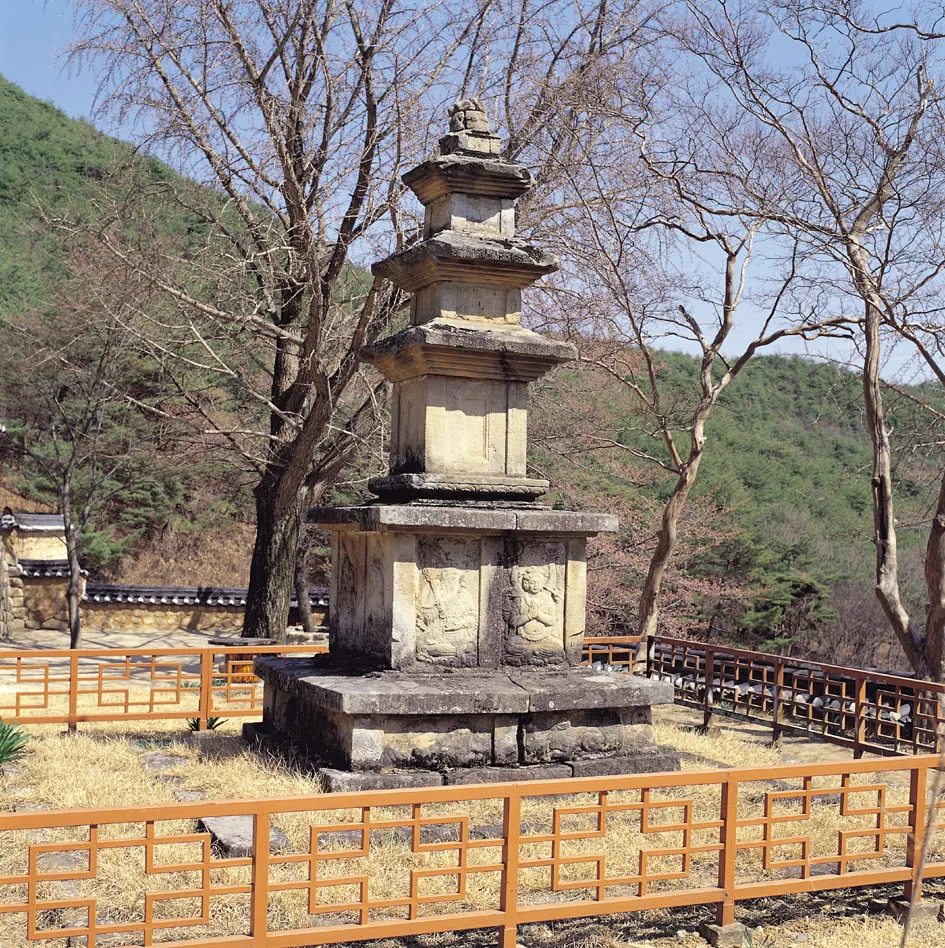
Jibosa Three-story Stone Pagoda, Gunwi
軍威 持寶寺 三層石塔
대구광역시 군위군
Basic information
- Designation
- Treasure No.682
- Category
- Sites & Pagodas
- Era
- 고려시대 초기
- Designated year
- 1980
- Location
- 군위군, 대구광역시— 대구광역시 군위군 상곡길 233(군위읍, 지보사)
- Coordinates
- 36.257691, 128.601955
AI Docent
Coming soonAn AI-generated, friendly retelling of this heritage site is available in Korean. An English version is on our roadmap — for now, please see the official description below.
Description
This is a pagoda located in Jibosa Temple. The name of this temple, Jibo, means “containing jewelry”. The temple was so named because it has preserved a milestone, an iron pot, and a bronze incense pot. Generally, a pagoda is made from the bottom up with the platform unit, the main unit, and the finial unit. This pagoda maintains a graceful appearance with a two-story platform, a three-story main section and a single strut at the finial. The platform follows the typical style of its composition and decoration. It has pillar-shaped carvings at every corner and in the middle of each side. Between the carvings are decorations with carved lions or the Eight Guardian Deities. The tall stone forming the platform makes the pagoda stand tall. A stone slab with a lotus flower decoration was inserted into the face of the platform and holds the three-story main part, which contain the sarira and considered the center of the pagoda. One core stone and the roof stone as a pair make up one story of the main part of the pagoda. The first story of the main part has a niche, as a wooden pagoda does, but here, the niche is kept small or as a mere decoration. This pagoda has also marked the niche with a door pattern decoration. The roof is made with another thick stone and supported by a four-layer strut. In the finial, the decoration of the bowl-shaped pattern and the base still remains. It is regrettable to see the severe abrasion on the pagoda. However, with its splendid decoration, it is still considered an excellent example of the work of the early Goryeo era.
Location
지도를 불러오는 중…
Have you visited this place?
Log in and verify your visit on-site via GPS to record a stamp in My Journey. (QR verification coming later.)
Images: KOGL (khs.go.kr) · Data source: Korea Heritage Service Open API (khs.go.kr)