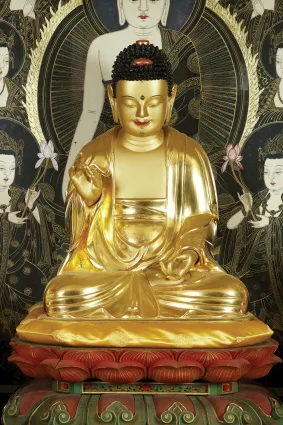
Wolmyeongam Wooden Amitabha Seated Buddha, Jinju
晉州 月明庵 木造阿彌陀如來坐像
경상남도 진주시
Basic information
- Designation
- Treasure No.1686
- Category
- Sculpture
- Era
- 1612년
- Designated year
- 2010
- Location
- 진주시, 경상남도— 경남 진주시 미천면 안간리 산200번지 월명사
- Coordinates
- 35.306142, 128.058831Kakao address conversion
AI Docent
Coming soonAn AI-generated, friendly retelling of this heritage site is available in Korean. An English version is on our roadmap — for now, please see the official description below.
Description
This Wooden Seated Amitabha Buddha, housed in Inbeopdang Hall of Wolmyeongam Hermitage was created in 1612, by a group of monk sculptors led by Hyeonjin, including Hakmun, Myeongeun, Uineung and Taehun. The date of its creation, indicated in the prayer text, discovered inside the statue, is identical to the year of creation of the Seated Avalokitesvara Bodhisattva of Sangnyeondae. Almost the same people, furthermore, were involved in the creation of these two statues, according to the prayer text, although the patrons who sponsored their creation were not exactly the same. Therefore, the Wooden Seated Amitabha Buddha of Wolmyeongam Hermitage appears to have been created at the same time as the Seated Avalokitesvara Bodhisattva of Sangnyeondae in Hamyang. Interestingly, Buddhist Monk Gakseong, listed as one of the patrons who funded the Seated Avalokitesvara Bodhisattva of Sangnyeondae, is also mentioned in the list of patrons for the Wooden Seated Amitabha Buddha of Wolmyeongam Hermitage; hence, indicating that this person was deeply involved in the making of Buddhist sculptures around this time. The prayer scroll, meanwhile, was put back inside the wooden Amitabha statue of Womyeongam. The seated Amitabha has broader shoulders than the seated Avalokitesvara and has more robust proportions than the latter as well. The head, round in shape, has a high-rising top half and is slightly bent forward. Between the conch-shaped curls covering the Buddha’s head, there are round top cudamani beads, and crescent-shaped mid-level cudamani beads; both very distinctly visible. The face is in a slim oval shape, and the half-closed eyes are almond-shaped. The arched nose has a delicate bridge, and the mouth, with a pair of thin lips, is lit with a smile. The overall impression conveyed by the Buddha is one of kindness and mercy. The chest below the broad shoulders is flat and voluminous. The torso is long, and the lower belly slightly convex in the middle. The right hand is held at the chest level, and the left resting on the right foot has the thumb and the tall finger joined together. The Buddha sits in a lotus position in which the right foot is placed above the left leg. The knees are positioned close to the throne with wide kneecaps, communicating an impression of stability. The Buddha is dressed in two layers of clothes, in a customary fashion. The straight top edge of the inner garment is visible at the chest level. The robe drapes over the two legs, and the long folds, in four tiers, are arched in shape. The drapery is treated in a similar manner in the Seated Avalokitesvara Bodhisattva of Sangnyeondae, created at the same time as this statue. One of the oldest extant Buddhist sculptures in Korea, the Seated Amitabha of Wolmyeongam Hermitage, in terms of facial features, is closer to the Seated Avalokitesvara and Mahasthamaprapta Bodhisattva of Cheoneunsa Temple, created two years after it, than to the Seated Avalokitesvara Bodhisattva of Sangnyeondae. Buddhist sculptures, created several years after it, such as the Clay Seated Amitabha Buddha of Muryangsa Temple (1626) or the Clay Buddha Triad of Beopjusa Temple, have a similarly large face and a robust body. The Wooden Seated Amitabha Buddha of Wolmyeongam Hermitage, therefore, is an early embodiment of such new characteristics that emerged around this time, in Joseon Buddhist sculptures. This statue is also likely to be useful for dating the various styles that appeared in the early 17th century.
Location
지도를 불러오는 중…
Have you visited this place?
Log in and verify your visit on-site via GPS to record a stamp in My Journey. (QR verification coming later.)
Images: KOGL (khs.go.kr) · Data source: Korea Heritage Service Open API (khs.go.kr)