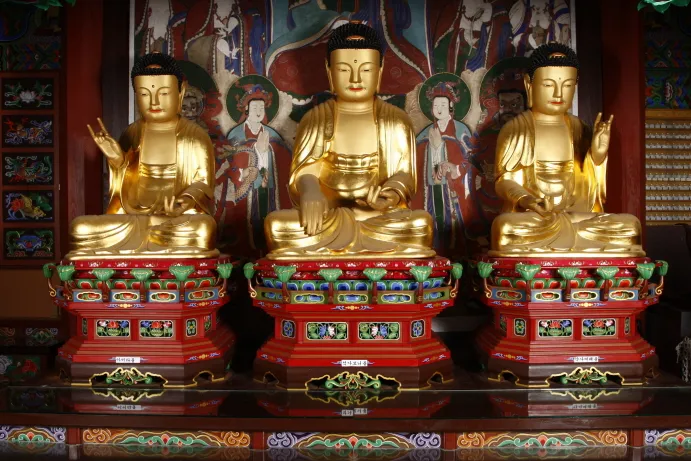
Eungseoksa Mokjoseokgayeoraesambul Seated Figure, Jinju
晉州 凝石寺 木造釋迦如來三佛坐像
경상남도 진주시
Basic information
- Designation
- Treasure No.1687
- Category
- Sculpture
- Era
- 조선 인조 21년(1643년)
- Designated year
- 2010
- Location
- 진주시, 경상남도— 경상남도 진주시 응석로 435(집현면, 응석사)
- Coordinates
- 35.296574, 128.059217Kakao address conversion
AI Docent
Coming soonAn AI-generated, friendly retelling of this heritage site is available in Korean. An English version is on our roadmap — for now, please see the official description below.
Description
In Daeungjeon Hall of Eungseoksa Temple, there are three Buddhist sculptures, representing the Buddhas of the Three Ages. The statue of Sakyamuni Buddha is placed between Bhaisajyaguru Buddha and Amitabha Buddha, seated to his left and right. According to the record accompanying these sculptures, Eungseoksa Temple was destroyed by fire and left in ruins for a long while. The temple was later rebuilt, funded by Gyeongcheon, Geuksu and Ilhwi, and after its completion, the three Buddha statues were placed there in 1643. The three statues were, meanwhile, carved by a group of monk sculptors, including Cheongheon, Beophyeon and Wontaek. The Sakyamuni statue is made slightly larger in size than the two other statues next to it, in a manner to emphasize its status of the main Buddha in this triad. All three statues have a head that is disproportionately large, compared to the size of their body. The face is square in shape, and the head is one with the ushnisha, with no demarcation between the two. The ushnisha is low-rising and round, and there are sculpted details representing top and middle cudamanis. The face with the eyes half-closed, a well-defined nose and a mouth with the two corners slightly turned up produces a comely impression. In spite of the rather broad shoulders, the torso looks small. The seated position, on the other hand, looks stable, with the high and wide knees contributing to this impression. The three Buddha statues, mostly identical, in facial features and bodily proportions and details, show, however, some differences, in terms of mudra and drapery folds. The Sakyamuni Buddha has his hand held down below the knees, assuming the earth-touching mudra (bhumisparsa mudra). Sakyamuni Buddha’s robe hangs from the left shoulder, leaving the right shoulder bare, in a manner showing a slight departure from the standard robe exposing the right shoulder. The top edge of the inner garment on the exposed chest shows folds. The draper folds in straight vertical lines and in slanted lines are in a simplified shape and are rather flat without much relief. The bottom edge of the robe is in stilted and awkward curves. The Bhaisajyaguru Buddha and Amitabha Buddha, meanwhile, have their one hand held up to the chest level with the other hand resting on the lap. The thumb and tall finger of the hand rested on the lap are joined together. The two Buddhas have the same hand position, but inverted. They are also dressed in two layers of clothes. But, their inner garment, unlike Sakyamuni Buddha’s, is devoid of details. Cheongheon, one of the makers of these three statues, was a monk sculptor who was active in the early 17th century. He was the author of numerous Buddha statues, many of which are counted among major late-Joseon Buddhist sculptures, including the Clay Seated Vairocana Buddha Triad of Beopjusa Temple, Boeun (1626, Treasure No. 1360), Wooden Seated Vairocana Buddha Triad of Hwaeomsa Temple, Gurye (1636, Treasure No. 1548), Wooden Seated Sakyamuni Buddha Triad and Four Standing Bodhisattvas of Ssanggyesa Temple, Hadong (1639, Treasure No. 1378), Wooden Seated Sakyamuni Buddha in Daeungjeon Hall of Neunggasa Temple, Goheung (1639), and the Clay Seated Sakyamuni Triad in Daeungjeon Hall of Songgwangsa Temple, Wanju (1641, Treasure No. 1274). This Wooden Buddha Triad of Eungseoksa Temple, created in 1643, is a work of his later years and an outstanding piece of sculptural art bearing valuable testimony to the later style of an artist occupying an important place in the history of Korean Buddhist sculpture.
Location
지도를 불러오는 중…
Have you visited this place?
Log in and verify your visit on-site via GPS to record a stamp in My Journey. (QR verification coming later.)
Images: KOGL (khs.go.kr) · Data source: Korea Heritage Service Open API (khs.go.kr)