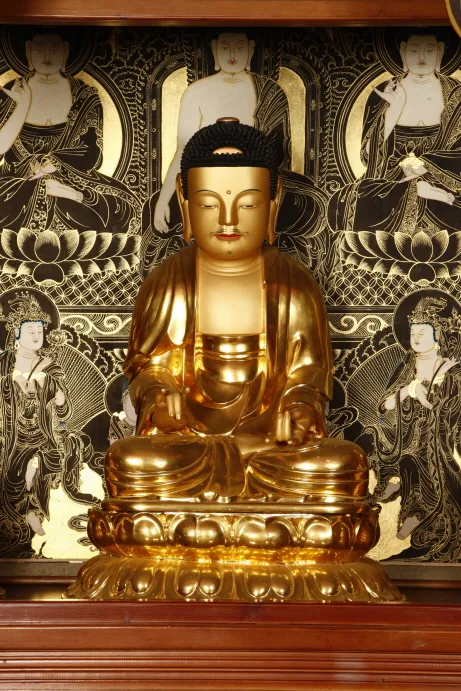
Simusa Wooden Amitabha Seated Buddha, Geochang
居昌 尋牛寺 木造阿彌陀如來坐像
경상남도 거창군
Basic information
- Designation
- Treasure No.1690
- Category
- Sculpture
- Designated year
- 2010
- Location
- 거창군, 경상남도— 경남 거창군 거창읍 하동4길 77, 심우사 (대동리)
- Coordinates
- 35.689645, 127.914865Kakao address conversion
AI Docent
Coming soonAn AI-generated, friendly retelling of this heritage site is available in Korean. An English version is on our roadmap — for now, please see the official description below.
Description
The Wooden Seated Amitabha Buddha of Simusa Temple was created in 1640 by a group of monk sculptors, including Cheongheo and Beophyeon. The prayer scroll found inside the statue informs that it was one of the Buddhist sculptures which were originally housed in Yeonsusa Temple in Deogyusan Mountain. Cheongheo was a Joseon monk sculptor who was active in the early to mid-17th century. In addition to this statue in Simusa Temple, he is one of the authors of the Wooden Seated Amitabha Buddha Triad of Namjangsa Temple, Sangju (1645, Treasure No.1635), in whose creation he participated as the head sculptor. Buddhist sculptures by Cheongheo are characterized by comely facial features and heavy yet flowing drapery. In his sculptures, the robe typically drapes down to the right ankle of the seated Buddha, forming several neatly-ordered folds at the level right below the knees, as exemplified by the statue of Namjangsa Temple. The square face with a clean-cut contour shows volume and depth. Under a pair of long, straight eyebrows, the Buddha’s eyes are half-closed as if lost in thought or in the state of Zen, and the nose, rather flat, is triangular in shape. The mouth is tightly sealed with its corners slightly turned upward, and the resulting impression is one of solemnity and gravitas. The head displays sculptural details representing conch-shaped hair curls and crescent-shaped and cylindrically-shaped cudamanis. The well-built body has wide shoulders, the broad lower body is in proportion to the upper body. The two hands with the thumb and the tall finger joined together were separately made and inserted to the arms. The hands are placed quite low, so that they nearly touch the knees. The Buddha wears his robe over an inner layer of clothes. The robe flows down from the right shoulder, forming ‘S’-shaped folds. The end of the left sleeve rests on the bent left leg of Buddha seated in a cross-legged position, forming leaf-shaped folds. The top edge of the inner garment, visible on the chest beneath the robe, is in two parallel horizontal lines and has the appearance of a belt. The abdomen protrudes slightly. The folds of the robe on the knees are rendered in three simple lines. In the middle of the lower body, meanwhile, the skirt-like bottom garment spreads down the left and right legs, creating folds that are arched like a handheld fan. The Amitabha Buddha of Simusa Temple, carved five years earlier than the Wooden Seated Amitabha Buddha Triad of Namjangsa Temple, Sangju (Treasure No.1635), another work of Cheongheo, holds inestimable significance for understanding the sculptural style of this major 17th-century monk sculptor.
Location
지도를 불러오는 중…
Have you visited this place?
Log in and verify your visit on-site via GPS to record a stamp in My Journey. (QR verification coming later.)
Images: KOGL (khs.go.kr) · Data source: Korea Heritage Service Open API (khs.go.kr)