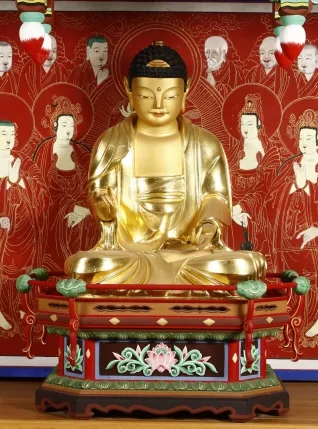
Beobinsa Wooden Amitabha Seated Buddha, Hamyang
咸陽 法印寺 木造阿彌陀如來坐像
경상남도 함양군
Basic information
- Designation
- Treasure No.1691
- Category
- Sculpture
- Era
- 1657년
- Designated year
- 2010
- Location
- 함양군, 경상남도— 경남 함양군 안의면 금성길 14, 법인사 (금천리)
- Coordinates
- 35.629318, 127.811064Kakao address conversion
AI Docent
Coming soonAn AI-generated, friendly retelling of this heritage site is available in Korean. An English version is on our roadmap — for now, please see the official description below.
Description
The Wooden Seated Amitabha Buddha housed in Geungnakbojeon Hall of Beobinsa Temple was created in 1657 by Yeonggyu and Joneung. While no other work by Yeonggyu is currently known, Joneung participated in the carving of the Wooden Seated Buddha of Bulmyeongsa Temple in Okgu, Jeollabuk-do, created in 1640, under a project led by Beopyeong, and was the head sculptor for the project of creating the Wooden Seated Avalokitesvara Bodhisattva of Bongseosa Temple in Jeonju, Jeollabuk-do (1655, Jeollabuk-do Tangible Cultural Heritage No. 156). This statue of Amitabha Buddha flaunts a good natured-looking oblong face. The broad shoulders, above a long torso, have rounded angles. The size of the lower body of the seated Buddha is in proportion to the upper body; the legs are large and voluminous enough and are positioned low, close to the throne. The mudra assumed is hapum jungsaengin (a variety of the vitarka mudra). The left hand is positioned so that the palm faces upward, and the palm of the right hand faces downward. The tall finger and the thumb are joined in both hands. The ushnisha on top of the head covered with conch-shaped hair curls is low-rising and is not very distinct. Around the bottom of the ushnisha, there is a crescent shaped cudamani, and at the top of the ushnisha, a cylindrical-shaped cudamani. The forehead in the oblong-shaped face is rather narrow. The half-closed eyes are slanted with their outer tips sharply pointed upward, and the eyebrows are arched like a crescent. The nose is well-defined, and the thin and long lips have their corners curled upward, into a faint smile. Between the eyebrows, there is the tuft of white hair (urna), and the neck shows three curved lines, another marker of Buddhahood, in shallow incised lines. The Buddha is dressed in two layers of clothes. The robe, hanging lightly from the right shoulder, drapes into a slightly curved hemline. The bottom garment covering the crossed legs flows down below the ankles, forming three to four folds on either side. This statue is highly peculiar in the way the folds of the bottom garment and the folds of the sleeve spread on the right leg are rendered. The folds on the two crossed legs are in arched lines like the arch of a handheld fan, but those to the left and right sides of the knees are not identical in shape. Meanwhile, the long narrow left sleeve flows down behind the left knee, in a position very close to the knee, to disappear beneath the top garment. This sleeve appears, at the same time, to fit snugly; a small but interesting detail that sets this statue apart from others. When the Wooden Seated Amitabha Buddha of Beobinsa Temple was designated as a Gyeongsangnam-do Tangible Cultural Heritage object, a prayer scroll was listed among the votive objects found inside it. This prayer scroll, however, appears to have been put back inside the statue thereafter. Other votive objects, including the Saddharmapundarika Sutra (The Lotus Sutra), the Casket Seal Dharani and the plug for sealing the hole on the back of the statue after placing votive objects are currently held in the Seongbo Museum of Haeinsa Temple, on a temporary custody basis. The Wooden Seated Amitabha Buddha of Beobinsa Temple is one of the better examples of Buddhist sculptures from this period.
Location
지도를 불러오는 중…
Have you visited this place?
Log in and verify your visit on-site via GPS to record a stamp in My Journey. (QR verification coming later.)
Images: KOGL (khs.go.kr) · Data source: Korea Heritage Service Open API (khs.go.kr)