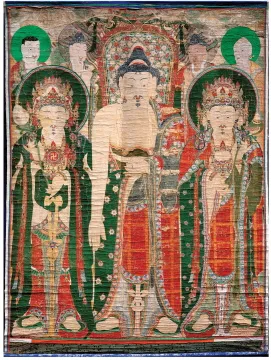
Anjeongsa Yeongsanhoe Hanging Buddhist Painting, Tongyeong
統營 安靜寺 靈山會 掛佛圖
경상남도 통영시
Basic information
- Designation
- Treasure No.1692
- Category
- Painting
- Era
- 조선 숙종 28년(1702년)
- Designated year
- 2010
- Location
- 통영시, 경상남도— 경남 통영시 광도면 안정1길 363, 안정사 (안정리)
- Coordinates
- 34.943777, 128.395198Kakao address conversion
AI Docent
Coming soonAn AI-generated, friendly retelling of this heritage site is available in Korean. An English version is on our roadmap — for now, please see the official description below.
Description
The Hanging Painting of Vulture Peak Assembly of Anjeongsa Temple was painted in 1702 by a group of three monk painters, Gwangheum, Hongteuk and Gakhwan, with Gwangheum being the head painter. The painting was repaired in 1934 by Gyehong. The gigantic painting, measuring 738cm by 964cm, was painted on thirteen interconnected pieces of hemp, each about 60cm in width. Sakyamuni Buddha, portrayed in the center of the painting, assumes the bhumisparsa mudra, and the title “Hanging Painting of Vulture Peak Assembly” is written in a corner. Sakyamuni Buddha is represented standing, accompanied by Manjusri Bodhisattva and Samantabhadra Bodhisattva. Sakyamuni Buddha and the two other members of this triad are huge in size and occupy most of the space. Meanwhile, Prabhutaratna Buddha, Amitabha Buddha, Ananda and Kasyapa, all in tiny size, are placed on either side of Sakyamuni Buddha’s nimbus. This iconography derives from the picture of Buddhas and Bodhisattvas in Ojong beomeumjip (Collection of Ritual Chants in Five Kinds) and was popularly adopted in late Joseon Buddhist hanging painting. The Hanging Painting of Vulture Peak Assembly of Naesosa Temple (1700, Treasure No. 1268) is the earliest example of a Buddhist painting having this composition. Other examples of hanging painting on the theme of Vulture Peak Assembly having the same composition are housed in Cheonggoksa Temple (1722, National Treasure No. 302), Unheungsa Temple (1730, Treasure No. 1317), Dabosa Temple (1745, Treasure No. 1343), Gaeamsa Temple (1749, Treasure No. 1269), and Daeheungsa Temple (1764, Treasure No. 1552). Daeheungsa Temple houses four other hanging paintings, aside from the Vulture Peak Assembly painting, and Uigyeom participated in the creation of these four paintings as the head painter. Gwangchim, the author of the Hanging Painting of Vulture Peak Assembly of Anjeongsa Temple, collaborated with Uigyeom, in 1719, when the latter was painting for Unheungsa Temple. Meanwhile, Gwangchim was the head monk of Unheungsa Temple by 1730 when another painting project was taking place there. These facts suggest that Gwangchim and Uigyeom could have belonged to the same monk painter group. The Hanging Painting of Vulture Peak Assembly of Anjeongsa Temple, although it is creased and cracked in places with paint peeled off and has suffered some humidity-induced damages, is still in a decent state of preservation. The case in which the Buddhist hanging painting was discovered appears to have been made around the same time as the painting.
Location
지도를 불러오는 중…
Have you visited this place?
Log in and verify your visit on-site via GPS to record a stamp in My Journey. (QR verification coming later.)
Images: KOGL (khs.go.kr) · Data source: Korea Heritage Service Open API (khs.go.kr)