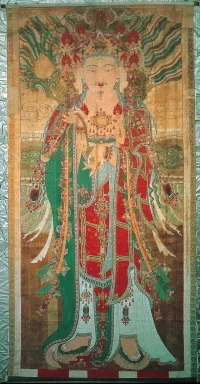
Ssanggyesa Hanging Buddhist Painting, Hadong
河東 雙磎寺 掛佛圖
경상남도 하동군
Basic information
- Designation
- Treasure No.1695
- Category
- Painting
- Era
- 조선(18세기)
- Designated year
- 2010
- Location
- 하동군, 경상남도— 경남 하동군 화개면 쌍계사길 59, 쌍계사 (운수리)
- Coordinates
- 35.228800, 127.589200Museum-based location
AI Docent
Coming soonAn AI-generated, friendly retelling of this heritage site is available in Korean. An English version is on our roadmap — for now, please see the official description below.
Description
The Hanging Painting of Ssanggyesa Temple represents a Bodhisattva-style Buddha, not accompanied by any attendant. The Buddha with a sumptuous jewel crown and lavish bead ornaments, stands on a lotus pedestal while holding a lotus blossom with his two hands, and his head is surrounded by a round-shaped nimbus. This iconography originates from a scene of the Vulture Peak Assembly in which Sakyamuni Buddha holds out a lotus flower. This scene is not mentioned in Buddhist scriptures, but is depicted in Illustration of the Avatamsaka Sutra (The Flower Garland Sutra), and was a popular theme for hanging painting for outdoor rites, more than it was for paintings hung at the altar, behind Buddha statues. The earliest example of a hanging painting representing a Bodhisattva-style Buddha standing with a lotus flower in the hands is the Hanging Painting of Yulgoksa Temple (1684, Treasure No. 1316). The Buddha depicted in the Hanging Painting of Yulgoksa Temple dons a jewel crown featuring five seated Transformation Buddhas, but in this painting, housed in Ssanggyesa Temple, Buddha’s crown is without Transformation Buddhas. There are several paintings that are iconographically similar to the one in Ssanggyesa Temple, including the Hanging Painting of Beopjusa Temple (1766, Treasure No. 1259) and the Hanging Painting of Sakyamuni Buddha of Tongdosa Temple (1767). But, the Hanging Painting of Ssanggyesa Temple shows a greater degree of similarity to the Hanging Painting of Bogyeongsa Temple (1708, Treasure No. 1609) and the Hanging Painting of Cheongnyangsan Mountain (1725, Buddhist Museum of Korea, Treasure No. 1210), even if Buddha is represented in the latter, with a jewel crown featuring Transformation Buddhas. The Hanging Painting of Ssanggyesa Temple is strikingly similar to the above two paintings – the one in Bogyeongsa Temple and the one in Cheongnyangsan Mountain – in terms of overall iconography as well as in details such as types of accessories and the way ornamental fabric motifs are rendered between the folds of the garment. The Hanging Painting of Ssanggyesa Temple carries no mention about the circumstances of its creation, but has information about a repair done in 1929, jotted down in a corner. The year of creation of this painting is referenced there, as the “4th year of Gagyeong,” which corresponds to 1799. Meanwhile, information about the monk artists who painted it or the name of Buddha represented in it is unavailable. The Hanging Painting of Ssanggyesa Temple is gigantic in size, measuring 589cm by 1295.6cm.It is painted on nineteen interconnected pieces of hemp fabric, each measuring 35cm to 37cm in width. The painting is currently on display in the Seongbo Museum of Ssanggyesa Temple and is in a good general condition and is mostly unsoiled. Although it has some creases and areas where the paint has been peeled off, the degree is not severe, compared to other hanging paintings of its age.
Location
지도를 불러오는 중…
Have you visited this place?
Log in and verify your visit on-site via GPS to record a stamp in My Journey. (QR verification coming later.)
Images: KOGL (khs.go.kr) · Data source: Korea Heritage Service Open API (khs.go.kr)