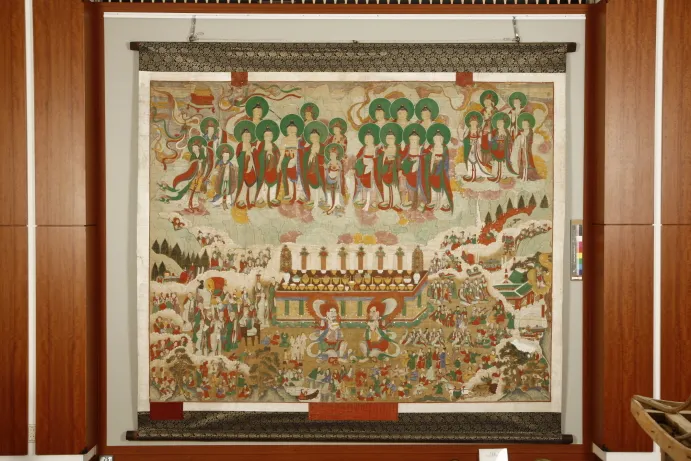
Ssanggyesa Gamrowangdo, Hadong
河東 雙磎寺 甘露王圖
경상남도 하동군
Basic information
- Designation
- Treasure No.1696
- Category
- Painting
- Era
- 조선시대(1728년)
- Designated year
- 2010
- Location
- 하동군, 경상남도— 경남 하동군 화개면 쌍계사길 59, 쌍계사 (운수리)
- Coordinates
- 35.228800, 127.589200Museum-based location
AI Docent
Coming soonAn AI-generated, friendly retelling of this heritage site is available in Korean. An English version is on our roadmap — for now, please see the official description below.
Description
The Painting of the King of Sweet Dew of Ssanggyesa Temple was painted in 1728, by a group of monk painters, including Myeongjeong, Choeu, Wonmin, Cheoyeong, Sinyeong and Yeongho. This Buddhist painting is divided into two sections by a series of clouds. The top section shows a Bodhisattva descending from the sky, riding on a cloud, and in the rather crowded bottom section, a scene of a Buddhist rite before an altar is deployed, with the images of demons of hell and dead souls nearby. On the right side, in the top section, Avalokitesvara and Ksitigarbha Bodhisattva stand, surrounded by Mahasthamaprapta Bodhisattva, Maudgalyayana and Ananda, forming a small group. There is, meanwhile, a group of seven Bodhisattvas nearby, but also, standing closer to the middle ground, and next to them, another group of figures, this time, surrounding Sakyamuni Buddha, including four Buddhas and three Bodhisattvas, as well as Bijeungbosal (Bodhisattva Superior in Compassion) and Illowangbosal (Guiding Bodhisattva), holding flags in their hands. Finally, above Bijeungbosal holding a flag, Beongnyeondaeban, a deity whose role is to lead dead souls to Paradise, is visible. Byeongnyeondaeban is seen frequently in 18th-century paintings of the King of Sweet Dew, usually near the top edge of a painting. Examples of paintings featuring Byeongnyeondaeban include the Painting of the King of Sweet Dew of Sudosa Temple in Uiryeong (1786, Gyeongsangnam-do Tangible Cultural Heritage No. 418), Painting of the King of Sweet Dew of Yongjusa Temple (1786) and the Painting of the King of Sweet Dew of Undaeam Hermitage of Baekcheonsa Temple (1801). Myeongjeong and Choeu, two monk painters who are the authors of this painting, appear to have belonged to the same school of Buddhist painting as Uigyeom, judging from the resemblance existing between the Paintings of the Eight Great Events from Sakyamuni Buddha’s Life, painted by them during the same year and housed in Palsangjeon Hall of Ssanggyesa Temple, and paintings on the same theme by the latter, housed in Unheungsa Temple (1718) and Songgwangsa Temple (1725).The Painting of the King of Sweet Dew of Ssanggyesa Temple features more Buddhist figures than other paintings on the same theme from this period – i.e., the group of seven Buddha absent in most others – and is considered a pioneering work in the iconography of paintings of the King of Sweet Dew with a large Buddhist pantheon. This work, outstanding in composition, is also remarkable for its colors.
Location
지도를 불러오는 중…
Have you visited this place?
Log in and verify your visit on-site via GPS to record a stamp in My Journey. (QR verification coming later.)
Images: KOGL (khs.go.kr) · Data source: Korea Heritage Service Open API (khs.go.kr)