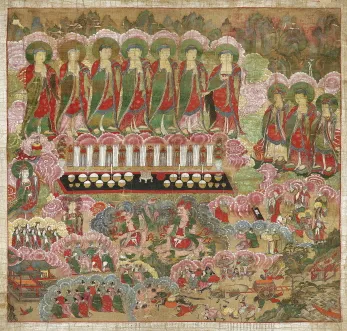
Haeinsa Gamrowangdo, Hapcheon
陜川 海印寺 甘露王圖
경상남도 합천군
Basic information
- Designation
- Treasure No.1697
- Category
- Painting
- Era
- 조선 경종 3년(1723년)
- Designated year
- 2010
- Location
- 합천군, 경상남도— 경상남도 합천군 가야산로 1742-17(가야면, 해인사성보박물관)
- Coordinates
- 35.801200, 128.102200Museum-based location
AI Docent
Coming soonAn AI-generated, friendly retelling of this heritage site is available in Korean. An English version is on our roadmap — for now, please see the official description below.
Description
The Painting of the King of Sweet Dew of Haeinsa Temple was painted in 1723, by three monk painters; namely, Simgam, Sino and Deukchong. Although created in the early 18th century, this work shows the lingering influence of early-Joseon paintings of the King of Sweet Dew. The painting is in two sections, above and below the altar. The emphasis is placed on the upper section where several Bodhisattvas are arriving to lead dead souls to heaven. The scene of the rite before the altar and the dead souls in the rather cluttered lower section are depicted in miniature. This composition is quite distinct from the prevalent three-tiered composition in late Joseon paintings on the theme of the King of Sweet Dew in which the Bodhisattvas occupy the top tier, the ritual scene the middle tier and the dead souls occupy the bottom tier. The group of seven Bodhisattvas in the upper half of the painting, arriving at a Buddhist sanctuary, is set against a landscape of which one of the elements is the Iron Ring Mountain. This scene naturally transitions into another one depicting a rite for the dead, shown below, on the left side, with the Amitabha triad appearing at the altar to receive the soul of the deceased. Below the altar before which the rite is being held, there are two pretas (hungry ghosts) with their hands gathered in a position of prayer, while holding a gold-colored bowl. On the right side of the altar, Illowangbosal (Guiding Bodhisattva) and Ksitigarbha Bodhisattva, each holding a flag and a staff, are breaking down the gate of hell to rescue the souls of the dead and lead them to Paradise. Near the bottom edge of the painting, scenes of various types of death are featured, alongside the images of enlightened beings, kings and emperors, including death from becoming run over by an ox cart and drowning in a flood. This Painting of the King of Sweet Dew, remarkable for its balanced and original composition, is also impressive for its details and the great harmony between pink, yellow and blue tones. The landscape, meanwhile, is in the style of An Gyeon, indicating the existence of a relationship of influence between secular and religious paintings.
Location
지도를 불러오는 중…
Have you visited this place?
Log in and verify your visit on-site via GPS to record a stamp in My Journey. (QR verification coming later.)
Images: KOGL (khs.go.kr) · Data source: Korea Heritage Service Open API (khs.go.kr)