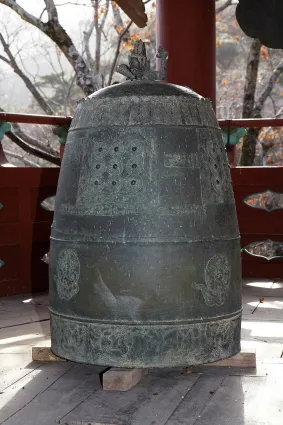
Anjeongsa Bronze Bell, Tongyeong
統營 安靜寺 銅鍾
경상남도 통영시
Basic information
- Designation
- Treasure No.1699
- Category
- Craft
- Designated year
- 2010
- Location
- 통영시, 경상남도— 경남 통영시 광도면 안정1길 363, 안정사 (안정리)
- Coordinates
- 34.943777, 128.395198Kakao address conversion
AI Docent
Coming soonAn AI-generated, friendly retelling of this heritage site is available in Korean. An English version is on our roadmap — for now, please see the official description below.
Description
This bell in the belfry of Anjeongsa Temple was cast in 1580 (the 13th year of King Seonjo’s reign) for a temple named Yongcheonsa Temple, located in Chuwolsan Mountain in Damyang-bu, Jeolla-do. Meanwhile, according to the hanging tablet on the front façade of Manseru Pavilion with information about the origin of this bell, it was purchased in 1908 from Yongchusa Temple at a cost of one thousand gold coins. The name inscribed on the bell, however, is Yongcheonsa, and not Yongchusa. According to Taegosabeop, a modern-era record, Yongchusa was formerly known as Yongcheonsa and is located in Chuwolsan Mountain, in Yong-myeon, Damyang-gun, and what’s more, an anti-Japanese, pro-independence militia was created in this temple, in 1905. Yongcheonsa, therefore, appears to have been renamed no later than 1905. The bronze bell, rather large for an early Joseon bell, stands 115cm tall and measures 68cm in mouth diameter. There is a blackish hue across the surface of this bell. The bell has a rounded shoulder, and there is a sound tube near the crown, wound around by the serpentine body of a dragon. Below the shoulder, the bell is ringed with a band of upward-facing petal motifs in the style of a yeouidumun (a swirling cloud-like design), in shallow relief. The bell flares out starting from the shoulder level, and tapers after the mid-level to a narrower base, into a shape resembling an upside-down jar. The body of the bell, adorned with various design motifs, is divided into two halves by a horizontal line. The top half is ringed with a wide band of lotus petal motifs in relief at the level right below the shoulder section. Beneath the band of lotus petals, a trapezoid-shaped frame, enclosing nine full-bloomed lotus flowers, accompanied by vine scrolls, is repeated in four places. The vine scrolls are further embellished by bead chains placed on either side. On the bottom half of the bell, there are four striking points with lotus and scroll design. The ornamental motifs for the striking points are particularly beautiful; six characters, known as the mantra of Yukja daemyeongwang (meaning literally “Six-syllable Luminescent King”), descend from the sky, on a cloud, while surrounding a swastika symbol amid them. The swastika symbol and the six characters, however, are inverted due to a casting error. The bell has its year of casting and the name of the temple for which it was intended in relief inscription, placed between the trapezoids in the upper half and below them. The names of the metal smiths involved in its creation are also provided, including Gyeo, Jinok and Munheon. The fact that these people were not designated by the title “court painter” and are provided with no surnames suggests that they were monk artisans.
Location
지도를 불러오는 중…
Have you visited this place?
Log in and verify your visit on-site via GPS to record a stamp in My Journey. (QR verification coming later.)
Images: KOGL (khs.go.kr) · Data source: Korea Heritage Service Open API (khs.go.kr)