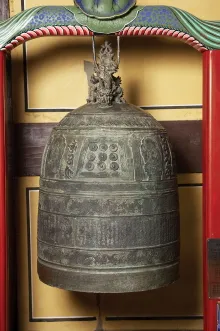
Gogyeonsa Bronze Bell, Geochang
居昌 古見寺 銅鍾
경상남도 거창군
Basic information
- Designation
- Treasure No.1700
- Category
- Craft
- Era
- 조선시대 1630년
- Designated year
- 2010
- Location
- 거창군, 경상남도— 경남 거창군 가조면 의상봉길 1049, 고견사 (수월리)
- Coordinates
- 35.745561, 128.039265Kakao address conversion
AI Docent
Coming soonAn AI-generated, friendly retelling of this heritage site is available in Korean. An English version is on our roadmap — for now, please see the official description below.
Description
This bell, currently kept inside Daeungjeon Hall of Gogyeonsa Temple, was cast in 1630 (the 8th year of King Injo’s reign) for a Buddhist bell of Gyeonamsa Temple, according to the inscription on its surface. Gyeonamsa is another name for Gogyeonsa Temple. Originally called “Gogyeonsa” when it was founded in 667 (the 7th year of the reign of King Munmu during the Silla Period), by Buddhist Monk Wonhyo and Uisang, the temple was renamed “Gyeonamsa” in 1271 (the 2nd year of the reign of King Wonjong during the Goryeo Dynasty) when it was placed under the administrative jurisdiction of the town of Geoje. In subsequent centuries, following the Japanese Invasion of 1592, the temple was left in ruins until it was rebuilt on the initiative of three monks, Unhyeon, Geumbok and Jonghae. Its name was changed back to “Gogyeonsa” at this time. The Bronze Bell of Gogyeonsa Temple is rather large for an early 17th-century bell, measuring 97.2cm in total height and 59.7cm in mouth diameter. The bell has a pale reddish hue throughout its surface. The crown on its deeply sloped shoulder is not accompanied by a sound tube, but only the sculptures of two dragons. The dragons, meanwhile, have the character 王 (wang, meaning ‘king’) on their forehead, a very unusual detail. The bronze bell is shaped like a cannonball in an upside-down position with its sides flaring out slowly, then forming a straight line to a narrower base. The body of the bell is divided into a top and a bottom half by three horizontal lines. In the upper half, below the shoulder of the bell, wide lotus petal motifs are placed in relief sculpture. Below the lotus petals, there are four trapezoids, surrounded by bands of scroll designs and enclosing nine full-bloomed lotus flowers. The trapezoids are interspersed by a series of ornamental designs including Buddhist statues, pagodas, Sanskrit characters and tablets with names of Buddhist deities. These designs are distributed in an identical manner on all sides of the bell. The area below is adorned with a band of lotus and scroll designs. Of the designs placed between the trapezoids, the seated Buddha statue and the pagoda designs are very distinctive in style and are unprecedented in any other Joseon-period bronze bell. The seated Buddha statue, seated cross-legged on a square throne adorned with lotus flowers, assumes one of the nine mudras of Amitabha, and the three-story pagoda surmounted by a roof stone has lotus motifs. The decoration in the bottom half is simple, compared to the top half. The area above the inscription providing the date when the bell was cast is adorned with lotus and scroll designs, and the area below has wave motifs and dragons amid clouds. The dragons, lively and realistic, are highly flattering. The inscription found on this bell, meanwhile, provides unusually thorough and detailed information about the circumstances of its creation, including the chronology of Gogyeonsa Temple and the length of time taken and materials used for the casting of the bell. This well-preserved bronze bell, impressive for the quality of casting, is also considered invaluable for being a work of Seolbong, a pioneering monk artisan of the early 17th century.
Location
지도를 불러오는 중…
Have you visited this place?
Log in and verify your visit on-site via GPS to record a stamp in My Journey. (QR verification coming later.)
Images: KOGL (khs.go.kr) · Data source: Korea Heritage Service Open API (khs.go.kr)