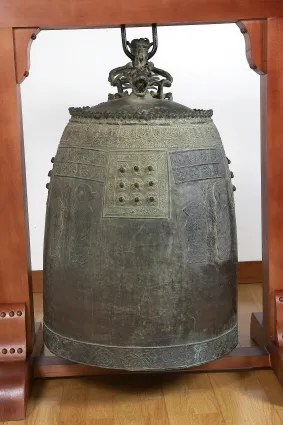
Ssanggyesa Bronze Bell, Hadong
河東 雙磎寺 銅鍾
경상남도 하동군
Basic information
- Designation
- Treasure No.1701
- Category
- Craft
- Designated year
- 2010
- Location
- 하동군, 경상남도— 경남 하동군 화개면 쌍계사길 59, 쌍계사 (운수리)
- Coordinates
- 35.228800, 127.589200Museum-based location
AI Docent
Coming soonAn AI-generated, friendly retelling of this heritage site is available in Korean. An English version is on our roadmap — for now, please see the official description below.
Description
This bronze bell, currently on display in the Seongbo Museum of Ssanggyesa Temple, is quite large for a late Joseon bell, measuring 94cm in total height and 62cm in mouth diameter. The surface of the bell has a blackish hue, and the crown above its round and sloping shoulder is in the shape of two dragons and has a sound tube. In the area below the shoulder, the bell is ringed with a band of upward-facing lotus petal motifs at narrow intervals. The sides of the bell are gently curved until the mid-belly level before they descend to a narrow base, forming almost straight lines. The surface of the bell is decorated with various designs in high relief. Two bead bands run below the shoulder, and the space between the two bands is densely filled with lotus and scroll designs. In the area beneath, four trapezoids enclosing lotus flowers and four circles enclosing Sanskrit characters are placed alternately. Each of the trapezoids surrounded by a band of lotus and scroll designs on four sides contains nine full-bloomed lotus flowers. Meanwhile, inside each circle, characters of two mantras are distributed along the circumference. The empty spaces between the trapezoids are filled with four standing Bodhisattvas and four tablets. The Bodhisattva is shown descending from the sky, riding on a cloud, with a lotus flower in the hands. The tablet is inscribed with a phrase of prayer for the safety and prosperity of the royal house and the propagation of Buddhism. Finally, the bell is ringed, toward the base, with a belt of lotus and scroll designs. The inscription in intaglio, located at the mid-level, provides the date of casting and the name of the temple for which it was made: cast in the year of sinsa and housed in Ssanggyesa Temple. The year of sinsa, referenced here, appears to be 1641 (the 19th year of King Injo’s reign), judging from the date of reconstruction of this temple. The tablet with the chronology of Ssanggyesa Temple, carved in 1857, indicates that after its destruction during the Japanese Invasion of 1592, the temple was left in ruins until it was rebuilt during the Chongzhen era (11628-1644) by two famous Zen masters of late Joseon; namely, Buddhist Monk Gakseong (1575-1660) and Taeneung (1562-1649). The year during the period of reconstruction, which corresponds to sinsa in the sexagenary cycle, is 1641. Meanwhile, even though the inscription does not contain any mention about the artisans who made the bell, it is likely that they were the same as the artisans who were mobilized for the reconstruction of the temple. The Bronze Bell of Ssanggyesa Temple, a well-preserved large temple bell, holds particular significance for the understanding of the new stylistic characteristics that emerged in late Joseon, in the wake of the Japanese Invasion and the Manchu Invasion it faithfully embodies. An early example of late Joseon bells showcasing the typical style of this period, displaying great workmanship, this bell can also cast light on the milieu of monk artisans of the 17th century.
Location
지도를 불러오는 중…
Have you visited this place?
Log in and verify your visit on-site via GPS to record a stamp in My Journey. (QR verification coming later.)
Images: KOGL (khs.go.kr) · Data source: Korea Heritage Service Open API (khs.go.kr)