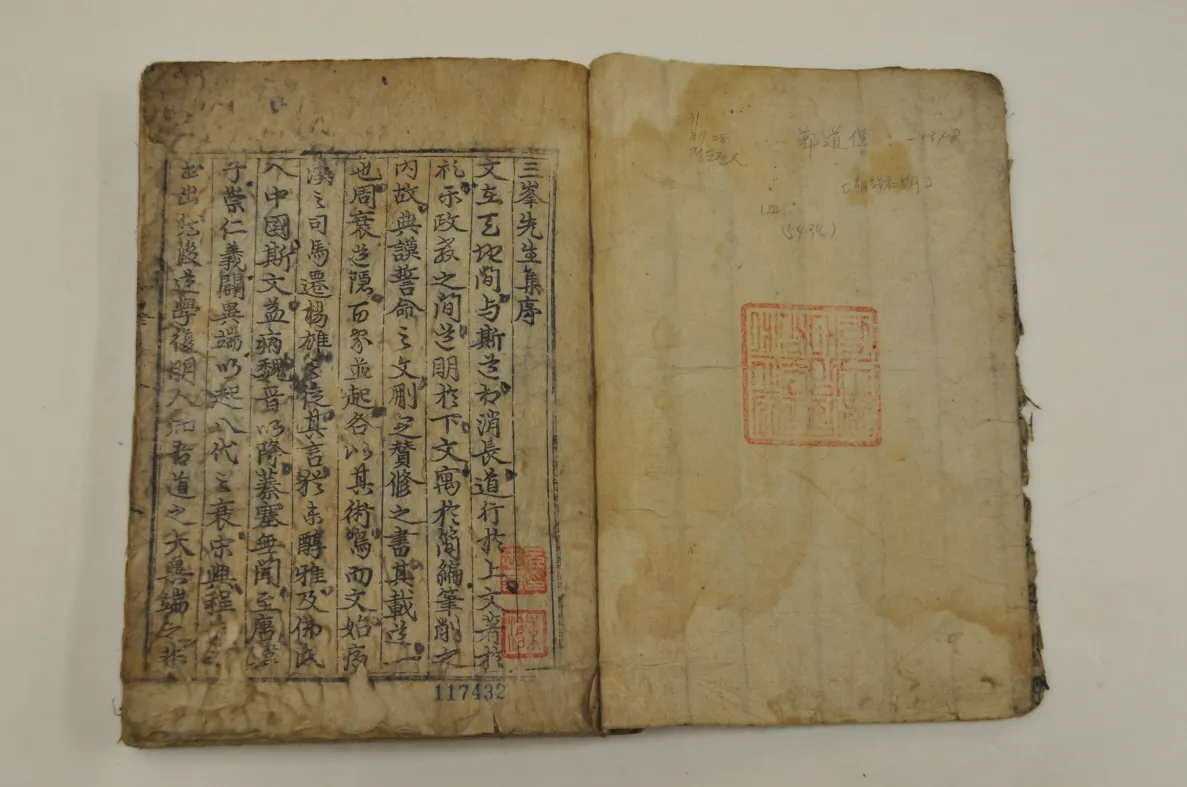
Sambongseonsaengjip Gwon1
三峯先生集 卷一
대구광역시 달서구
Basic information
- Designation
- Treasure No.1702
- Category
- Books & Records
- Era
- 1465년
- Designated year
- 2011
- Location
- 달서구, 대구광역시— 대구 달서구 달구벌대로 1095 (신당동,계명대학교성서캠퍼스)
- Coordinates
- 35.855906, 128.484579Kakao address conversion
AI Docent
Coming soonAn AI-generated, friendly retelling of this heritage site is available in Korean. An English version is on our roadmap — for now, please see the official description below.
Description
Sambong seonsaengjip is the collected works of Jeong Do-jeon (1342-1398, pen-name: Sambong), a scholar-official of late Goryeo to early Joseon. This book is the first volume of the second edition published in 1465 (the 11th year of King Sejo’s reign). The works included in this collection were selected by Gwon Geun (1352-1409) in 1397 (the 6th year of King Taejo’s reign), while Jeong Do-jeon was still alive, from the manuscripts kept by the latter’s son Jeong Jin (1361-1427). The bijeom (round dots placed in poems by their critical reviewers to mark their approval of certain passages) were added by Seong Seok-rin (1338-1423). The first edition was prefaced by Gwon Geun. Soon after the publishing of the first edition, Jeong Do-jeon was put to death in 1398, for his involvement in the First Princely Coup D’etat, and the printing blocks were dispersed and disappeared subsequent to this event. The second edition was published in 1465 (the 11th year of King Sejo’s reign) by his great-grandson, Jeong Mun-hyeong (1427-1501), while the latter was the Governor of Gyeongsang-do. The second edition was augmented by adding three other works of Jeong Do-jeon – Gyeongje mungam (Mirror for Governance), Joseon gyeonggukjeon (Administrative Code of Joseon) and Bulssi japbyeon (Array of Critiques against Buddhism) – and was prefaced by Sin Suk-ju (1417-1475). The seven-volume publication was printed in Andong-bu, with woodblocks, and the blocks were stored there, after the printing was completed. A third edition was published thereafter, also by Jeong Mun-hyeong, in 1487 (the 18th year of King Seongjong’s reign) by adding other poems and writings of Jong Do-jeon he collected from various parts of the country – one hundred-twenty sheets of manuscripts – and Gyeongje mungam byeoljip (Appendix to the Mirror for Governance). Additional printing blocks were carved in Gangneung for this eight-volume set and were stored in Andong, along with the woodblocks for the second edition, after the completion of printing. Finally, centuries later in 1791 (the 15th year of King Jeongjo’s reign), Sambong seonsaengjip of Jeong Do-jeon was completely re-edited and proof-read in Gyujanggak on the order of the king, and this re-edited version was printed with woodblocks in Daegu, with the woodblocks stored there after the printing. This fourth edition, consisting of fourteen total volumes (seven books), is the version that is currently circulating. There are slight differences between these four editions of Sambong seonsaengjip. While in the first edition, each volume has the phrase “Selected by Seong Seok-rin, Annotated by Gwon Geun in Andong” below the volume title, and the text is highlighted by bijeom, both the phrase and bijeom are absent in the second edition. The image of the fish tail in the middle of the printing blocks is also different between these two editions. The third edition is made up of eight volumes, unlike the two earlier editions consisting of seven volumes. Finally, the fourth edition, consisting of far more numerous volumes (fourteen volumes) than others, is also marked by bijeom. This book containing literary works of Jeong Do-jeon, a key contributor to the founding of Joseon, is of great significance due both to the historical importance of its author and the interest of its contents. Meanwhile, as the sole surviving copy of Sambong seonsaengjip, this book’s value is literally inestimable.
Location
지도를 불러오는 중…
Have you visited this place?
Log in and verify your visit on-site via GPS to record a stamp in My Journey. (QR verification coming later.)
Images: KOGL (khs.go.kr) · Data source: Korea Heritage Service Open API (khs.go.kr)