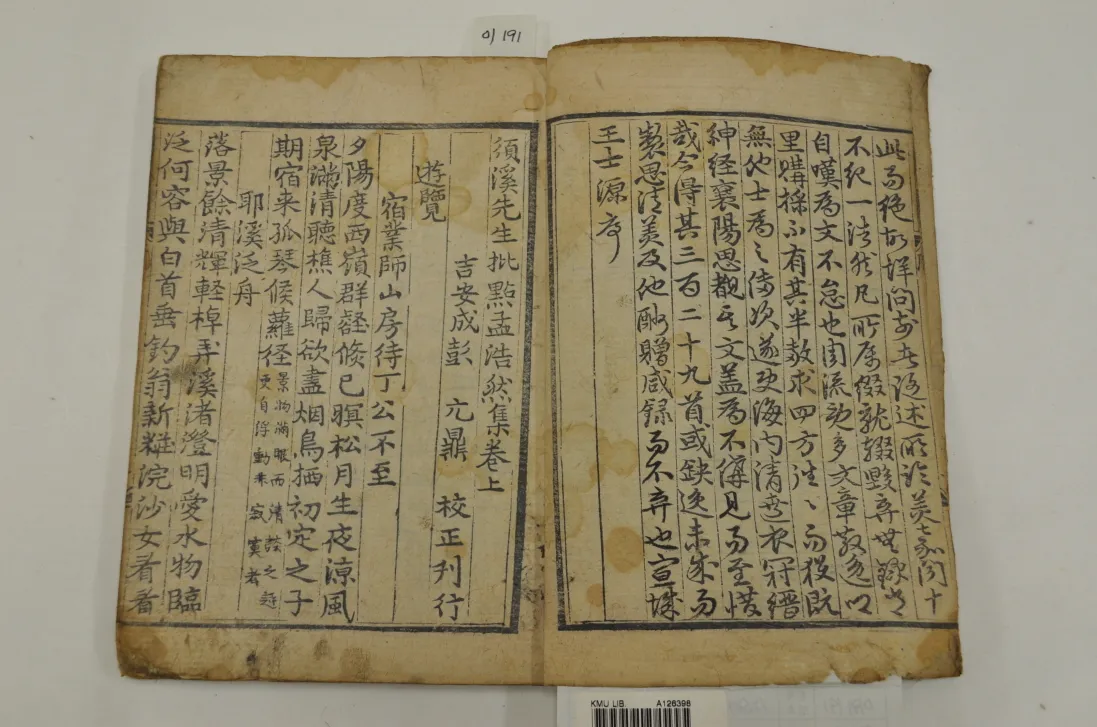
Sugyeseonsaengbijeommaenghoyeonjip
須溪先生批點孟浩然集
대구광역시 달서구
Basic information
- Designation
- Treasure No.1703
- Category
- Books & Records
- Era
- 조선 세종 27년(1445년)
- Designated year
- 2011
- Location
- 달서구, 대구광역시— 대구 달서구 달구벌대로 1095 (신당동,계명대학교성서캠퍼스)
- Coordinates
- 35.855906, 128.484579Kakao address conversion
AI Docent
Coming soonAn AI-generated, friendly retelling of this heritage site is available in Korean. An English version is on our roadmap — for now, please see the official description below.
Description
Sugye seonsaeng bijeom Maeng Ho-yeon jip (Collection of Meng Haoran’s Poems Highlighted by Yu Jin-hong) contains poems by Meng Haoran, a major poet of the High Tang era, known for his focus on the natural world. This book was printed in 1445 (the 27th year of King Sejong’s reign), by Namwon’s county administration, with woodblocks carved based on an annotated edition with bijeom (round dots placed in poems by their critical reviewers to mark their approval of certain passages) by Yu Jin-hong (Liu Chenweng in Chinese), a man of letters of the late Song to the early Yuan period, and proofread by a certain Cheng Peng, native of Jian. Two hundred-four poems by Meng Haoran, included in this three-volume collection, are organized by theme. The first volume contains fifty-seven poems on themes related to touring scenic sites, and thirty-one conversational poems; and the second volume contains thirty poems on travel-related themes, and thirty-six on themes related to separation and farewell. The third and last volume contains seventeen poems on music and merrymaking, fifteen on life’s sorrows and regrets and nineteen on pastoral living. Annotations, rather minimal, are written in two lines of small characters. The postscript offers detailed information about the background and circumstances of the publication of this book. According to this postscript, the publishing of Meng Haoran’s poetry was an idea that Jo Won-bok, an advisor to the Governor of Jeolla-do, proposed in 1445, to Han Jeon, then, the Governor of Jeolla-do. The carving of printing blocks was sponsored jointly by Han Jeon and Yu Han-saeng, the Magistrate of Namwon. Jo Won-bok asked Sin Ja-gyo, who was staying in Nawon at that time to guard his late father’s grave as part of the customary mourning process, to write the manuscript that served as the base text for the printing blocks and also to contribute a postscript. Han Jeon, meanwhile, was a brother of Han Hwak, the father of Queen Dowager Insu, and Sin Ja-gyo, a cousin of the famous scholar-official Sin Suk-ju. The postscript is followed by the list of people who participated in the publishing of this book in various capacities; which provides further light on its circumstances. Although Sugye seonsaeng bijeom Maeng Ho-yeon jip was based on a Yuan-dynasty edition of the same book, a new manuscript was drafted for the carving of its printing blocks, rather than carving the blocks directly from the printed book, as can be gathered from the information provided by the postscript; hence, the particular significance of this publication for research into early Joseon books and publishing.
Location
지도를 불러오는 중…
Have you visited this place?
Log in and verify your visit on-site via GPS to record a stamp in My Journey. (QR verification coming later.)
Images: KOGL (khs.go.kr) · Data source: Korea Heritage Service Open API (khs.go.kr)