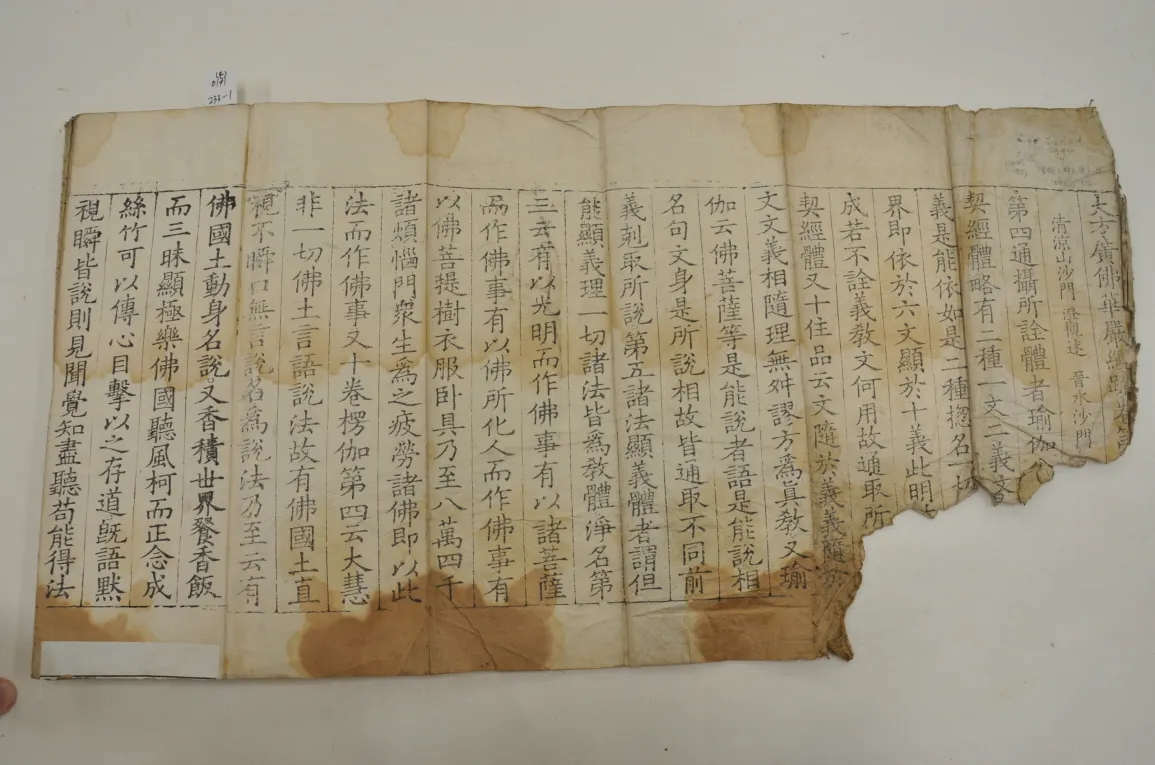
Daebanggwangbulhwaeomgyeongso
大方廣佛華嚴經疏
대구광역시 달서구
Basic information
- Designation
- Treasure No.1707
- Category
- Books & Records
- Designated year
- 2011
- Location
- 달서구, 대구광역시— 대구 달서구 달구벌대로 1095 (신당동,계명대학교성서캠퍼스)
- Coordinates
- 35.855906, 128.484579Kakao address conversion
AI Docent
Coming soonAn AI-generated, friendly retelling of this heritage site is available in Korean. An English version is on our roadmap — for now, please see the official description below.
Description
Commentary on the Avatamsaka Sutra (The Flower Garland Sutra) is a commentary on the Avatamsaka Sutra, one of the canonical scriptures of Mahayana Buddhism with annotations by Cheng Deng of the Tang Dynasty and comments by Jing Yuan of the Song Dynasty. The central idea expressed in this sutra is the unity of Buddha and sentient beings. This sutra is the most fundamental text for Korean Huayan Buddhism and has had a seminal influence on Korean Buddhist philosophy, along with the Saddharmapundarika Sutra (The Lotus Sutra). This text is the 41st of the 120 total volumes printed with woodblocks sent by the author Jing Yuan to the Goryeo monk Uicheon, through a Song merchant named Seo Jeon (Xu Jian in Chinese). The annotations and comments were added to the Zhou version of the Avatamsaka Sutra. This copy, printed on a paper dyed with oak galls, is in a decent state of preservation. The title on the cover page and the title in the middle of the sheet are written in gold. As for the page layout, the top and bottom borders are both in a single line, and each line contains fifteen characters. Each sheet is folded into five sections, and the number of the block is specified for ease of use and storage. All sheets are mulberry paper sheets and show traces of having been smoothened to create a glossy surface and prevent the bleeding of ink. At the end of Volume 83, there is an ink-written text with a reference to the year 1552. This note, however, does not appear to be printing information added at the time of printing, but, rather a note added by the owner of the book. The text is in a typical style of Ouyang Xun, a style highly popular in Song-dynasty books. Given how the print translates well the strokes of each character, this text is likely to have been printed relatively soon after the carving of the wooden blocks. In Korea, since the first printing of this book with woodblocks brought by the Song merchant Xu Jian, in 1087 (the 4th year of the reign of King Seongjong during the Goryeo Dynasty), other copies were made as needed, thereafter. Some prints had illustrations printed with woodblocks carved in Korea, added at the beginning (of Volume 41). The existence of such illustrations, therefore, may be used as an indicator when dating different copies of this book. The woodblocks of this sutra are said to have been given to Japan which had made numerous requests for a set of Tripitaka Koreana woodblocks, in 1424 (the 6th year of King Sejong’s reign). Several other copies of this same text have been already designated as Treasures. Commentary on the Avatamsaka Sutra is a particularly important text insofar as its woodblocks were made in Song China, upon a specific request from Goryeo, and this fact is well documented in historical records. These imported printing blocks, as they were later re-exported to Japan, hold also great significance for the history of Buddhist exchanges between China, Korea and Japan. Meanwhile, this book is also important for the light it casts on the monk Uicheon’s project for making a compendium of sutra commentaries and as a piece of physical evidence to the transmission of the printing blocks brought from the Song Dynasty to posterity, giving also a concrete idea about their appearance.
Location
지도를 불러오는 중…
Have you visited this place?
Log in and verify your visit on-site via GPS to record a stamp in My Journey. (QR verification coming later.)
Images: KOGL (khs.go.kr) · Data source: Korea Heritage Service Open API (khs.go.kr)