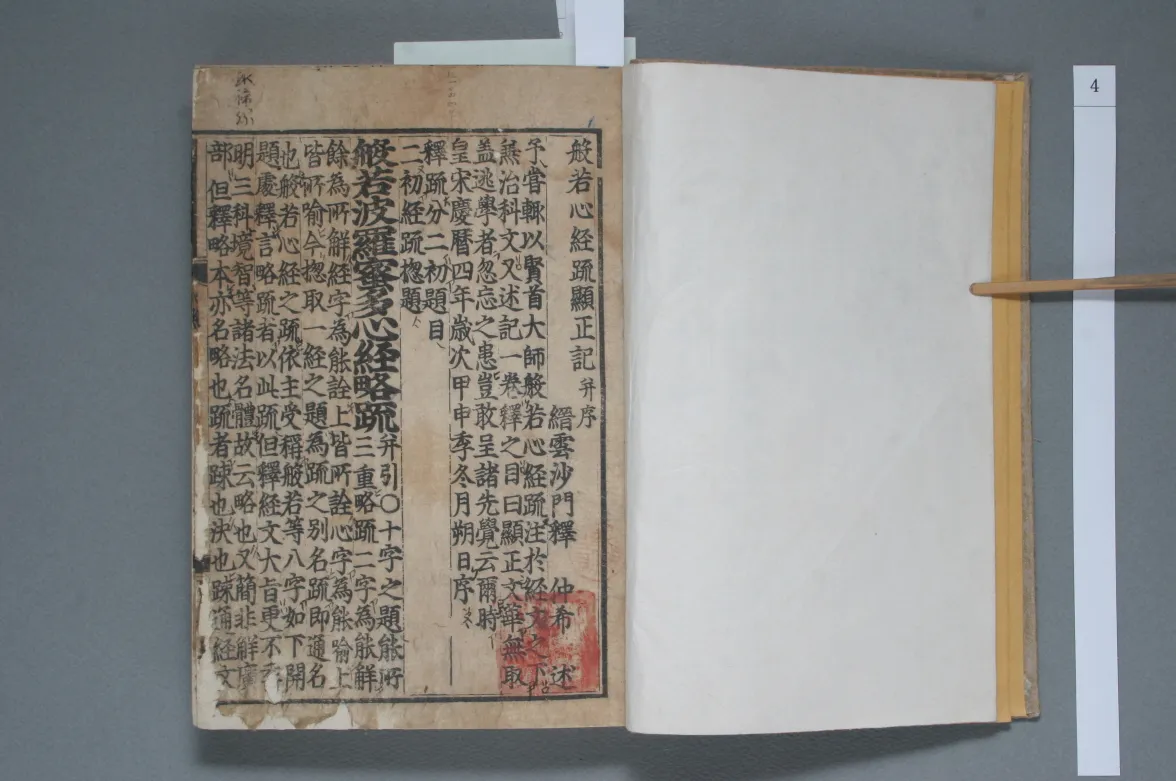
Banyasimgyeongsohyeonjeonggi(eonhae)
般若心經疏顯正記(諺解)
경기도 양주시
Basic information
- Designation
- Treasure No.1708
- Category
- Books & Records
- Era
- 1495년(연산군1)
- Designated year
- 2011
- Location
- 양주시, 경기도— 경기도 양주시 호국로550번길 346-11 (장흥면)
- Coordinates
- 37.710568, 126.989972Kakao address conversion
AI Docent
Coming soonAn AI-generated, friendly retelling of this heritage site is available in Korean. An English version is on our roadmap — for now, please see the official description below.
Description
This is the Korean translation of the Commentary on the Maha prajnaparamita hridaya Sutra (The Heart Sutra) by the Tang monk Fazang and Hyeongjeonggi (Xianzhengji in Chinese) by the Song monk Zhongxi. These texts were translated into Korean, in 1464, by Prince Hyoryeong and Han Gye-hui on the order of King Sejo, and the woodblocks were carved in the Directorate of Buddhist Publications, during the same year. This particular copy was printed in 1495 using the woodblocks carved in 1464. The title literally means the ‘sutra of the heart that attains the perfect state of nirvana through the light of wisdom’; in other words, the ‘compendium of essential teachings from the various perfection of wisdom (Prajnaparamita) sutras.’ This sutra summing up central ideas of major perfection of wisdom sutras, published over centuries, in two hundred-sixty characters is one of the shortest Buddhist sutras. The Heart Sutra is always recited in Korea, during all Buddhist rites. One of the key concepts in this sutra is ‘gong (emptiness: sunyata).’ Literally meaning ‘emptiness,’ it also expresses the notion that as physical beings are in a perpetual state of change in relation to one another, even if they may exist as phenomena, there is no way to comprehend them in their essence or being. Copies of this book, published by the Directorate of Buddhist Publications during King Sejo’s reign are currently held in Jajaeam Hermitage in Dongducheon, Gyujanggak in Seoul National University and the Cheongju Early Printing Museum. The copy in Jajaeam (Treasure No. 1211), for example, has, at the beginning of the book, a text written by Hwang Su-sin in 1464 and titled “Jingeumganggyeong simgyeongjeon,” and at the end, a postscript by Han Gye-hui, written during the same year; both of which are absent in this copy. Therefore, when the version to which this copy belongs was printed in the later years of King Seongjong’s reign, these two texts were omitted, replaced by a postscript by Hakjo, written in 1495 and printed with the eulhae type. The title at the head of the volume “Commentary on the Maha prajnaparamita hridaya Sutra and Xianzhengji” is followed by a short phrase about the author; “Jiunsamun Yeokjungchisul.” Meanwhile, in the fifth line, there is the title “Abridged Commentary on the Maha prajnaparamita hridaya Sutra”, and its contents occupy the fourteen first sheets. The Heart Sutra proper begins at the fifteenth sheet, accompanied by annotations and comments. The quality of printing is decent overall with no blurry characters, although printed with woodblocks that had been previously used many times. Hangeul characters in Gothic style are square in the overall shape, and Chinese characters are in the calligraphy style of Yan Zhenqing. Given this book’s similarity in calligraphy style to the 1467 edition of Susimgyeol (Secrets on Cultivating the Mind), the calligraphers who wrote the base text for this book could be the same as those who wrote the latter; namely, Anhye, Yuhwan and Bakgyeong. The book is printed on a coarse type of mulberry paper, and not on gojeongji (paper made of oat and straw) as is the case with the first edition. This type of paper appears to have been used for Buddhist scripture printing from the later part of King Seongjong’s reign to King Jungjong’s reign during the Joseon Dynasty. Meanwhile, the top and bottom page margins were unfortunately cut off during a restoration work done sometime in the past. This Korean-translated sutra, printed in 1495 (the first year of King Yeonsangun’s reign), is missing Comments to the Vajracchedika prajnaparamita Sutra (The Diamond Sutra) and the postscript by Han Gye-hui that are included in the first edition printed in 1464 (the tenth year of King Sejo’s reign), but has a new postscript by Hakjo. It is invaluable for the comparative study of versions of this Korean-translated sutra.
Location
지도를 불러오는 중…
Have you visited this place?
Log in and verify your visit on-site via GPS to record a stamp in My Journey. (QR verification coming later.)
Images: KOGL (khs.go.kr) · Data source: Korea Heritage Service Open API (khs.go.kr)