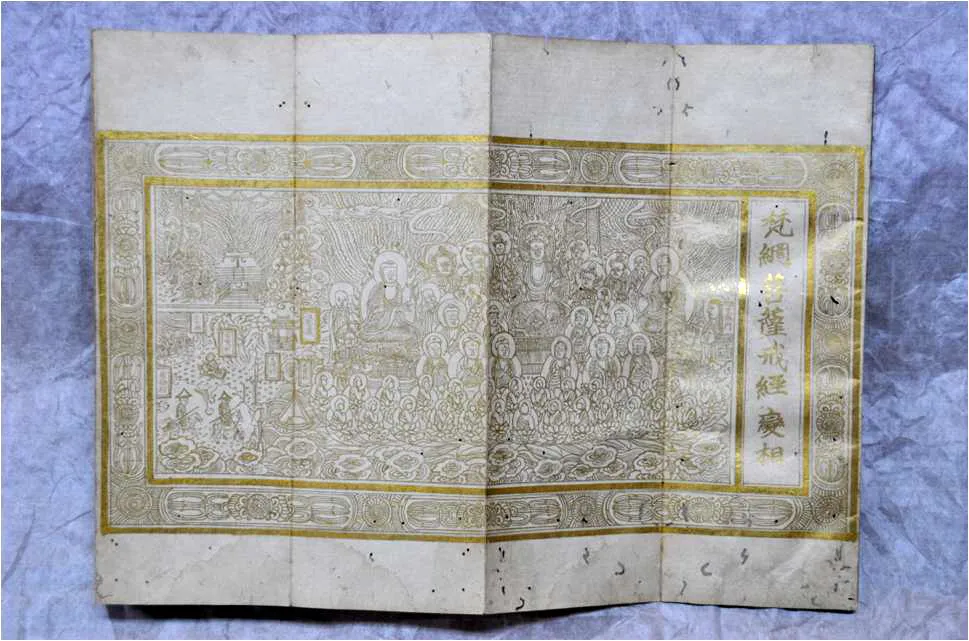
Baekjigeumni Beommangbosalgyegyeong
白紙金泥 梵網菩薩戒經
충청북도 단양군
Basic information
- Designation
- Treasure No.1714
- Category
- Books & Records
- Era
- 1364년(공민왕13)
- Designated year
- 2011
- Location
- 단양군, 충청북도— 충청북도 단양군 백자길 9 (영춘면, 대한불교천태종 불교천태중앙박물관)
- Coordinates
- 37.043564, 128.485169Kakao address conversion
AI Docent
Coming soonAn AI-generated, friendly retelling of this heritage site is available in Korean. An English version is on our roadmap — for now, please see the official description below.
Description
This Transcription of Brahmajala Sutra (The Sutra of Brahma’s Net) in Gold on White Paper is a hand-copied sutra, dating from 1364 (the 13th year of the reign of King Gongmin during the Goryeo Dynasty). The text is written in gold on sheets of lined white mulberry paper. The second volume is about the ten major vows and minor vows of the Bodhisattvas. Meanwhile, the scene of Buddha’s sermon, discussed in this sutra, appears to be in continuity with that in the Avatamsaka Sutra (The Flower Garland Sutra). This is the reason why the Brahmajala Sutra is regarded by many as the conclusion of the Avatamsaka Sutra. This Mahayana Buddhist text, as it deals with the code of conduct for the Bodhisattvas, is considered extremely important in Korea, as well as in other East Asian countries such as China and Japan. Although in decent condition overall, the book shows some minor insect damages. The cover and back pages appear to have been repaired sometime in the recent past. Although the title on the indigo-colored cover page is no longer legible, the cover page itself is almost intact, as well as the inside pages. The hand-copied sutra begins with an illustration, and the text, written in gold, is organized in the order of ‘Moral Code of the Bodhisattvas,’ ‘Vairocana Speaks of the Bodhisattva Precepts,’ ‘Induction into the Bodhisattva Precepts’ and ‘Etiquette for the Transmission of the Bodhisattva Precepts.’ If excluding the page with the illustration, the sutra consists of fifteen sheets, and all sheets are written on both sides, except for the first sheet. Each page, including the front and back sides of the sheets, has six gold lines. The front side of all sheets, and the back side of the first three sheets are bordered at the top and bottom with two parallel horizontal lines, and all other pages are bordered with single lines. The afterword added at the end provides concrete background information about this sutra. According to this information, the sutra was written in the fifth lunar month of 1364, in the hand of Jiam, and the illustration was drawn by Muoe. A monk named Gyewon made arrangements for this sutra hand-copying project, which was funded by Lady Yi who was the wife of Prince Gangyang, according to the same afterword. The widow of Prince Gangyang made donations toward this project, to implore Buddha’s mercy on the souls of her late husband and daughter. Meanwhile, at the tail end of the volume, there is an ink-written note which informs that the sutra was donated to a Japanese temple, in February 1595, by a certain Japanese man. This hand-copied sutra with text written in gold is nearly intact with no missing pages, and the illustration at the head of the volume is of outstanding quality as well. The information provided about the circumstances of its transcription and the place the hand-copied sutra was later housed is quite thorough and well detailed. Meanwhile, the fact that this sutra had left the country and had been repatriated in the recent past adds further interest to it, making it indeed worthy of a place in the list of government-protected cultural heritage objects.
Location
지도를 불러오는 중…
Have you visited this place?
Log in and verify your visit on-site via GPS to record a stamp in My Journey. (QR verification coming later.)
Images: KOGL (khs.go.kr) · Data source: Korea Heritage Service Open API (khs.go.kr)