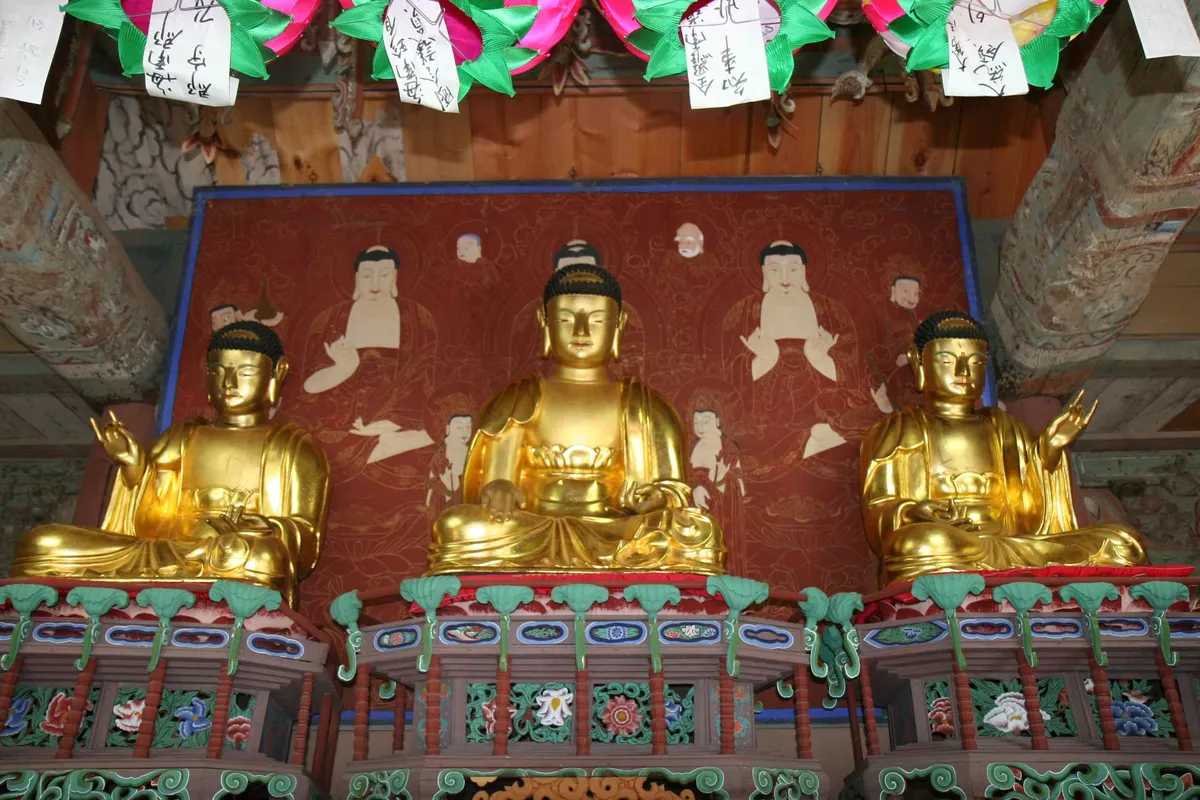
Seodongsa Mokjoseokgayeoraesambul Seated Figure, Haenam
海南 瑞洞寺 木造釋迦如來三佛坐像
전라남도 해남군
Basic information
- Designation
- Treasure No.1715
- Category
- Sculpture
- Era
- 조성: 효종1, 중수: 1804년(순조 4)
- Designated year
- 2011
- Location
- 해남군, 전라남도— 전남 해남군 화원면 금평리 571 서동사
- Coordinates
- 34.689406, 126.310316Kakao address conversion
AI Docent
Coming soonAn AI-generated, friendly retelling of this heritage site is available in Korean. An English version is on our roadmap — for now, please see the official description below.
Description
Seodongsa is a branch temple of Daeheungsa Temple, the head temple of the 22nd parish of the Jogye Order of Korean Buddhism. The history of this temple nestling on a slope of Ungeosan Mountain is not well known. Its general chronology, however, could be gathered from the information found in a building repair record dated 1870, discovered during a roof repair work in the 1980s, and on a hanging tablet inscribed with a text also related to the repair of the temple, dated the same year. These two records report that Seodongsa Temple ‘is said to’ have been founded by Choe Chi-won (pen-name: Goun) sometime during the reign of Queen Jinseong (r. 887-896) of Unified Silla. Centuries later, during the Imjin War (more precisely during the 2nd Japanese Invasion of 1597), the temple was completely consumed by fire. According to the same two records, it was rebuilt in 1779, and was renovated about ninety years later, in 1780, on the initiative of the monks Uiyun, Jeonggi and Jinil. Some Buddha statue-related records were discovered about twenty years ago, by the monk Hwasan, after a burglary in the temple. According to these records, the Sakyamuni Buddha triad was created in the winter in 1650 (the first year of the reign of King Hyojong during the Joseon Dynasty), by eight monk sculptors, including Unhye, under a project sponsored jointly by Seodongsa’s monks and ordinary members of the temple’s parish, and supervised by Okbo. Renovation work was done to these statues one hundred fifty-four years later, in 1804 (the fourth year of King Sunjo’s reign). The statues were re-gilded at this time, by a group of nineteen monk artists and artisans, including Punggyesunjeong. Unhye, the monk sculptor who is the author of this Buddha triad, initially emulated Suyeon, an early 17th-century monk sculptor whose works were characterized by a massive feel and thick and forceful lines, but, later forged his own style under the latter’s influence to become a major monk sculptor of the mid to late 17th century. The Buddha triad in Daeungjeon Hall of Seodongsa Temple represents the Buddhas of the Three Ages, including Sakyamuni Buddha, the master of Sahalokadhatu (World of Suffering), and Bhaisajyaguru Buddha and Amitabha Buddha seated to his left and right, ruling over the Full Moon World and the Western Paradise, respectively. This type of Buddha triads was highly popular during the 17th century, along with Vairocana Buddha triads. Aside from philosophical or doctrinal reasons, there must have been also practical reasons behind this popularity of triad Buddha sculptures. This phenomenon probably owed to the fact that in the wake of several major wars that had raged the country, including the Japanese Invasion of 1592 and 1597 and the Manchu Invasion of 1627, they lacked resources for rebuilding all worship halls destroyed during the wartime. In other words, due to the scarcity of resources and lack of space, they must have started to house Buddha statues representing different religious persuasions or that are worshipped in different cults in the same room. All three Buddhas are made by assembling individual parts. Sakyamuni Buddha, the main Buddha, has his robe draping down from the left shoulder, leaving the right shoulder bare, and is seated on a seat surrounded by upward-facing lotus petal motifs above an octagonal throne, in a cross-legged position. The hemispherically-shaped top half of Buddha’s head is densely covered with conch-shaped curls that were separately made and glued. The ushnisha, meanwhile, is rather indistinct. The head is adorned with cudamanis at the mid-level and at the summit. The cudamani at the mid-level of the head is large and crescent-shaped. The oblong face with a narrow chin has a nose which juts out sharply at the level of the lower bridge and a pair of tightly-sealed lips; which gives this face a lot of personality as well as makes it look rather stern. The ears, shaped like a side-lying letter ‘W,’ are quite stylized and abstract, and have two long grooves along the top and bottom ridges. Ears with such shape are, in fact, a signature feature of works by the monk sculptor Unhye. The folds in the robe baring the right shoulder, rendered in high relief, are slightly exaggerated. These unnatural-looking folds form some sort of bumps which appear almost like an extra-layer of clothes. Unnecessary folds are, however, eliminated in the upper body which is, as a result, elegantly simple. On the other hand, folds in the bottom garment of the lower body are strongly emphasized. The somewhat exaggerated effect of the deep, flexible and lively folds in the lower body is offset by the simplicity of an upper body, highly minimalistic in the expression of drapery. The scalloped bottom edge of the lower garment, shaped like a chain of petals, provides an accent alleviating the monotony of the otherwise rather plain upper body. The folds near the left knee, in the shape of a large pouch, and the narrow arched-shaped folds on the left side of the body strike particularly as unusual and original. The Buddha assumes the bhumisparsa mudra, and the upward facing palm of the left hand shows criss-crossed lines in the shape of a pound sign. Garment folds, shaped like the letter ‘L’ with a rounded, arched corner, near the knees, accompanied by folds that are flowing like waves of water, and the palms lined into the shape of the pound sign are considered telltale features of sculptures by Unhye.The statues of Bhaisajyaguru Buddha and Amitabha Buddha that are the left and right attendant Buddhas both assume a mudra in which the thumb is joined with the tall finger, but in a manner symmetric to each other. Meanwhile, unlike the main Buddha, the two attendant Buddhas are dressed in two layers of garments. Amitabha Buddha assumes the mudra of the lower grade, middle birth. Bhaisajyaguru Buddha assumes the same mudra, but in a left-and-right inverted position, with a small medicine jar in the left palm. While the fingers of the two attendant Buddhas are longer and more delicate than those of the main Buddha, they have the same palms like the latter’s, lined in the shape of the pound sign. The clothes are rendered excessively thick and rather awkward, as was the case with the clothes of the main Buddha. But, this detail is not so unsightly as to undermine, or distract from, the overall elegance of the sculpture. The main Buddha baring his right shoulder and the two attendant Buddhas dressed in two layers of garments are features frequently seen in 17th-century triad sculptures. This triad is very illustrative of the style of Unhye, one of the monk sculptors who participated in its creation as the head of the monk sculptor group, particularly regarding facial and bodily features. Meanwhile, as the earliest of the surviving works of Unhye, this Buddha triad is considered highly significant for the understanding of 17th-century Joseon Buddhist sculpture and the procedures of repairing and re-gilding Buddhist statues that were customary during this period.
Location
지도를 불러오는 중…
Have you visited this place?
Log in and verify your visit on-site via GPS to record a stamp in My Journey. (QR verification coming later.)
Images: KOGL (khs.go.kr) · Data source: Korea Heritage Service Open API (khs.go.kr)