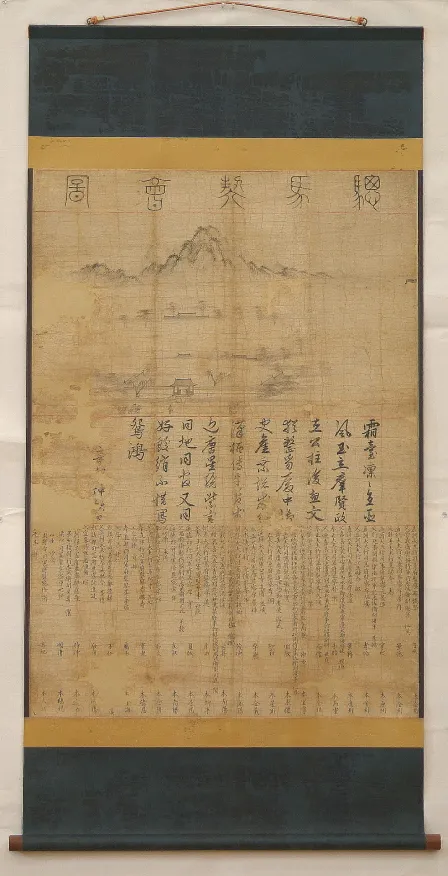
Chongmagyehoedo
驄馬契會圖
전라남도 나주시
Basic information
- Designation
- Treasure No.1722
- Category
- Painting
- Era
- 1591년
- Designated year
- 2011
- Location
- 나주시, 전라남도— 전라남도 나주시 고분로 747 (반남면, 국립나주박물관)
- Coordinates
- 35.018700, 126.707300Museum-based location
AI Docent
Coming soonAn AI-generated, friendly retelling of this heritage site is available in Korean. An English version is on our roadmap — for now, please see the official description below.
Description
This Chongma gyehoedo (Gathering of Officials of the Inspector-general) is a 16th-century gyehoedo (painting on the gathering of officials) with a precisely known date of creation and whose owner is also identified. One learns from the background information provided in the verses written below the painting, and the chronologies of the participants of this meeting that it was painted in the eighth lunar month in 1591. While the date of creation is known for most gyehoedo, including those gyehoedo designated as a cultural heritage object, the name of their owner is rarely known. The identity of the owner permits to trace the path of transmission of a gyehoedo, at the same time as casting some light on the background to its creation; enabling, in sum, an in-depth empirical study by linking with other documentary sources of information. It is also known where Chongma gyehoedo was successively housed and how it changed hands. This painting was brought into the possession of Park Ji-su, a scion of the Miryang Park Clan and a native of Wolgok-ri, Neungju, Jeollanam-do, in the eighth lunar month in 1591 when he was appointed as an inspector of Saheonbu (also known as Chongma which was a government agency equivalent to today’s government audit office). Thereafter, Chongma gyehoedo was passed down in Park Ji-su’s family as an heirloom, along with other personal effects of his, including letters from the king appointing him to various government positions. It was later moved to Chunghyosa Shrine in 1598 (the 31st year of King Seonjo’s reign), when this shrine was constructed to commemorate Park Ji-su’s scholarship and integrity, on the proposal of local Confucian scholars. Chunghyosa was shut down during the reign of King Gojong, on the order of Heungseon Daewongun banning Confucian academies in 1879 (the 16th year of King Gojong’s reign). Memorial services are currently held in this shrine for Park Ji-su and his son Park Cheon-su. Chongma gyehoedo was housed in Chunghyosa until the 1990s and was, thereafter, managed by the Miryang Park Clan. This painting, created in 1591, therefore, stayed in Park Ji-su’s family for nearly four hundred-twenty years. This painting is today considered invaluable for the light it sheds on how this custom of convening social gatherings of government officials, known as “gyehoe,” in Joseon’s capital, was practiced during the late 16th century, and the associated custom of documenting these gatherings through paintings. The gathering depicted in this painting is a “sinchamnye,” during which an official newly assigned to Saheonbu met other members of this government agency. The custom of holding such meeting when a new official joins a government agency is also attested to by the biographical account of Yi Jeong-hui and his diary titled Songgan ilgi. Yi Jeong-hui, a native of Andong, owned two Chongma gyehoedo, both painted in 1591 which are currently in the collection of the Horim Museum. In early 1591, a new inspector of Saheonbu, or Chongma, was required to arrange for the creation of a gyehoedo, when meeting other inspectors through a sinchamnye meeting. The Chongma gyehoedo of Park Ji-su also appears to have been painted under similar circumstances. Concerning its style, this Chongma gyehoedo is in keeping with the prevailing style of the 16th century, especially in the way the landscape elements and figures are depicted. The painting also shows the lingering influence of An Gyeon’s style, which was widely emulated in early Joseon and was characterized, among others, by the use of short lines and dots to render the texture of mountains. As for the way the small figures are depicted against the landscape, it is reminiscent of banchado (paintings of a royal procession) of the early 17th century, in its simplicity, at the same time as being evocative of the popular style of the late 16th century. This Chongma gyehoedo, one of the very few dated paintings from the 16th century, holds high significance for stylistic research into early Joseon paintings. Finally, this painting is in its original mounting and can serve, therefore, as a reference for restoring 16th-century scroll-mounted paintings to their original appearance. Not only its mounting appears to have been left untouched, but the painting also shows no trace of having been altered or retouched in any manner whatsoever. The indigo panels at the top and bottom of the scroll, the horizontal strip of yellow silk fabric above the painting and the narrow strips of indigo silk added along the left and right edges are characteristic of the mounting style of late 16th-century gyehoedo scrolls. This painting is, besides, identical in mounting style to Isipsam sangdaehoedo (Gathering of 23 Officials of Inspector-general, 1487), known as the oldest extant gyehoedo, which is currently in the collection of the Gyeonggi Provincial Museum. Isipsam sangdaehoedo, although it is missing the top indigo panel, has a bottom panel which is identical to the one in Chongma gyehoedo, as well as a similar strip of yellow silk fabric. The vast majority of extant 16th-century gyehoedo paintings were re-mounted in later eras, and this Chongma gyehoedo can be highly useful for restoring them back to their original style of mounting. To sum up, this Chongma gyehoedo of Chunghyosa Shrine is one of the very rare pre-Imjin War paintings of officials with a precisely established date of creation (1591), which, furthermore, is known to have been passed down in the family of Park Ji-su, its original owner, for nearly four hundred and twenty years. The availability of information about the gyehoe meeting it represents and the circumstances of its creation, its style and the style of scroll are other things that add interest to this painting.
Location
지도를 불러오는 중…
Have you visited this place?
Log in and verify your visit on-site via GPS to record a stamp in My Journey. (QR verification coming later.)
Images: KOGL (khs.go.kr) · Data source: Korea Heritage Service Open API (khs.go.kr)