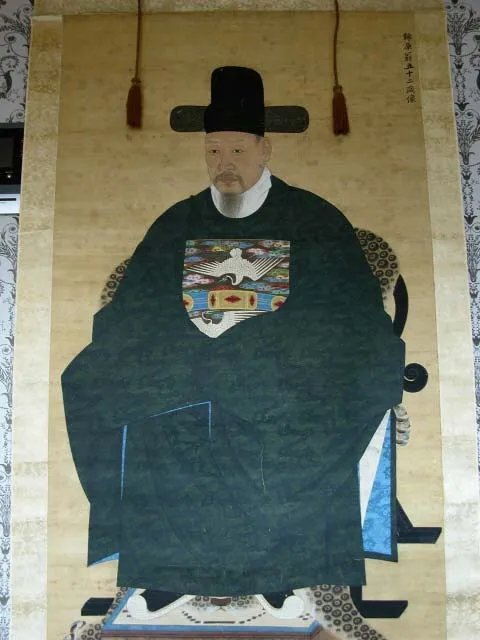
Portrait of Baksaik
朴師益 肖像
경기도 성남시
Basic information
- Designation
- Treasure No.1724
- Category
- Painting
- Era
- 1726년
- Designated year
- 2011
- Location
- 성남시, 경기도— 경기도 성남시 분당구 하오개로 323 (운중동, 한국학중앙연구원)
- Coordinates
- 37.393030, 127.052183
AI Docent
Coming soonAn AI-generated, friendly retelling of this heritage site is available in Korean. An English version is on our roadmap — for now, please see the official description below.
Description
Bak Sa-ik (1675-1736) was a civil official of late Joseon. He was a courtier in the court of King Gyeongjong, then in the court of King Yeongjo. His family originated from Banam, and he used the courtesy name Gyeomji and the pen-name Noju. After his death, he was bestowed the posthumous title of Jangik. A descendant of Bak Dong-ryang, Bak Sa-ik was the son of Bak Pil-ha. In 1710 (the 36th year of King Sukjong’s reign), he successfully passed the sogwa examination, the civil service examination for qualification for minor local government positions. Two years later, in 1712, he tried for the regular civil service examination and was admitted to the service of the central government to become appointed a court historian, holding a concurrent position as a lecturer of Confucian classics. Later, he successively occupied several government positions, and was included in dodangnok, the list of officers nominated for a position in the Office of Special Advisers. In 1717, he volunteered to be transferred to a position outside the capital, in Gangseo, to be able to look after his elderly parents, then approaching seventy years of age. Later, back in the capital, he was appointed as a deputy second drafter of the Office of Special Advisers, and after his petition to King Gyeongjong, then the crown prince in regency, about the governing of the country which pleased the latter, was assigned to the position of asistant section chief in the Ministry of Personnel. After King Gyeongjong’s accession to the throne, he was appointed the governor of Jeolla-do, and when tensions between the Noron and Soron parties led to the outbreak of the Purge of 1721, Bak Sa-ik was banished to Taein for not having attended a meeting of senior government officials, and later to Cheongha. After King Gyeongjong’s death and King Yeongjo’s rise to the throne, his banishment was lifted with his government post being returned to him. In ensuing years, he occupied the position of the third minister of the Ministry of Personnel, then that of the special mayor of Ganghwa. During his term, he undertook a project for renovating the island’s fortified walls. In 1727 (the third year of King Yeongjo’s reign), he was appointed as minister of military affairs, and was also bestowed the title of Geumwongun shortly thereafter. He remained in the government service until his demise in 1736 (the 12th year of King Yeongjo’s reign), successively serving as an inspector-general, minister of punishment, minister of works, minister of rites, and the sixth state councilor. Bak Sa-ik was also a talented calligrapher whose surviving writing samples include the inscriptions on the Stele for the Third State Councilor Min Jin-won and the Stele for the Second Minister of Rites An Jeok. The portrait of Bak Sa-ik has its title written near the top edge, which reads: “Geumwongong at the Age of Fifty-two.” This full-size seated portrait represents Bak Sa-ik seated on a chair and wearing a green official’s costume and a matching hat. With his face slightly turned toward the right, showing a one-eighth profile, he is shown in a polite posture, holding one hand with the other. The rather high-rising hat is well in line with the court costume style of the early period of King Yeongjo’s reign. He is donning a golden belt over a rank badge, placed on the torso, with two embroidered cranes; both the belt and rank badge are insignias of his status as an official of 2nd rank or above. The chair is covered with a tiger skin, and the face of the tiger is visible between the two feet of the royal official on the foot rest, held in a splayed position. The two front paws of the tiger, meanwhile, lie on either side of the foot rest, in a very natural position. The floor is bare, without a rush mat or rug, customarily seen in Joseon portraits of courtiers. The face is in a bright flesh color with a darker color used for outlining the contour, eyes, nose and the mouth. The eyebrows are carefully drawn in pale ink, in several short strokes rather than one single stroke. A slight touch of red is added to the inner corners of the both eyes. The upper and lower eyelids are drawn in black lines, and lashes are added only on the upper lid. The red color, used in the eye, nose bridge and forehead areas, adds depth to the face. As for the beard, each hair is depicted separately against a gold-painted background. Although rather sparse, the beard looks elegant. Distinctive facial features of Bak Sa-ik’s like the vertical lines between the eyebrows and the mole under an ear are well captured in this portrait. The slightly rigid impression conveyed by the figure with a solemn facial expression also communicates well his personality. Wrinkles and folds in clothes are rendered in line drawing, and are emphasized by painting surrounding areas with slight darker colors. The sleeves, wide as it was customary in Bak Sa-ik’s days, hang low beneath the gathered hands, giving a bit of the impression of misshapenness. This, besides, is a common characteristic among early 18th-century portraits of government officials donning a uniform.
Location
지도를 불러오는 중…
Have you visited this place?
Log in and verify your visit on-site via GPS to record a stamp in My Journey. (QR verification coming later.)
Images: KOGL (khs.go.kr) · Data source: Korea Heritage Service Open API (khs.go.kr)