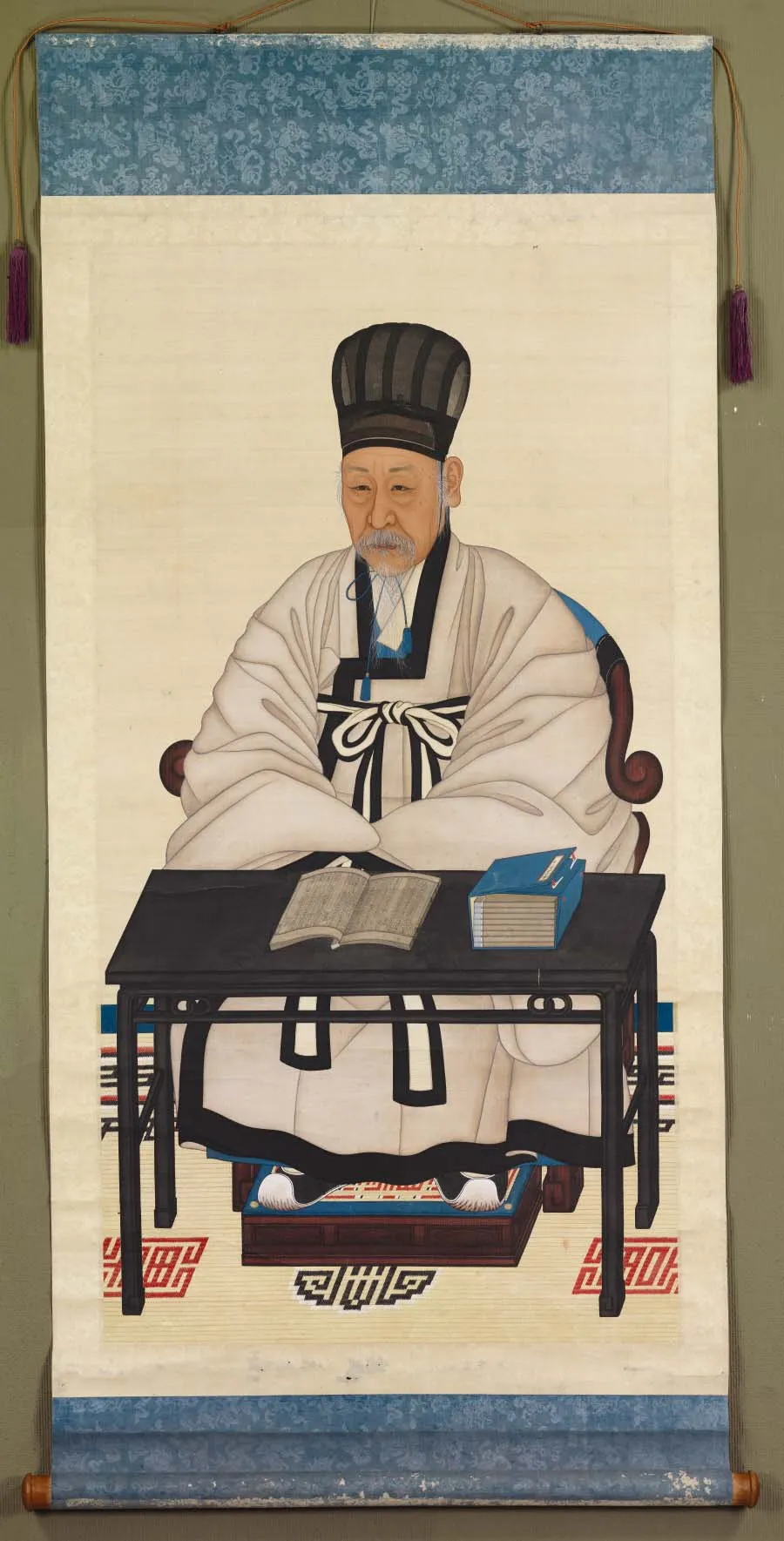
Portrait of Heojeon
許傳 肖像
경기도 용인시
Basic information
- Designation
- Treasure No.1728
- Category
- Painting
- Era
- 19세기 후반
- Designated year
- 2011
- Location
- 용인시, 경기도— 경기도 용인시 기흥구 상갈로 6-0 (상갈동, 경기도박물관 )
- Coordinates
- 37.268330, 127.108756
AI Docent
Coming soonAn AI-generated, friendly retelling of this heritage site is available in Korean. An English version is on our roadmap — for now, please see the official description below.
Description
Heo Jeon (1797-1886) was a civil official of late Joseon. His family originated from Yang Cheon, and he used the courtesy name Ino and the pen-name Seongjae. In 1828 (the 28th year of King Sunjo’s reign), he successfully completed his first civil service examination. In 1835 (the first year of King Heonjong’s reign), at the age of thirty-nine, Heo Jeon was appointed as an assistent of Seungneung Royal Tomb after his success at a special session of the civil service examination. Thereafter, he successively occupied several government positions including an assistant section chief of the Ministry of Personnel. In 1847, when he was appointed Magistrate of Hampyeong, he decided to end all corporal punishment in favor of education, and ordered the destruction of all instruments of corporal punishment. But, due to conflicts with the governor of Jeolla-do, his superior, he soon resigned from this post. In 1850, he became a subeditor, then the sixth counselor of the Office of Special Counselors, but was banished to Myeongsan during the same year for opposing the decision to strip Jo Ha-mang (1682-1747) of his titles posthumously. His banishment was, however, lifted shortly after, and Heo Jeon returned to the service of the royal government, editing and publishing Saui, a book on etiquette and rites, on the order of King Cheoljong. Saui, a book in the young and progressive spirit of the Geungi Silhak School, was written by carefully reviewing past theories on etiquette and rites. Saui breaks the mold of traditional treatises on this topic, which were essentially annotations and commentaries to Juja garye (Zhuxi jiali in Chinese, Family Rites of Zhu Xi) and places a greater emphasis on the rationality and practicality of family rituals. In 1864 (the first year of King Gojong’s reign), he was appointed as the magistrate of Gimhae. As the magistrate of Gimhae, he lectured on hyangyak (village code) in Joseon. Thereafter, he was the vice minister successively of military affairs, punishment, and personnel and occupied other high government positions including the king’s advisor, to finally become appointed minister of personnel. In 1886 (the 23rd year of King Gojong’s reign), at ninety years of age, Heo Jeon was promoted to the top government rank of Sungnokdaebu and was appointed as the second minister of the Office of Royal Relatives. Aside from his collected works Seongjae munjp, Heo Jeon also wrote Jongyorok and Cheolmyeongpyeon where he discusses attributes of an ideal monarch. Heo Jeon was a brilliant man with an intrepid mind. Born in a scholarly family, he was introduced to Confucian studies through Hyogyeong (Xiaojing in Chinese, Classic of Filial Piety). He studied under Hwang Deok-gil (1750-1827), who praised him highly, calling him ‘one who attained the utmost scholarship which one can hope. While in government service, Heo Jeon was often assigned to positions outside the royal capital or positions at the fringe of power, as his uncompromising personality rubbed quite a few people in the inner political circles of Joseon the wrong way. Everywhere he went, he managed to make a difference for the community he served. Jo Du-sun (1796-1870) who was a provincial governor and one of the direct superiors of Heo Jeon’s famously said: “I was told that girin (an mythical hooved chimerical creature) was an imaginary beasts and did not exist in the real world. But, I see one right here [in the person of Heo Jeon].”When he was called back to the royal court, he lectured on Sohak (Minor Learning) texts in the king’s seminar hall and urged the king to surround himself with upright people, stressing also the importance of etiquette and manners as the foundation of all other values. Heo Jeon was a scholar of the Namin School of Giho (central western Korea), in the lineage headed by Yi Ik (1681-1763) and continued by An Jeong-bok (1712-1791) and Hwang Deok-gil. A leading figure of scholarly circles of his time, Heo Jeon was one of the most eminent scholars of this period, on a par with Yu Chi-myeong (1777-1861), heir of the Toegye School of Yeongnam (Southeastern Korea). According to his descendants, this portrait of Heo Jeon was painted while he was alive, on the order of the king. The portrait was kept in the possession of successive direct-line descendants of Heo Jeon until it was moved to Yeotaekdang, a shrine constructed in 1891 (the 28th year of King Gojong’s reign), in Sangcheong-gun, Gyeongsangnam-do to commemorate his life and work, following the publication of his complete works during the same year), in 1916, when Mulsan Yeongdang, the portrait hall, was completed inside this shrine. In 2008, the portrait was donated to the Gyeonggi Provincial Museum. Heo Jeon is represented in this portrait, seated on a chair, in a dignified position, wearing a tall black cap and a long white day coat with black trim. There is a table-type desk in front of him with a pile of books whose title on the cover page of the top book reads Juja daejeon (The Complete Works of Zhu Xi) and one open book, ostensibly one of the volumes of the complete works. Props were generally never used in portraits in early to mid-Joseon. But, starting in the mid-18th century, tables with books and even antique objects made their debut in some portraits, as indicators of both the social status and personal taste of the person portrayed. The portraits of Yun Dong-seom, Im Mae or Yi Ha-yong are cases in point. The portrait of Heo Jeon, therefore, appears to echo this new trend in portrait painting. In this portrait, the facial contour and features are outlined and depicted based on traditional phrenological criteria, all the while not erasing Heo Jeon’s distinctive individual features. Facial reliefs are masterfully rendered using the so-called yungnimun technique, a technique for depicting expressions, focused on the skin and flesh. The folds and wrinkles in the clothing are drawn in gray ink lines which are then overlaid with a darker gray line. It is very obvious that the portrait artist spent many hours observing Heo Jeon in person. Such details as the flexible and subtle lines along the upper and lower eyelids say clearly that this work is the result of an earnest attempt to capture the personality of the subject, which the artist studied through live observation. The pupils, painted in black, show a light touch of gray with the hue of flesh color near the irises, to render the cloudiness of the white of the eye in an elderly person. The eyes with droopy upper eyelids hint at a temperamental personality and show glints of the super-sized intellect of this man with an impressive career of scholarship. The portrait of Heo Jeon, meanwhile, is highly evocative in style of the portrait of another Joseon scholar-official. A work, exemplary for the embodiment of the principle of capturing the moral personality behind the physical appearance of a portrait subject, this portrait not only accurately depicts the appearance of Heo Jeon in his later years after a long and rewarding scholarly career, but offers also insights into his temperament and character
Location
지도를 불러오는 중…
Have you visited this place?
Log in and verify your visit on-site via GPS to record a stamp in My Journey. (QR verification coming later.)
Images: KOGL (khs.go.kr) · Data source: Korea Heritage Service Open API (khs.go.kr)