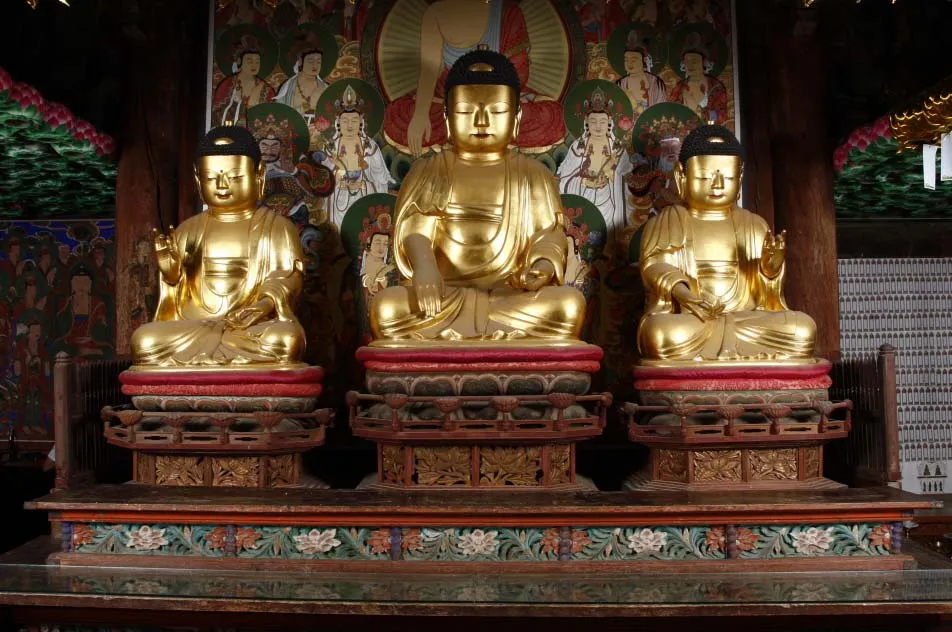
Gwanryongsa Mokjoseokgayeoraesambuljwasang Mit Daejwa, Changnyeong
昌寧 觀龍寺 木造釋迦如來三佛坐像 및 臺座
경상남도 창녕군
Basic information
- Designation
- Treasure No.1730
- Category
- Sculpture
- Era
- 1630년
- Designated year
- 2011
- Location
- 창녕군, 경상남도— 경상남도 창녕군 화왕산관룡사길 171 (창녕읍, 관룡사)
- Coordinates
- 35.532734, 128.553527Kakao address conversion
AI Docent
Coming soonAn AI-generated, friendly retelling of this heritage site is available in Korean. An English version is on our roadmap — for now, please see the official description below.
Description
The Wooden Seated Sakyamuni Buddha Triad of Gwallongyonsa Temple in Changnyeong-gun, Gyeongsangnam-do is made up of a statue of Sakyamuni Buddha, accompanied by Bhaisajyaguru Buddha and Amitabha Buddha that are the left and right attendants. An ink-written inscription near the base of the main Buddha’s pedestal informs that the carving of the three statues began in the tenth lunar month in 1629 (the seventh year of King Injo’s reign) and came to completion in the fifth lunar month of the following year. The sculptures are by eight monk sculptors including Hyeonjin, Seungil, Cheonmin, and Suyeong. Hyeonjin, the best known of them, took part in the creation of a series of other Buddhist sculptures dating from the early 17th century, such as the Wooden Bodhisattva of Cheoneunsa Temple in Gurye, Jeollanam-do and the Clay Amitabha Buddha Triad of Beopjusa Temple in Boeun, Chungcheongnam-do. The Buddha Triad of Gwallyongsa Temple was realized at a relatively late point of his life. The main Buddha is quite large, measuring 150cm in height, and the two attendant Buddhas are shorter, measuring about 120cm in height. All three statues have a square face with a very high and voluminous nose. The rather small chin gives these Buddhas an air of childlike innocence and candidness. Folds in the clothing, simple and large, appear fluid and unstilted. The legs in the crossed position, on the other hand, are disproportionately narrow in width, making the posture of these statues look unstable and even somewhat whimsical. The three statues are, meanwhile, bereft of the sweet appearance characterizing Hyeonjin’s early works or the solemn expression seen in the triad statues of Beopjusa Temple, and appear, instead, naïve and guileless; a defining characteristic of his Buddhist sculptures. Hyeonjin collaborated with Seungil for the first time on this triad of Gwallyongsa Temple. Some of the stylistic elements are echoed in other works of Seungil, such as the Sakyamuni Buddha Triad of Bulgapsa Temple in Yeonggwang, Jeollanam-do, and the Wooden Sakyamuni Buddha Triad of Ssanggyesa Temple in Hadong, Gyeongsangnam-do. This early 17th-century Buddhist triad, highly informative of relationships of influence that existed between various sculptural styles and monk sculptors, is also outstanding in its expression of religious feelings; thereby, amply deserving its place among government-protected cultural heritage objects.
Location
지도를 불러오는 중…
Have you visited this place?
Log in and verify your visit on-site via GPS to record a stamp in My Journey. (QR verification coming later.)
Images: KOGL (khs.go.kr) · Data source: Korea Heritage Service Open API (khs.go.kr)