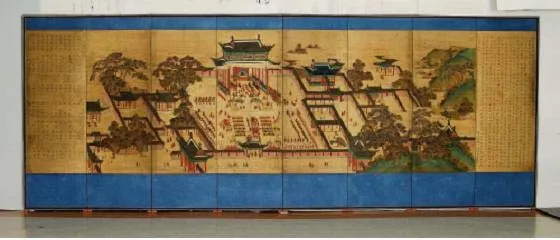
Heonjonggaryejinhado Byeongpung(2011)
憲宗嘉禮陳賀圖 屛風(2011)
경기도 용인시
Basic information
- Designation
- Treasure No.733-2
- Category
- Painting
- Era
- 1844년
- Designated year
- 2011
- Location
- 용인시, 경기도— 경기 용인시 기흥구 상갈로 6 경기도박물관
- Coordinates
- 37.268330, 127.108756
AI Docent
Coming soonAn AI-generated, friendly retelling of this heritage site is available in Korean. An English version is on our roadmap — for now, please see the official description below.
Description
This folding screen is a court painting depicting scenes from the royal wedding of King Heonjong (1827-1849, r. 1834-1849; the 24th king of the Joseon Dynasty), who ascended to the throne at the age of eight, and Queen Hyojeong. Following the death of his first wife, Queen Hyohyeon of the Andong Kim clan (1828-1843), Hong Jae-ryong’s daughter was invested as Queen Hyojeong on October 18, 1844 and they were married on October 21, 1844. This folding screen consists of eight panels, the first of which contains words composed for King Heonjong’s wedding celebration by Jo Byeong-gu (1801-1845), the master of ceremonies at the wedding. Six panels (second to seventh) feature scenes of the wedding celebration against the background of Injeongjeon Hall at Changdeokgung Palace. However, this detail is inconsistent with the fact that all of the ceremonies, including the investiture, wedding and celebration of Queen Hyojeong, actually took place at Gyeonghuigung Palace. In fact, 19th-century wedding celebration folding screens were always painted agaisnt the background of Injeongjeon Hall, Changdeokgung Palace regardless of their actual venues. Therefore, this folding screen splendidly depicts large and small royal palace buildings, a landscape, trees, men and horses as well as Injeongjeon Hall of Changdeokgung Palace. The palace picture is expressed as a bird’s-eye view using a parallel and angular perspective. The scene of the wedding celebration, depicting the king and the implements used in national ceremonies to symbolize the forms of state, reveals the dignity of Joseon royal culture and its magnificent atmosphere. The eighth panel contains a list of 25 Seonjeongwan (military guards) including Yoon Myeong (1779-?), Yi Hui-gyeong (1790-?) and their official ranks, positions, years of birth, state examination date, family clan, and so on. Judging from this list, the military guards of the Seonjeongwan Office took the lead to in producing this folding screen in order to celebrate King Heonjong’s wedding. Indeed, this type of screen appears to have been distributed to all the military staff guards on the list in accordance with the custom. This large painting of a wedding celebration expressed with a very fine touch and deep-colored pigments is considered a highly valuable cultural and historical asset for research not only on the history of paintings but also on royal wedding scenes of the 19th century. Two other paintings similar to Heonjong garye jinhado (King Heonjong’s Wedding Celebration) are kept at Dong-A University Museum (designated as Treasure No. 733 in 1982) and by the National Museum of Korea, respectively. All three folding screens are different in terms of their rough sketches, ceremonial implements, clothes, arrangements and numbers of people. However, as on the whole the styles of expression of the paintings are similar to each other, it is assumed that they were painted around the same time. This folding screen of Heonjong garye jinhado (King Heonjong’s Wedding Celebration) possessed by Gyeonggi Provincial Museum is regarded as an important material related to a major royal wedding ceremony of the late Joseon Dynasty. Compared to other folding screens of royal events painted around the same time, it exhibits a superior delicate touch and style of painting than Treasure No. 733 and has been preserved in a good condition, despite being less complete in overall artistic terms.
Location
지도를 불러오는 중…
Have you visited this place?
Log in and verify your visit on-site via GPS to record a stamp in My Journey. (QR verification coming later.)
Images: KOGL (khs.go.kr) · Data source: Korea Heritage Service Open API (khs.go.kr)