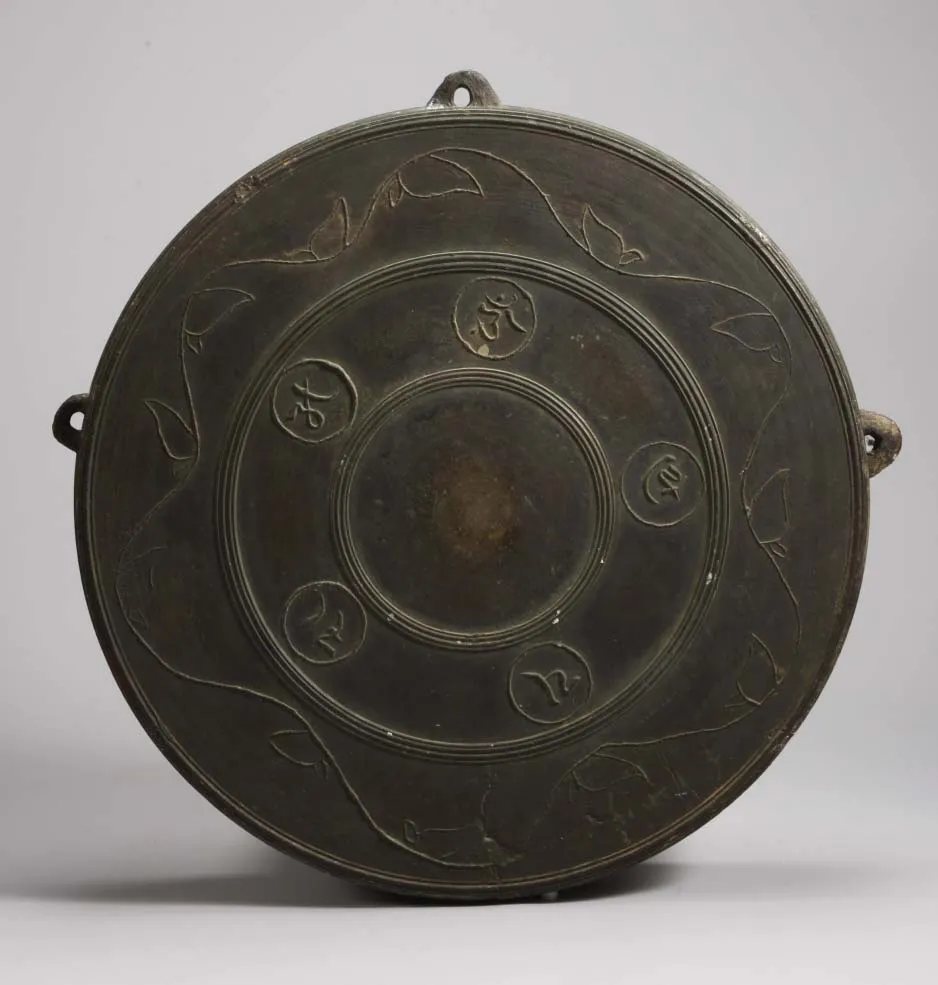
Gukcheongsa Bronze Drum, Busan
釜山 國淸寺 靑銅金鼓
부산광역시 금정구
Basic information
- Designation
- Treasure No.1733
- Category
- Craft
- Era
- 1666년
- Designated year
- 2011
- Location
- 금정구, 부산광역시— 부산광역시 금정구 북문로 42(금성동, 국청사)
- Coordinates
- 35.253954, 129.054664Kakao address conversion
AI Docent
Coming soonAn AI-generated, friendly retelling of this heritage site is available in Korean. An English version is on our roadmap — for now, please see the official description below.
Description
While there are quite a number of bronze gongs that have survived from the Goryeo Period, those surviving from early Joseon, on the other hand, are surprisingly few. The only bronze gong thus far identified as dating from a pre-Imjin War (Japanese Invasion of 1592) era is the one housed in Bukoji Temple in Tsushima, Japan. The number of bronze gongs produced thereafter, in the 17th century and later, is also extremely small. It is this scarcity of surviving bronze gongs which partly explains the recent designation of the Bronze Gong of Eunhaesa Temple (1646) as a Treasure. The Bronze Gong of Gukcheongsa Temple (1666), made barely twenty years after the Bronze Gong of Eunhaesa Temple, is one of the exceedingly rare artifacts of this type dating from the 17th century. This mid-size bronze gong measures 40.5cm in diameter and has a typical shape of a gong with a broad rim or a drum with an open back. The façade is ringed with two concentric circles around the middle circle where the percussion instrument is struck, which is left plain, in this bronze gong, without ornamental motifs. The area between the middle circle and the outer concentric band shows five of the six Sanskrit characters making up Gwangmyeongjineon (Light Mantra); a motif seen in Buddhist temple bells from the same period, which appears to be a transition characteristic for bronze gongs from this period. The outer concentric band, meanwhile, is adorned with elegant lotus and scroll designs. Scroll designs like these, harking back to late-Goryeo bronze gong, have never been seen in other late Joseon bronze gong. The rim has three half-moon-shaped loops attached to it. Most bronze gongs have inscriptions in incised carving along the rim, but such is not the case with this one. The inscription on the Gronze Gong of Gukcheongsa Temple is found on the rear side and is in relief carving. The inscription says that the bronze gong, belonging to Jangcheonsa Temple in Yeonhwasan Mountain in Gyeongju-bu, Gyeongsang-do, was cast with one hundred pounds [of bronze] in the third month of the year of Byeongo, 50th year of Kangxi with funding from two donors, Bak Chung-min and Yi Mak-nam, and that the work was done by three blacksmiths, Taeeung, Sinyeol, and Yeongdeuk. The inscription also lists the names of the monks who arranged for this casting project; Gyeho, Seoreun, Seoram, and Seolsim. The artisans who cast, for example, the Bronze Gong of Eunhaesa Temple, mentioned earlier, are unknown. The knowledge of the identities of monk artisans who cast it is something that makes the Bronze Gong of Gukcheongsa Temple as valuable as the latter, even if postdating it and inferior to it in the quality of metalwork. This information is, needless to say, crucial for establishing the lineage of late Joseon monk artisans. The inscription on the rim, in dotted lines, on the other hand, appears to have been added sometime later. ‘Jangcheonsa,’ mentioned in the inscription as the temple in which the bronze gong was originally housed, is believed to have been located in Cheonjeon-ri, Dudong-myeon, Ulju-gun, in Ulsan. In a map of the town center of Ulsan, drawn in late Joseon, there is, at one edge of the map, a place named “Dalcheonchang,” and a pavilion named “Bangudae,” lying southeast of this place and right before the town line. Jangcheonsa Temple is marked in a location northwest of this pavilion. This place appearing to be the site where Jangcheonsa Temple once stood, however, was submerged following the construction of Daegok Dam. An excavation project was carried out in 1999, prior to the submersion of this area. The excavation resulted in the discovery of a roof tile bearing the date inscription of “the 40th year of Kangxi” among others. This suggests that Jangcheonsa Temple may have been shut down around this time; in other words, sometime during the 18th century. The inscription on the bronze gong, meanwhile, lists the names of the copper smiths who are its creators, including Daejang Taeeung, Sinyeol, and Yeongdeuk. Taeeung, referred to as “Daejang (Great Artisan),” appears to be a senior monk artisan having his own group of artisans. However, no other metal craftwork by him is known, aside from this bronze gong. On the other hand, there are three non-metal Buddhist artworks that are associated with Taeeung. Taeeung is listed among those who participated in the casting of the Bronze Bell of Beopjusa Temple with the Inscription of Jungsajaam Hermitage (1636), not in the capacity of a copper smith, but as a monk who oversaw the project. Taeeung is also mentioned in the prayer scroll inside the Seated Mahasthamaprapta Bodhisattva of Muryangsa Temple (1633), this time as a monk artist who took part in the creation of this statue. Although Taeeung is listed as an artist contributing to the creation of the Seated Mahasthamaprapta Bodhisattva of Muryangsa Temple, this probably does not mean that he was involved in the carving of the statue, but rather that he took part in the creation of metal objects, such as those lodged inside the statue as votive items. However, further evidence is needed to confirm this idea. Taeeung is also mentioned in the Hanging Painting of Rocana Buddha of Sudeoksa Temple (1673), suggesting that he was a prolific artisan involved in many Buddhist art and craft projects. The Bronze Gong of Gukcheongsa Temple, although rather simple in terms of surface design, holds great significance as one of the very few surviving artifacts of its kind from the 17th century and is notable also for the unusual location and style of its inscription, which may shed light on the bronze gong-casting technology of this period. This bronze gong has also revealed the existence of Taeeung, a hitherto unknown 17th-century monk artisan. Along with the Bronze Gong with the Inscription of “Sudosa” of Eunhaesa Temple, the Bronze Gong of Gukcheongsa Temple is one of the two most important artifacts for the understanding of the history of this percussion instrument.
Location
지도를 불러오는 중…
Have you visited this place?
Log in and verify your visit on-site via GPS to record a stamp in My Journey. (QR verification coming later.)
Images: KOGL (khs.go.kr) · Data source: Korea Heritage Service Open API (khs.go.kr)