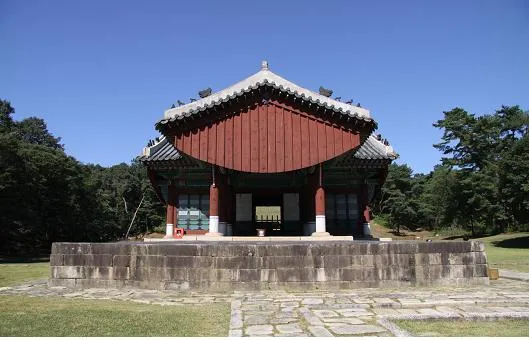
Donggureung Geonwonreung Jeongja Pavilion, Guri
九里 東九陵 健元陵 丁字閣
경기도 구리시
Basic information
- Designation
- Treasure No.1741
- Category
- Architecture
- Era
- 조선시대
- Designated year
- 2011
- Location
- 구리시, 경기도— 경기도 구리시 동구릉로 197 (인창동)
- Coordinates
- 37.624253, 127.131093
AI Docent
Coming soonAn AI-generated, friendly retelling of this heritage site is available in Korean. An English version is on our roadmap — for now, please see the official description below.
Description
Geonwolleung is the Royal Tomb of King Taejo of the Joseon Dynasty, located inside the East Nine Royal Tombs in Guri, Gyeonggi-do. This tomb, constructed in 1408 (the eighth year of King Taejong’s reign), was modeled on Hyeolleung, the Royal Tomb of King Gongmin of the Goryeo Dynasty. Building a jeongjagak (T-shaped Wooden Shrine) alongside a king’s tomb was a custom practiced since the Goryeo Period, and this custom was followed, in Joseon, from the early years of the dynasty. Geonwolleung also was constructed with the shrine. The shrine was built south of the tomb, on a downslope, as dictated by the custom. This shrine, built in 1408 (the eighth year of King Taejong’s reign), at the same time as the construction of the tomb itself, is recorded to have been renovated in 1586 (the 19th year of King Seonjo’s reign). A legend has it that in 1592 (the 25th year of King Seonjo’s reign), Japanese troops unsuccessfully attempted to set the tomb on fire, as it refused to catch fire. According to Sukjong sillok (Annals of King Sukjong), King Sukjong renounced his plan to refurbish Geonwolleung after hearing this strange account. However, in 1764 (the 40th year of King Yeongjo’s reign), a decision was reached to repair the shrine of Geonwolleung, by then seriously dilapidated, and the Directorate for Restoration was set up to oversee the repair. Some two decades later, in 1784 (the eighth year of King Jeongjo’s reign), new repair work was done to the same building, but, this time, at a smaller scale. In 1879 (the 16th year of King Gojong’s reign), the building was again repaired under a project for refurbishing the shrine of several royal tombs including Mongneung, Hwireung, Hyereung, Wolleung, Sureung, and Gyeongneung. According to Ilseongnok (Daily Records of the Royal Court and Important Officials), the Yeongjo-era royal chronicle, the repair made at this time was mainly for the stele pavilions and stone steps outside the shrine. The last recorded repair made in Geonwolleung took place in 1899 and concerned stone graveyard monuments. Its shrine is likely not to have been touched at this time. In Gukjo oryeui (Five Rites of State), a Joseon-era book describing five major state rites, the ideal location for a jeongjagak is said to be south of a grave. The jeongjagak should furthermore be three kan (the space between two columns, one kan being about 2.5m) in width and face the south with steps on its east and west sides, according to the same book. The book also provides the image of an ideal shrine. The shrine of Geonwolleung matches this drawing quite precisely, in terms both of its appearance and position in relation to the grave. The shrine lies north of the hongsalmun gate and south of the grave. The building rests on a long rectangular stone platform and consists of a main area measuring three kan on the front and two on the side with two lateral wings, each measuring one kan on the front and two on the side, for an overall plan which is shaped like the letter “T.” The cleanly-shaped platform is built with four tiers of rectangular stone blocks. The right railing of the stone steps leading up to the platform on the east side of the building, meanwhile, is severely defaced, making it difficult to make out the image sculpted on its surface. But, it is probably a series of clouds, a customary motif in stonework for the shrine. The main area in the middle has two columnar brackets for each bracket arm, which has sculptural details, typical of the 18th-century style, at their tip. It is overall in the classical style of a Joseon shrine, in size as well as appearance. As for the columnar brackets, finished in the 18th-century style, they appear to have been redone during the renovation in 1764 (the 40th year of King Yeongjo’s reign).The shrine of Geonwolleung, although repaired and renovated several times since its construction in 1408, appears to have retained its original appearance, at least in terms of general appearance, judging from the information provided in Gukjo oryeui. The graveyard shrine for King Taejo, Joseon’s founding monarch, the shrine of Geonwolleung also holds a huge historical, artistic and academic significance as a reference in architecture related to the funerary rites and burial of Joseon royals.
Location
지도를 불러오는 중…
Have you visited this place?
Log in and verify your visit on-site via GPS to record a stamp in My Journey. (QR verification coming later.)
Images: KOGL (khs.go.kr) · Data source: Korea Heritage Service Open API (khs.go.kr)