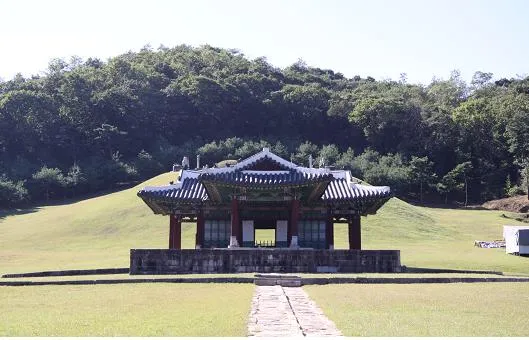
Donggureung Sungreung Jeongja Pavilion, Guri
九里 東九陵 崇陵 丁字閣
경기도 구리시
Basic information
- Designation
- Treasure No.1742
- Category
- Architecture
- Era
- 조선시대
- Designated year
- 2011
- Location
- 구리시, 경기도— 경기도 구리시 동구릉로 197 (인창동)
- Coordinates
- 37.615976, 127.128234
AI Docent
Coming soonAn AI-generated, friendly retelling of this heritage site is available in Korean. An English version is on our roadmap — for now, please see the official description below.
Description
Sungneung, the Royal Tomb of King Hyeonjong, the 18th ruler of Joseon and his wife, Queen Myeongseong, is located near the west end of the East Nine Royal Tombs in Guri. Sungneung is a couple tomb with two separate mounds in a yard enclosed by a low-rising wall. The burial mound with King Hyeonjong’s remains was constructed first, in 1674 (the first year of King Sukjong’s reign). The burial mound of his queen consort was added next to his, ten years later, in 1684 (the tenth year of King Sukjong’s reign). The two burial mounds are fronted by a shrine and a stele pavilion. The south side of the graveyard is low in elevation and is, for this reason, frequently flooded, but the rest of the graveyard is at a safely high altitude. The shrine, removed from the red-spiked gate by some distance and built on a slope, is prominently visible even from afar. The shrine of Sungneung was built at the same time as the Royal Tomb of King Hyeonjong; in other words, in 1674. The shrine was repaired several times thereafter, and a woldae (stone terrace) is said, in Sunjo sillok (Annals of King Sunjo), to have been built in 1828 (the 28th year of King Sunjo’s reign). The last recorded repair, dated 1879 (the 16th year of King Gojong’s reign), was that of its stone steps. The shrine is surmounted by a hipped-and-gabled roof, which became the norm since the shrine of Jangneung, the Royal Tomb of King Injo. The latter was a five-kan (the space between two columns, one kan being 2.5m) building with the main worship room consisting of three kan and the two side rooms together measuring two kan. The precedent was followed by the shrine of the Royal Tomb of King Hyojong, also located in the East Nine Royal Tombs. In 1673 (the 14th year of King Hyeonjong’s reign) when Yeongneung, the Royal Tomb of King Hyojong, was relocated to Yeoju, the shrine was expanded to the width of eight kan (five kan for the main worship room and three kan for the two side rooms). The roof was kept in the hipped-and-gabled style. In Hyeonjong salleungdogam uigwe, the record on the construction of the Royal Tomb of King Hyeonjong compiled subsequently, one reads that when Sungneung was constructed in the East Nine Royal Tombs, in 1674 (the first year of King Sukjong’s reign), its shrine was modeled on that of Yeongneung Royal Tomb. Meanwhile, Hyojong yeongneung cheolleung dogam uigwe records that when Yeongneung was relocated, the shrine was rebuilt using the shrine of Gwangneung Royal Tomb as the model. The shrine of eight kan size were constructed continuously since Gwangneung, in graveyards including Seolleung, Jeolleung, Hyoreung, Gangneung, and Jangneung Royal Tombs. The shrine of Yeongneung, Sungneung, Myeongneung Ingneung, and Uineung were also eight kan in size. The apparition of eight-kan shrine is at times explained by the disappearance of Yeongakjeon and transfer of its functions to the shrine. Surviving eight-kan shrine include the ones in Ingneung, Hwireung and Uireung Royal Tombs. But, all other shrine, except the one in Sungneung, are surmounted by a gable roof. The shrine of Sungneung is the only of forty-two buildings of its kind (forty in South Korea, two in North Korea) with a hipped-and-gabled roof and is eight kan wide (five kan occupied by the worship hall and three kan by two side rooms). The columnar bracket system consists of one bracket arm and two brackets for the worship room, and two brackets without a bracket arm for the two side rooms. Although the size was expanded to eight kan, the building appears well-proportioned. The only hipped-and-gabled roof shrine of eight-kan size, the shrine of Sungneung has been mostly preserved in its original state ever since its construction in 1674, both in its roofing style and size. As an important example of a 17th-century shrine, this building is of great historical, academic and artistic significance.
Location
지도를 불러오는 중…
Have you visited this place?
Log in and verify your visit on-site via GPS to record a stamp in My Journey. (QR verification coming later.)
Images: KOGL (khs.go.kr) · Data source: Korea Heritage Service Open API (khs.go.kr)