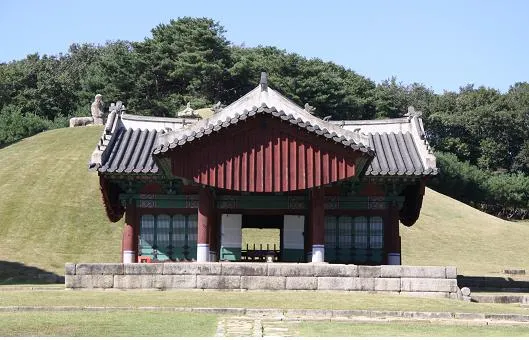
Donggureung Mokreung Jeongja Pavilion, Guri
九里 東九陵 穆陵 丁字閣
경기도 구리시
Basic information
- Designation
- Treasure No.1743
- Category
- Architecture
- Era
- 조선시대
- Designated year
- 2011
- Location
- 구리시, 경기도— 경기도 구리시 동구릉로 197 (인창동)
- Coordinates
- 37.625678, 127.133140
AI Docent
Coming soonAn AI-generated, friendly retelling of this heritage site is available in Korean. An English version is on our roadmap — for now, please see the official description below.
Description
Mongneung is a group of the Royal Tombs built for King Seonjo (the 14th monarch of the Joseon Dynasty), Queen Uiin (wife and Queen Consort of King Seonjo), and Queen Inmok (second wife and Queen Consort of King Seonjo). The tombs are located inside Donggureung, a tumulus group in Guri, Gyeonggi-do. When Queen Uiin died in 1600 (the 33rd year of the reign of King Seonjo), the Mongneung tomb site was originally designated as the Yuleung tomb site for the queen. Then, with the death of King Seonjo in 1608 (the first year of the reign of Prince Gwanghae), the tomb of King Seonjo, called Mongneung, was established to the west of the Geonwolleung royal tomb. However, according to an appeal to a higher court to the effect that the Mongneung site was humid and not an appropriate location for a royal tomb, it was relocated to its current position by placing the Monggneung and Yuleung royal tombs together in 1630 (the 8th year of the reign of King Injo). Then, following the death of Queen Inmok in 1632 (the 10th year of the reign of King Injo), the queen’s tomb was added to the Mongneung site, leaving three royal tombs together at the Mongneung site. The house for sacrifice at the Mongneung royal tombs was built to the west of the Geonwolleung royal tomb in 1608, but was relocated to the east of the Geonwolleung royal tomb in 1630 in accordance with the principles of feng shui. According to the construction record, the staircase of the house was repaired in 1879 (the 16th year of the reign of King Gojong), along with several other repair works, after the relocation of the site. The house of sacrifice, which is a gable-roof building featuring the unique dapo bracket system (brackets placed on and between the pillars) compared to other houses of sacrifice, rests on a long rectangular stone platform and consists of a main area measuring three kan (a unit of measurement referring to the distance between two columns) at the front and two kan at the sides, with two lateral wings, each measuring one kan at the front and two at the sides. In particular, two columns were erected to support the wall at the sides of the main area. The rest of the walls with windows and doors or fire protection were built in the typical style of houses of sacrifice of the Joseon Dynasty. The house of sacrifice at the Mongneung royal tomb site has retained its appearance well since its relocation in 1630. As a unique building with the dapo bracket system among other houses of sacrifice of the Joseon Dynasty, this house is an invaluable material for research on the style and structure of the elaborate curlicue ornamentation seen on the tops of pillars.
Location
지도를 불러오는 중…
Have you visited this place?
Log in and verify your visit on-site via GPS to record a stamp in My Journey. (QR verification coming later.)
Images: KOGL (khs.go.kr) · Data source: Korea Heritage Service Open API (khs.go.kr)