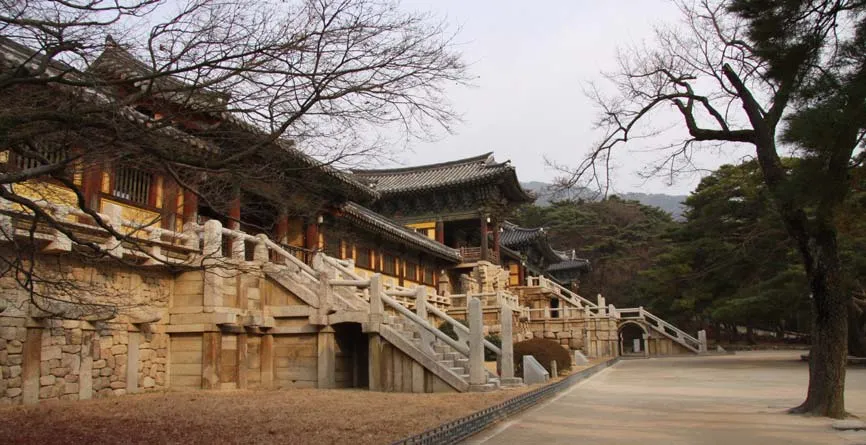
Dry-stone Masonry Platform of Bulguksa Temple, Gyeongju
慶州 佛國寺 架構式 石築
경상북도 경주시
Basic information
- Designation
- Treasure No.1745
- Category
- Books & Records
- Era
- 통일신라시대
- Designated year
- 2011
- Location
- 경주시, 경상북도— 경상북도 경주시 불국로 385(진현동, 불국사)
- Coordinates
- 35.789798, 129.331767
AI Docent
✨ AI-generatedWelcome to Bulguksa Temple! Imagine stepping into the 8th century, when Prime Minister Kim Daeseong began constructing this masterpiece in 751. What you see today—those stunning stone platforms, elegant bridges, and precisely fitted stones—survived centuries of upheaval, including warfare that destroyed every wooden building. The brilliance lies in the stonework. Craftsmen carved and placed stones with such skill that they created sturdy platforms that adapt perfectly to the mountain's natural slope. Those four famous bridges—Cheongungyo, Baegungyo, Yeonghwagyo, and Chilbogyo—aren't just beautiful; they're engineering marvels, especially their distinctive rainbow-shaped arches. Notice how the platforms vary: some use huge natural stones at the base with trimmed stones above, others feature rectangular stone frames fitted together like a puzzle. The largest platform even represents the forty-eight vows of Amitabha Buddha through its sixteen steps arranged in three rows. These 1,300-year-old stones tell the story of Silla Dynasty mastery—craftsmanship that has endured earthquakes, invasions, and time itself.
⚠ This is an AI-generated retelling of the official description. For accuracy, refer to the official description below.
Description
□ Location and Historical and Cultural background: The south-facing Bulguksa Temple in Gyeongju is located at the western foot of Tohamsan Mountain, the fabled East Mountain of the Silla Dynasty. The stone elevation was harmoniously built according to the topography of the temple, which is characterized by low west and south, and high east and north. The temple is framed by corridors into which Jahamun Gate, Daeungjeon Hall, and Museoljeon Hall are built. The transepts to the east and west of Daeungjeon Hall connect to the east and west corridors. Jwagyeongnu Pavilion is located in the eastern corner of the south corridor, while Beomyeongnu Pavilion sits in its western corner. Cheongungyo and Baegungyo Bridges, both of which lead to Daeungjeon Hall, are situated in south of Jahamun Gate. Geungnakjeon Hall (Hall of Paradise), which is surrounded by large corridors, is situated west of Daeungjeon Hall at Bulguksa Temple. The hall can be reached via Yeonghwagyo and Chilbogyo Bridges and by Anyangmun Gate. The stone elevation situated to the northeast of Geungnakjeon Hall and consisting of three rows of sixteen steps, which represent the forty-eight vows of Amitabha, leads to Daeungjeon Hall. □ History and Architectural Characteristics: ○ History - According to Samguk yusa, construction of the temple was begun in 751, the tenth year of the reign of King Gyeongdeok of the Silla Dynasty, by Prime Minister Kim Daeseong and completed on December 2, 774 (the 10th year of the reign of King Hyegong), shortly after Kim’s death. The temple underwent nine series of reconstruction and restoration work between the mid-8th century in the United Silla Period and the Japanese Invasion of Korea during the Joseon Period. During the Japanese Invasion of Korea, all the temple’s wooden buildings were burned to the ground, leaving only its only stone structures – including the stone elevation, Yeonghwagyo and Chilbogyo Bridges, Cheongungyo and Baegungyo Bridges, two stone pagodas, stone lantern, stupa, flagpole supports, other stone stereobates and building foundations – intact. Centuries later, the stone elevation and other stone structures were repaired in 1923, during the Japanese occupation, while excavation, investigation and restoration works were conducted in 1969. The stone elevation was rebuilt in 1970. ○ Construction - The beautifully constructed Cheongungyo and Baegungyo Bridges are situated in front of Jahamun Gate, before which a now buried pond (gupum yeonji) was one located. The land on which Geungnakjeon Hall is located is lower than the site of Daeungjeon Hall. Yeonghwagyo and Chilbogyo Bridges are situated in front of Anyangmun Gate, which stands in front of Geungnakjeon Hall. The corridors leading to Anyangmun Gate encompass Geungnakjeon Hall, whose eastern corridor connects to the corridor of Daeungjeon Hall. The perfectly composed stone elevations stand in front of Anyangmun Gate and Jahamun Gate. The east stone elevation in front of Jahamun Gate was built by changing the structure of its upper tier on the staircase of Baegungyo Bridge, while the west stone elevation in front of Anyangmun Gate was built by erecting well-trimmed stone pillars with long supporting stones, in between which natural stones were fitted. The stone elevation in front of Jahamun Gate and Beomyeongnu Pavilion was built using huge natural stones for the lower tier, and with processed stones for the upper tier. Stone pillars were erected under the projecting part of the columns of Beomyeongnu Pavilion, while the stone bridge was built with a sophisticated style of rainbow-shaped arch. Stone elevations were also built under the west corridor around Daeungjeon and Geungnakjeon Halls. As regards the stone elevations, rectangular grid frames, in which natural stones were compactly fitted together, were erected with vertical stone pillars and horizontal juduseok (cheomchaseok) stone and short stone pillars, cornerstones, and flat stones. Daeungjeon Hall has a single-tiered stone elevation, while Geungnakjeon Hall has a two-tiered one. □ Value of the Treasure: All four bridges (Cheongungyo and Baegungyo, and Yeonghwagyo and Chilbogyo) have been recognized for their historical and architectural value and designated as national treasures. The stone elevations related to the bridges, built in the mid-8th century, attest to the excellence of stonemasonry techniques of the Silla Period.
Location
지도를 불러오는 중…
Have you visited this place?
Log in and verify your visit on-site via GPS to record a stamp in My Journey. (QR verification coming later.)
Images: KOGL (khs.go.kr) · Data source: Korea Heritage Service Open API (khs.go.kr)