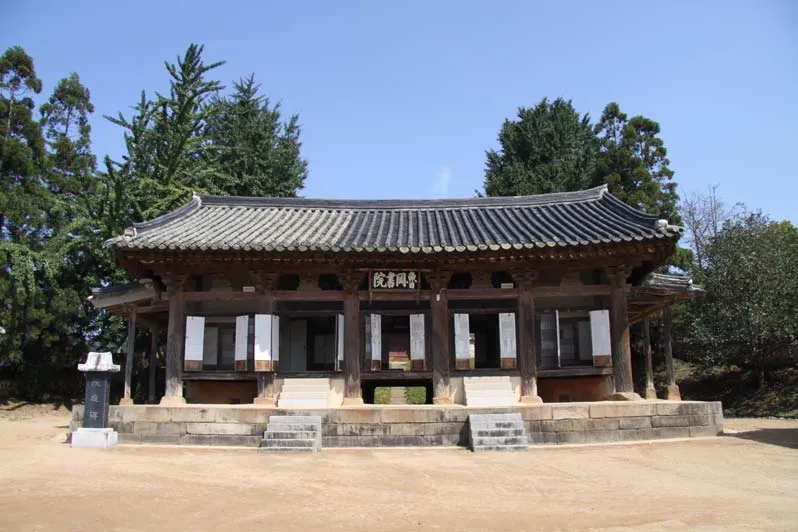
Nogangseowon Gang Hall, Nonsan
論山 魯岡書院 講堂
충청남도 논산시
Basic information
- Designation
- Treasure No.1746
- Category
- Architecture
- Era
- 조선시대
- Designated year
- 2011
- Location
- 논산시, 충청남도— 충청남도 논산시 오강길 56-5(광석면, 노강서원)
- Coordinates
- 36.259839, 127.073210
AI Docent
Coming soonAn AI-generated, friendly retelling of this heritage site is available in Korean. An English version is on our roadmap — for now, please see the official description below.
Description
□ Location and Historical and Cultural Background: Nogangseowon Confucian Academy stands facing in a southwesterly direction directly behind the village on a low foothill of Hoamsan Mountain, Noseong-myeon, Nonsan. The front of the village is traversed by a stream, with a broad plain spreading out in front of it. The hierarchical configuration of the village and its surroundings exhibits the characteristic features of building arrangement in the Giho region (Gyeonggi and Chungcheong Provinces). The education space, which can be reached via the red gate with a spiked top at the entrance and three outer gates, consists of a lecture hall and the Dongjae and Seojae (east and west buildings intended as reading and living spaces for students of the academy). The sacrificial space for religious rites, situated behind the lecture hall, consists of three inner gates and a shrine. Although Nogangseowon Confucian Academy was built in the latter half of the 17th century when the standard arrangement of buildings was no longer followed, the academy adhered to the layout of the previous period. Interestingly, the three inner gates were built with a clear distinction between the entrance and exit of men and gods. □ History and Architectural Characteristics: ○ History-Nogangseowon Confucian Academy was established at the suggestion of Kim Su-hang in 1675 (the first year of the reign of King Sukjong of the Joseon Dynasty) to commemorate the scholarly achievements and virtues of Yoon Hwang and to promote Confucian education for the local people. Then, in 1682 (the 8th year of the reign of King Sukjong), when the king granted the academy’s name plaque, the ancestral rite for the son of Yoon Hwang, Yun Moon-geo (pen-name: Seokho), began to be performed by the academy, followed in 1732 (the 3rd year of the reign of King Gyeongjong) by that of Yun Seon-geo (pen-name: Noseo) and his son Yun Jeung (pen-name: Myeongjae). However, in 1717 (the 43rd year of the reign of King Sukjong) when Yun Seon-geo and Yoon Jeung were deprived of their government offices during a period of political strife, the name plaque was also removed. But in 1722 (the 2nd year of the reign of King GyeongJong) their public posts and plaque were restored. Since then, Nogangseowon Confucian Academy has retained its original condition for about 330 years, even surviving the period of reforms passed by the Daewongun (regent of Joseon) in 1871 (the 8th year of the reign of King Gojong), and most particularly the decree requiring the demolition of all the Confucian academies in Korea. ○ Construction - The lecture hall of Nogangseowon Confucian Academy measures five kan (a unit of measurement referring to the distance between two columns) at the front and three kan at the sides, and is one of the largest Confucian academies in Chungnam Province. The hall consists of a main room, and two rooms with ondol, the traditional Korean floor-heating system. All the front sides of the building have four-paired sliding doors with frames, while the space between the main room and the two ondol rooms, two-paired sliding doors papered on both sides, which can be also found in the lecture halls of the Sosuseowon (rebuilt in 1602) and Dodongseowon (relocated in 1605) Confucian Academies. The hall is composed of a rectangular stereobate on which the foundation stone is placed, and columns. Despite the poorly-balanced frames and roof, the relatively high columns give the hall an imposing aspect. The bracket system of the building exhibits the Ikkong structural style, which consists of a decoration resembling a bird’s beak engraved with various designs such as lotus flowers, clouds, etc. that served to support the weight of the roof. The heads of the beams are engraved in relief with a lotus flower and crocket design. The hall has a gable roof with double-layered eaves. There is also a rare case of a monitor roof on the top of the building, examples of which can be also seen at the Eungdodang Lecture Hall of the Donamseowon Confucian Academy, Nonsan (Treasure No. 1569). □ Value of the Treasure: Nogangseowon Confucian Academy, as a representative Confucian academy of the Giho School that has not been relocated or changed since its establishment in 1675, and which survived the reforms of Daewongun, conforms to the hierarchical order of the time and the style of building arrangement common to the Giho region. The lecture hall, one of the largest in Chungnam Province, exhibits a harmonious splendor and simplicity in the structure of its stereobate, foundation stone, and outstanding bracket system. In particular, its gabled roof with monitor roof, which lends a sense of stability to the precariously high hall, was built to protect it from wind damage. The hall’s sliding doors with frames, papered on both sides, exhibit an antique style of construction common at the beginning of the 17th century during the Joseon Dynasty. Thus, the lecture hall of Nogangseowon Confucian Academy in Nonsan is an invaluable material for study of the characteristic style of Confucian structures in the Giho region and the construction of Confucian academies in Korea at the end of the 17th century.
Location
지도를 불러오는 중…
Have you visited this place?
Log in and verify your visit on-site via GPS to record a stamp in My Journey. (QR verification coming later.)
Images: KOGL (khs.go.kr) · Data source: Korea Heritage Service Open API (khs.go.kr)