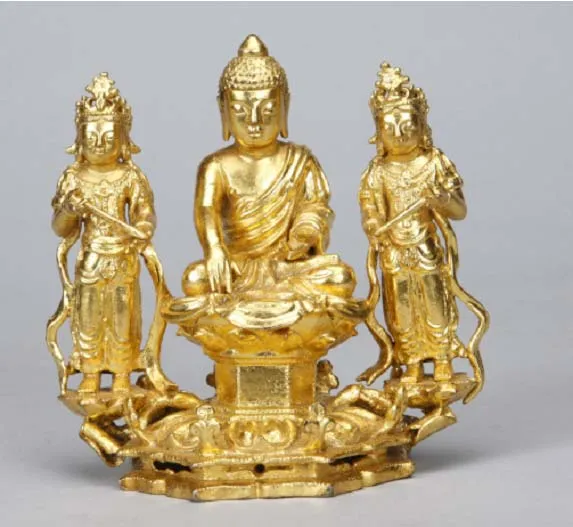
Tongdosa Eunjedogeumamitayeoraesamjonsang Mit Reliquary Objects, Yangsan
梁山 通度寺 銀製鍍金阿彌陀如來三尊像 및 腹藏遺物
경상남도 양산시
Basic information
- Designation
- Treasure No.1747
- Category
- Sculpture
- Era
- 1450년(세종32년)
- Designated year
- 2012
- Location
- 양산시, 경상남도— 경상남도 양산시 통도사로 108 (하북면, 통도사)
- Coordinates
- 35.490900, 129.057400Museum-based location
AI Docent
Coming soonAn AI-generated, friendly retelling of this heritage site is available in Korean. An English version is on our roadmap — for now, please see the official description below.
Description
According to a written prayer discovered inside the Buddha’s body, this triad was made in 1450 (the 32nd year of the reign of King Sejong of the Joseon Dynasty). The principal Buddha, Amitabha, is seated cross-legged on a hexagonal lotus pedestal and displays, uniquely, the mudra for “expelling evil by touching the ground." Each of his two attendants, Avalokitesvara and Mahasthamaprapta, carries a sutra book, an element rarely seen in other representations of the two bodhisattvas. The characteristic form and style of the triad display similarities with those of the Buddhist statues discovered in and around Geumgangsan in North Korea. They were made under the strong influence of the Tibetan Buddhist icons that flourished in China during the Yuan and Ming periods, sharing the characteristic style of small gilt-bronze seated Buddhist statuettes made in the Geumgangsan area between the late Goryeo and early Joseon periods, such as the Gilt-bronze Seated Amitabha Triad made in 1451 and discovered at Eunjeonggol Valley on Geumgangsan Mountain. This is why art historians are agreed that it was made in 1450, as stated in the written prayer stored inside its body. The statues are comparatively small, but the artistic excellence and spiritual aspiration of these imposing figures make them rare masterpieces. They are also highly regarded as a source of knowledge on Buddhist sculpture in the period between late Goryeo and early Joseon.
Location
지도를 불러오는 중…
Have you visited this place?
Log in and verify your visit on-site via GPS to record a stamp in My Journey. (QR verification coming later.)
Images: KOGL (khs.go.kr) · Data source: Korea Heritage Service Open API (khs.go.kr)