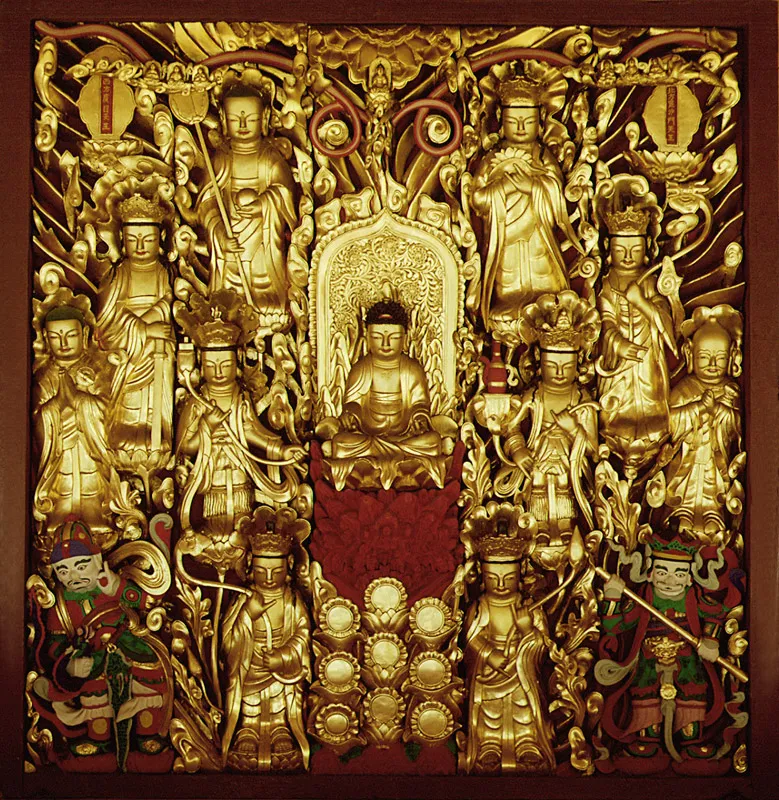
Gyeongguksa Mokgagamitayeoraeseolbeopsang, Seoul
서울 慶國寺 木刻阿彌陀如來說法像
서울특별시 성북구
Basic information
- Designation
- Treasure No.748
- Category
- Painting
- Era
- 조선시대
- Designated year
- 1983
- Location
- 성북구, 서울특별시— 서울특별시 성북구 보국문로 113-10 (정릉동, 경국사)
- Coordinates
- 37.589116, 127.018215
AI Docent
Coming soonAn AI-generated, friendly retelling of this heritage site is available in Korean. An English version is on our roadmap — for now, please see the official description below.
Description
This wooden Buddha made during the Joseon Dynasty is kept at Geungnakjeon Hall of Gyeongguksa Temple in Jeongneung-dong, Seongbuk-gu, Seoul. There are thirteen statues of Buddha in total, positioned around the Amitabha Buddha in the middle. The Amitabha Buddha sits on a several-tiered pedestal in the center of the background of the large mandorla. The Buddha’s hair, which is expressed in the curly nabal style (i.e. twirled up and around in a seashell-shaped bun) on top of his head, and the wide face are typical characteristics of Buddha statues made during the end of the Joseon period at a time when the formalization of the art was becoming more established. The body is small, compared with the face, and the robe draped over the shoulders is thick, obscuring the contours of the body. The mandorla (Buddhist halo of light) exhibits the unique style of the Joseon Dynasty, i.e. the width of the top and that of the bottom of the body are the same. The flame patterns are spread out and rise high, with little figures of Buddha engraved inside them. Eight Amitabha Bodhisattvas are placed on the left and right of the principal Buddha. The Vairocana, one of the Four Guardian Kings, is guarding the south, while Dhrtarastra, another of the Four Guardian Kings, is guarding the east, among the Four Guardian Kings standing to the left and right beneath it. The eight Bodhisattvas (excluding the Ksitigarbha Bodhisattva) are wearing crowns, and stand on a lotus wearing a thick robe and holding a lotus flower in their hand. A statue of an Arhat of the same height as the principal Buddha stands on both sides of the Bodhisattva. The entire piece exhibits a simple and plain style in a restricted but well-executed form. This wooden Amitabha Buddha altarpiece is considered an important material as it is one of only several rare examples of wooden Buddha altarpieces made during the end of the Joseon Dynasty.
Location
지도를 불러오는 중…
Have you visited this place?
Log in and verify your visit on-site via GPS to record a stamp in My Journey. (QR verification coming later.)
Images: KOGL (khs.go.kr) · Data source: Korea Heritage Service Open API (khs.go.kr)