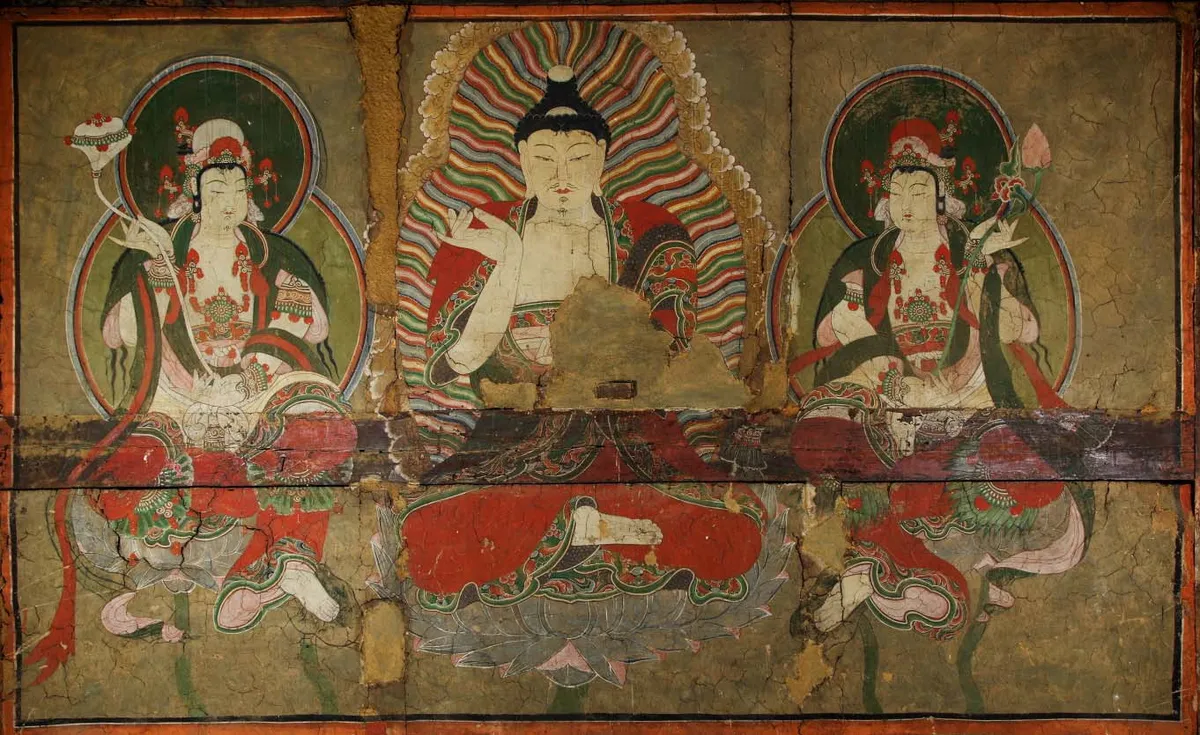
Sinheungsa Daegwangjeon Mural Painting, Yangsan
梁山 新興寺 大光殿 壁畵
경상남도 양산시
Basic information
- Designation
- Treasure No.1757
- Category
- Painting
- Era
- 17세기 후반
- Designated year
- 2012
- Location
- 양산시, 경상남도— 경상남도 양산시 원동로 2282-111 (원동면, 신흥사)
- Coordinates
- 38.125500, 128.464300Museum-based location
AI Docent
Coming soonAn AI-generated, friendly retelling of this heritage site is available in Korean. An English version is on our roadmap — for now, please see the official description below.
Description
This collection of about fifty mural works refers to the paintings on the inner and outer walls, the upper half walls, the inner surface of the cross beam, and the tall inner columns of Daegwangjeon Hall of Sinheungsa Temple. The interior of the prayer hall is almost entirely covered with paintings of the Buddha’s world - on the east and west walls, the inter-columnar upper walls in the north and south, and even the wall behind the altar. As it is situated within the gabled roof the building, the hall has large open spaces on the east and west walls, making them suitable for large murals on Buddhist themes, the like of which are rarely seen in other temples. The mural paintings on the eastern wall consist of a seated Bhaisajyaguru Triad in the upper central area, paintings of Sakyamuni and the eight phases of his life on the outer columns and lintels on either side, and a painting of demons on the lower wall under the lintel on the far left. The paintings on the western wall take up the entire wall regardless of its upper and middle braces. The wall is divided into three parts to contain the painting of the seated Amitabha Triad at the top, six bodhisattvas in the middle, and the Four Heavenly kings in the lower part. On the columns and lintels on either side are, as on the eastern wall, paintings of Sakyamuni and the eight phases of his life, while the wall under the lintel on the far left contains a painting of the Buddhist guardian deities. Right behind the altar is a drawing of three Avalokitesvara Bodhisattvas, one seated in the middle with the other two standing on either side of him, depicted by white lines against a dark blue background. The slanted ceiling, the upper walls and other components of the building are also filled with paintings. While some of these murals were either restored or repainted during the early 19th century, the Bhaisajyaguru Triad and the Amitabha Triad on the east and west walls exhibit the characteristic style of 17th-century Buddhist paintings.
Location
지도를 불러오는 중…
Have you visited this place?
Log in and verify your visit on-site via GPS to record a stamp in My Journey. (QR verification coming later.)
Images: KOGL (khs.go.kr) · Data source: Korea Heritage Service Open API (khs.go.kr)