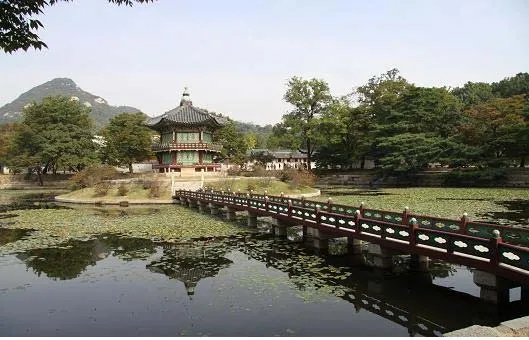
Gyeongbokgung Hyangwon Pavilion
景福宮 香遠亭
서울특별시 종로구
Basic information
- Designation
- Treasure No.1761
- Category
- Architecture
- Era
- 조선시대
- Designated year
- 2012
- Location
- 종로구, 서울특별시— 서울특별시 종로구 사직로 161 (세종로, 경복궁)
- Coordinates
- 37.581968, 126.977071
AI Docent
Coming soonAn AI-generated, friendly retelling of this heritage site is available in Korean. An English version is on our roadmap — for now, please see the official description below.
Description
Hyangwonjeong Pavilion stands on an islet at the center of a square pond named Hyangwonji, which is located in the rear garden of Gyeongbokgung Palace. According to Sejo sillok (Annals of King Sejo), a pavilion named Chwirojeong was constructed in the area now occupied by Hyangwonji Pond in 1456 (the 2nd year of the reign of King Sejo of the Joseon Dynasty) with lotus flowers planted around it. The square-shaped Hyangwonji Pond (4,605㎡) has rounded corners, and is inhabited by carp and water plants including lotus flowers. The water of the pond originates from Yeolsangjinwon Well, which is located on a small hill to the north of the pond. In 1873, a wooden bridge named Chwihyanggyo was installed in the northern part of the pond, allowing people to reach Hyangwonjeong from Geoncheonggung. It was the longest wooden bridge (length: 32m, width: 1.6m) built on a pond during the Joseon Period. However, the bridge was destroyed during the Korean War, and a new bridge was built over the southern part of the pond in 1953. Hyangwonjeong is the most famous structure of the marvelous rear garden of Gyeongbokgung Palace, and was used as a place of relaxation by Joseon’s kings and their family members. It displays outstandingly beautiful architectural features, including the hexagonal foundation stone and hexagonal hipped roof, as well as harmonious proportions and a graceful appearance.
Location
지도를 불러오는 중…
Have you visited this place?
Log in and verify your visit on-site via GPS to record a stamp in My Journey. (QR verification coming later.)
Images: KOGL (khs.go.kr) · Data source: Korea Heritage Service Open API (khs.go.kr)