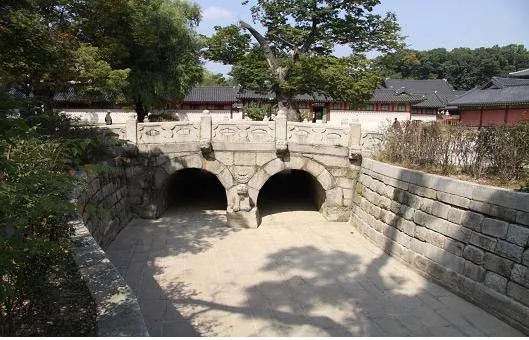
Changdeokgung Geumcheongyo
昌德宮 錦川橋
서울특별시 종로구
Basic information
- Designation
- Treasure No.1762
- Category
- Arms & Armor
- Era
- 조선시대
- Designated year
- 2012
- Location
- 종로구, 서울특별시— 서울특별시 종로구 율곡로 99-0 (와룡동, 창덕궁)
- Coordinates
- 37.578473, 126.990052
AI Docent
Coming soonAn AI-generated, friendly retelling of this heritage site is available in Korean. An English version is on our roadmap — for now, please see the official description below.
Description
Geumcheongyo is the name of the bridge over a brook named Myeongdangsu which flows between Donhwamun and Jinseonmun, two gates of Changdeokgung Palace in Seoul. Also known as Geumcheon, or ‘Forbidden Stream’, the brook runs from north to south and flows out of the palace after arriving at Donhwamun Gate, where it is confined between embankments built by piling up hewn granite and crossed over by the stone bridge. Geumcheongyo Bridge was originally built outside Jinseonmun Gate in 1411, six years after the completion of Changdeokgung, and has maintained its original condition although the palace sustained serious damages as a result of fires and wars. It is the oldest extant bridge in the royal palaces of Joseon. The bridge is marked by a pair of arches with three abutments, one built in the middle of the channel, the other two on the buttress walls at each end. The road deck consists of three sections, all of which are floored with rectangular stones, and has stone statues of imaginary animals at its four corners. The bridge also has stone railings made with posts decorated with lotus caps and panels between them. Each stone panel is divided into two parts by a lotus post carved in relief, and each part in turn contains an “elephant’s eye” window. The bridge also features railing posts carved with animal heads, demonic faces carved in relief on both walls between the two arches, and animal carvings on the foundation stone of the central abutment, such as a mythical animal like a lion with horns in the south and a turtle in the north. As one of the oldest stone bridges remaining in Seoul, Geumcheongyo Bridge is widely admired for the historical, artistic and architectural value embodied by its elaborately carved sculptures full of symbolic meanings, its wealth of ornamental motifs, and its excellent construction techniques, respectively.
Location
지도를 불러오는 중…
Have you visited this place?
Log in and verify your visit on-site via GPS to record a stamp in My Journey. (QR verification coming later.)
Images: KOGL (khs.go.kr) · Data source: Korea Heritage Service Open API (khs.go.kr)