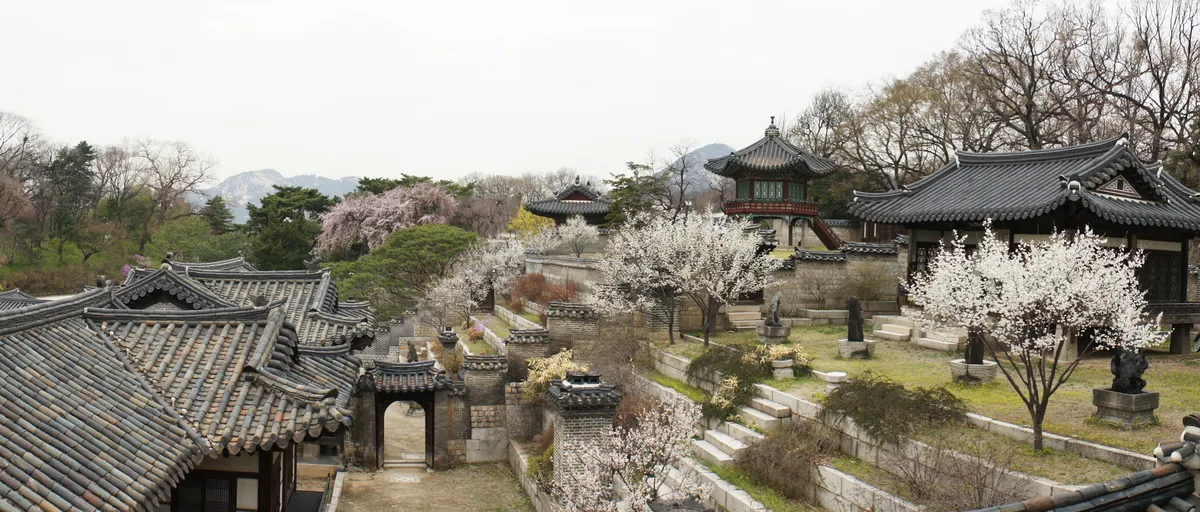
Changdeokgung Nakseonjae
昌德宮 樂善齋
서울특별시 종로구
Basic information
- Designation
- Treasure No.1764
- Category
- Architecture
- Era
- 조선시대
- Designated year
- 2012
- Location
- 종로구, 서울특별시— 서울특별시 종로구 율곡로 99-0 (와룡동, 창덕궁)
- Coordinates
- 37.578743, 126.993464
AI Docent
Coming soonAn AI-generated, friendly retelling of this heritage site is available in Korean. An English version is on our roadmap — for now, please see the official description below.
Description
Nakseonjae Hall stands in the area between Changdeokgung Palace and Changgyeonggung Palace. The complex, in which Nakseonjae is located, includes Seokbokheon and Sugangjae Halls, as well as stone stairs decorated with interestingly shaped stones and flower trees on the gently sloping hills behind the buildings. In the rear garden there are three more buildings, namely Sangnyangjeong and Chwiunjeong Pavilions and Hanjeongdang Hall. Nakseonjae was originally built in 1847 (the 13th year of the reign of King Heonjong of the Joseon Dynasty) as the king’s quarters, while Seokbokheon and Sugangjae were added to the complex the following year for the king’s grandmother and consort. With the construction of the complex, King Heonjong wanted to establish the strong authority of the royal court and show his determination to introduce reforms. After the coup in 1884, Nakseonjae was used as the king’s office for a while, while Yi Eun, the last crown prince of the Joseon Dynasty, lived here from 1963 to 1970. His wife, Yi Bangja, also lived in this place from 1966 to 1989. Unlike other buildings in Joseon royal palaces, Nakseonjae was built in accordance with the architectural style of aristocratic residences without using dancheong, or multi-color paintings, on the building’s surface. Also, the walls and fences were decorated with unique and various designs, which was not usually the case in other palace buildings. Nakseonjae has significant architectural value as it exhibits the excellent skills of master architects of the late Joseon Period.
Location
지도를 불러오는 중…
Have you visited this place?
Log in and verify your visit on-site via GPS to record a stamp in My Journey. (QR verification coming later.)
Images: KOGL (khs.go.kr) · Data source: Korea Heritage Service Open API (khs.go.kr)