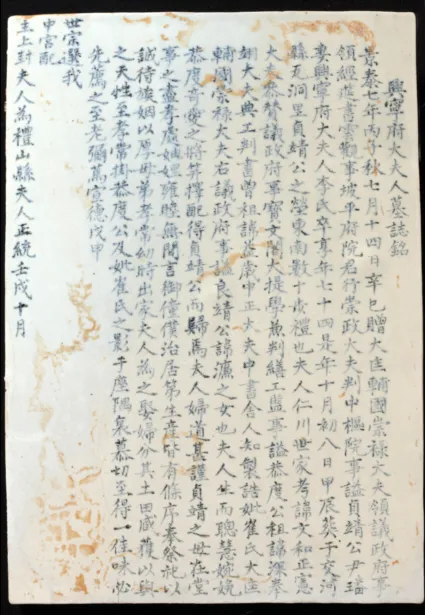
White Porcelain Cheonghwa Heungnyeongbudaebuin Myoji Mit Seokham
白磁 靑畵 興寧府大夫人 墓誌 및 石函
경기도 파주시
Basic information
- Designation
- Treasure No.1768
- Category
- Craft
- Era
- 세조 2
- Designated year
- 2012
- Location
- 파주시, 경기도— 경기도 파주시
- Coordinates
- 37.760045, 126.779881
AI Docent
Coming soonAn AI-generated, friendly retelling of this heritage site is available in Korean. An English version is on our roadmap — for now, please see the official description below.
Description
The White Porcelain Memorial Tablets of Lady Yi with Inscription in Underglaze Cobalt Blue and Stone Case were excavated on May 18, 2001, from the graveyard of the Jeongjeonggong Branch of the Papyeong Yun clan located in Dangha-ri, Gyoha-myeon, Paju, Gyeonggi-do. The stone case, in which six white porcelain memorial tablets were contained, was buried between the stone slabs and square stone altar of the tomb of Lady Yi from Incheon (1383-1456), the wife of Yun Beon (1384-1448). Upon its discovery, the stone case was tied with a copper string and the memorial tablets inside the case were damp with moisture. The rectangular stone case was produced to exactly fit the size of the memorial tablets. Lady Yi from Incheon was the mother-in-law of King Sejo, the seventh ruler of the Joseon Dynasty, and was invested with the honorable title of Lady Yi. The text, written in cobalt blue on the white porcelain memorial tablets, states that she died in 1456, and records the burial process, her virtuous deeds, and information about her descendants. Produced in 1456, these memorial tablets are the earliest white porcelain objects with an inscription in under-glaze cobalt blue discovered so far. They are larger than other white porcelain memorial tablets produced later, and offer a valuable clue to understanding the history of white porcelain and its production skills. In addition, they provide interesting information on the manufacturing and burial method of early white porcelain memorial tablets, as the memorial tablets in the later period were buried in a white porcelain case.
Location
지도를 불러오는 중…
Have you visited this place?
Log in and verify your visit on-site via GPS to record a stamp in My Journey. (QR verification coming later.)
Images: KOGL (khs.go.kr) · Data source: Korea Heritage Service Open API (khs.go.kr)